Understanding Why Car Battery Problems Are Extremely Common In UAE Conditions
click here
Table of Contents
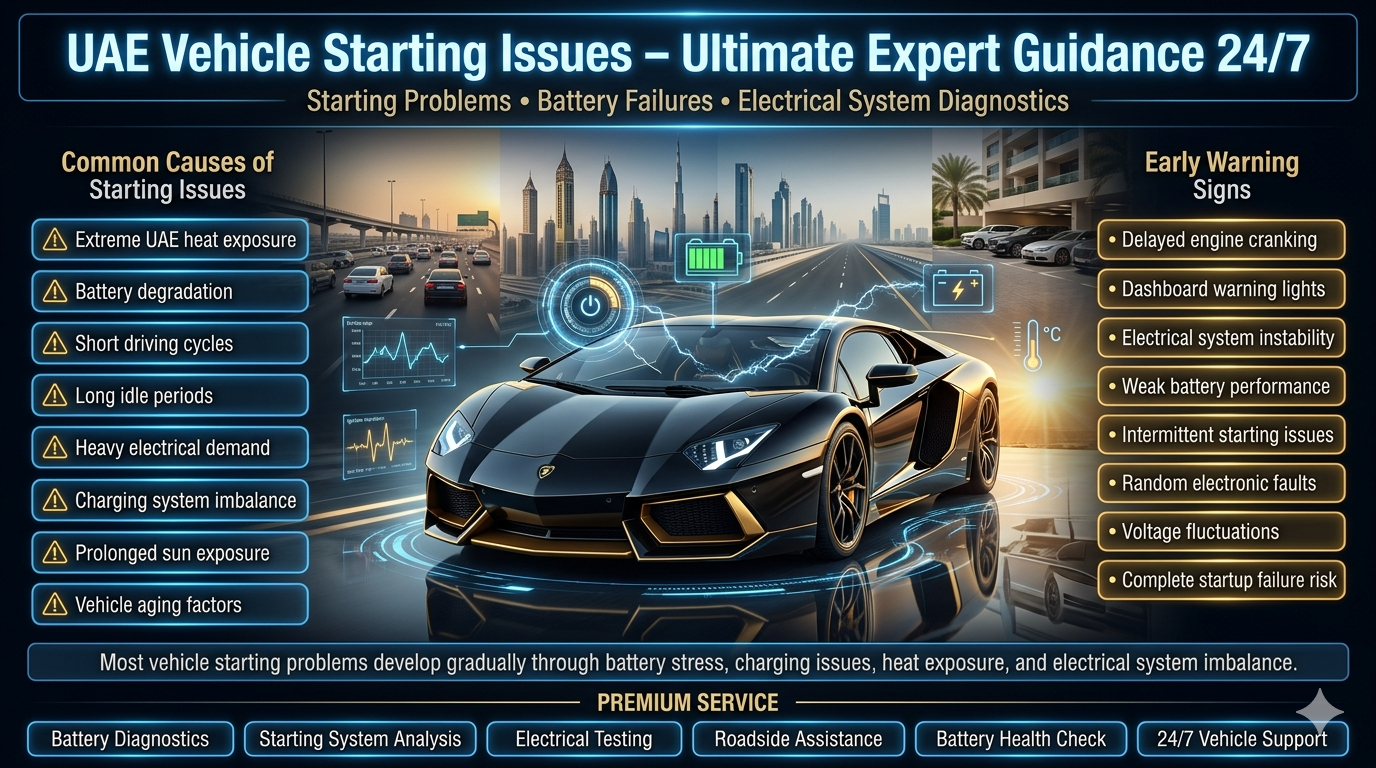
UAE Vehicle Starting Issues-Ultimate Expert Guidance 24/7.Car battery problems are considerably more common in hot climate regions compared to moderate weather countries. Many drivers assume batteries fail because of age alone, but in reality, environmental conditions, driving habits, charging patterns, vehicle electronics, parking habits, and temperature exposure collectively determine battery performance.
The UAE creates one of the harshest operating environments for vehicle batteries. Continuous exposure to extreme temperatures, prolonged sun exposure, heavy traffic conditions, long idling periods, short driving cycles, and demanding electrical loads place significant stress on automotive battery systems.
Many drivers discover battery problems only after experiencing delayed starts, warning lights, electrical failures, or complete vehicle shutdown. Understanding why batteries fail allows drivers to recognize early warning signs before emergency situations occur.
Why UAE Weather Creates Extreme Pressure On Vehicle Batteries
Vehicle batteries operate through chemical reactions. These reactions become unstable when excessive temperatures continuously affect internal battery components.
High temperatures accelerate:
- Internal chemical degradation
- Electrolyte evaporation
- Plate corrosion
- Faster discharge cycles
- Reduced charging efficiency
- Internal resistance growth
- Permanent capacity reduction
Unlike colder countries where batteries struggle because reactions slow down, UAE conditions create the opposite problem. Excessive heat forces battery chemistry to work harder, increasing wear speed.
Vehicles parked outdoors daily experience significantly greater battery stress compared to vehicles stored inside covered parking.
Many drivers mistakenly believe winter damages batteries more than summer. In extremely hot regions, continuous heat exposure often becomes the primary factor behind premature battery failure.
How Long Does A Car Battery Last In UAE Weather Conditions
Battery lifespan depends heavily on operating conditions.
Several factors influence lifespan:
Temperature Exposure
Continuous exposure to direct sunlight increases internal battery temperature significantly.
Driving Patterns
Short trips may prevent full charging cycles.
Vehicle Electronics
Modern vehicles consume power continuously.
Battery Quality
Manufacturing standards affect durability.
Charging System Health
Poor alternator performance shortens battery life.
Parking Conditions
Long outdoor parking accelerates battery aging.
Battery lifespan differs greatly between drivers because operating conditions differ significantly.
Some batteries fail earlier because they experience:
- Daily extreme heat
- Long idle periods
- Heavy electrical loads
- Frequent short trips
- Poor maintenance
- Repeated deep discharge cycles
- This article covers all possible tips and hacks about car jumpstart specialy for uae drivers.
Why Heat Damages Car Batteries Faster Than Most Drivers Realize
Heat damage does not always appear immediately.
Most battery deterioration occurs gradually.
Drivers may notice:
- Slower cranking
- Dim headlights
- Weak starting performance
- Random electrical behavior
- Longer ignition times
- Dashboard warnings
The dangerous part is that heat damage often accumulates silently.
Internal deterioration may continue for months before obvious symptoms appear.
A battery that appears functional today may already have significant internal degradation.
This explains why some drivers experience sudden failure without obvious warning.
How Car Batteries Actually Work Inside Your Vehicle
Many drivers know batteries store power but do not fully understand their role.
Vehicle batteries perform several critical functions:
Starting The Engine
Large electrical current powers starter motor operation.
Stabilizing Electrical Systems
Battery supports voltage consistency.
Supporting Vehicle Electronics
Electronic systems require stable power.
Operating During High Demand
Battery assists when electrical demand exceeds charging supply.
Backup Energy Storage
Stored power supports systems when engine remains off.
When battery performance weakens, numerous systems may begin behaving unpredictably.
Problems often appear beyond starting issues.
Why Modern Vehicles Create More Battery Stress
Modern vehicles consume significantly more electricity.
Examples include:
- Sensors
- Infotainment systems
- Cameras
- Security systems
- Electronic steering
- Electric seats
- Charging ports
- Navigation systems
- Parking sensors
- Driver assistance systems
Even while parked, many vehicles continue consuming electricity.
This continuous demand increases stress on aging batteries.
Many drivers compare older vehicles with modern vehicles without realizing electrical demand has increased substantially.
Understanding Battery Capacity Loss Over Time
Battery capacity reduction happens gradually.
Drivers may initially notice:
- Slightly slower starting
- Reduced responsiveness
- Longer cranking
Later stages may include:
- Multiple starting attempts
- Random electrical warnings
- Complete failure after parking
Capacity reduction accelerates when batteries repeatedly experience:
- Deep discharge
- Excessive temperatures
- Partial charging
- Corrosion
- Overcharging
- Undercharging
Understanding gradual capacity loss helps drivers identify problems before emergencies occur.
Why Vehicles Parked For Long Periods Develop Battery Problems
Many assume battery wear occurs only during driving.
In reality, parked vehicles often experience battery problems.
Reasons include:
Continuous Background Consumption
Security systems continue consuming electricity.
Natural Self Discharge
Batteries lose charge naturally.
Heat Exposure
High temperatures accelerate discharge speed.
Low Charging Opportunity
Parked vehicles cannot replenish lost energy.
This explains why vehicles left unused sometimes develop starting problems unexpectedly.
Does Driving More Always Protect Battery Life?
Not necessarily.
Driving habits matter more than total distance.
Short trips may create problems because:
- Engine starts consume large power amounts
- Limited driving reduces recharge time
- Accessories continue consuming power
Longer driving cycles generally allow:
- Better charging
- Reduced discharge accumulation
- Improved battery recovery
However, extremely heavy electrical loads may still create stress.
Why Some Drivers Experience Sudden Battery Failure Without Warning
Sudden failure often appears random but usually results from accumulated damage.
Common reasons include:
- Hidden internal damage
- Plate deterioration
- Extreme heat exposure
- Repeated deep discharge
- Charging problems
- Aging components
Many batteries show minimal symptoms until remaining capacity falls below operational requirements.
This creates the impression of instant failure.
In reality, deterioration often existed long before failure occurred.
Why Understanding Battery Problems Matters Before Complete Failure
Battery failure rarely occurs at convenient times.
Drivers commonly experience issues during:
- Morning starts
- Work commutes
- Shopping trips
- Long parking periods
- Airport parking
- Outdoor parking
- Summer afternoons
Understanding battery behavior allows earlier detection.
Early detection reduces:
- Emergency situations
- Unexpected breakdowns
- Vehicle downtime
- Additional component stress
Battery awareness is not simply maintenance knowledge.
It directly affects reliability, convenience, and overall vehicle operation.
The Real Difference Between Battery Aging And Battery Failure
Aging does not automatically mean failure.
Some batteries age gradually.
Others fail rapidly.
Battery aging refers to:
- Reduced capacity
- Lower efficiency
- Slower charging
- Increased resistance
Battery failure occurs when:
- Required starting power unavailable
- Voltage instability occurs
- Internal damage prevents operation
Recognizing the difference helps drivers understand why older batteries sometimes continue operating while newer batteries occasionally fail unexpectedly.
This foundation becomes important because understanding battery behavior makes it easier to identify warning signs before complete breakdown occurs.
Signs Your Car Battery Is Dying – Early Warning Signs Drivers Often Ignore
Many vehicle owners assume battery failure happens instantly.
In reality, batteries usually provide multiple warning signs before complete failure occurs.
The problem is simple:
Most drivers either ignore these symptoms or mistake them for temporary problems.
A weak battery often produces subtle behavior changes weeks or even months before complete failure occurs.
Recognizing these early signals can help avoid emergency breakdown situations.
Slow Engine Cranking Is One Of The Earliest Battery Warning Signs
When drivers turn the key or press the ignition button, engine cranking speed provides important information.
Healthy batteries generally produce:
- Fast cranking
- Consistent starting
- Smooth ignition behavior
- Stable electrical output
Weak batteries may produce:
- Slower engine rotation
- Hesitation before starting
- Longer crank duration
- Uneven cranking speed
Many drivers ignore slow cranking because the vehicle still starts.
However, slow cranking frequently indicates declining battery capacity.
Repeated slow starts often suggest battery weakness is already developing.
Why Your Vehicle Takes Longer To Start In The Morning
Morning starting problems are extremely common.
Several reasons contribute:
Overnight Energy Loss
Batteries naturally lose small amounts of energy.
Lower Internal Efficiency
Aging batteries recover slower.
Background Power Consumption
Vehicle systems continue consuming electricity.
Reduced Reserve Capacity
Older batteries possess lower stored energy.
Morning starting delays should never be ignored repeatedly.
If morning starting problems become common, battery performance may already be deteriorating.
Clicking Sounds When Starting Often Indicate Battery Weakness
Drivers sometimes hear:
- Single click
- Rapid clicking
- Repeated clicking noises
These sounds usually occur because:
Starter systems require high electrical current.
Weak batteries may provide enough power for electronics but insufficient power for engine cranking.
Repeated clicking commonly indicates:
- Low voltage
- Weak battery output
- Poor connections
- Electrical resistance
Clicking sounds should always be investigated because complete failure may follow shortly afterward.
Dim Headlights Can Reveal Hidden Battery Problems
Headlight brightness often reflects battery condition.
Drivers may notice:
- Weak lights during starting
- Temporary dimming
- Flickering lights
- Reduced brightness while idling
Electrical systems require stable voltage.
Weak batteries struggle maintaining stable output.
Headlight behavior becomes particularly useful because visual changes are easier to notice than voltage changes.
Dashboard Warning Lights Drivers Frequently Ignore
Modern vehicles contain numerous warning indicators.
Battery related warnings may include:
- Battery icons
- Electrical warnings
- Charging warnings
- Power system messages
However, battery problems do not always trigger battery lights.
Sometimes drivers see:
- Random warning lights
- Temporary system messages
- Electronic malfunctions
- Unexpected alerts
Voltage instability can confuse multiple vehicle systems.
This creates misleading symptoms.
Why Electronics Start Behaving Strangely When Battery Health Drops
Weak batteries affect more than engine starting.
Drivers sometimes experience:
- Screen resets
- Infotainment problems
- Clock resetting
- Window issues
- Sensor warnings
- Camera malfunctions
- Lock problems
Modern vehicles depend heavily on stable electrical supply.
Voltage fluctuations create unpredictable behavior.
Random electronic problems occasionally indicate battery deterioration rather than component failure.
Intermittent Starting Problems Are Dangerous Warning Signs
Some vehicles fail only occasionally.
Example:
Monday:
Vehicle starts normally.
Tuesday:
Starting becomes difficult.
Wednesday:
Normal again.
Drivers often ignore inconsistent problems because symptoms disappear temporarily.
Intermittent failures frequently occur because weak batteries operate near minimum acceptable performance.
Small temperature changes may create noticeable differences.
Why Hot Weather Makes Weak Batteries More Obvious
Heat accelerates deterioration.
Drivers commonly notice:
- Longer cranking after parking outdoors
- More difficult afternoon starts
- Increased electrical irregularities
- Faster discharge behavior
High temperatures increase internal stress.
Previously hidden battery weakness becomes more visible.
This explains why many drivers experience problems suddenly during hotter periods.
Vehicle Needs Multiple Attempts Before Starting
A vehicle requiring repeated attempts should never be considered normal.
Possible symptoms:
- First attempt fails
- Second attempt works
- Longer ignition duration
- Engine hesitates repeatedly
Multiple starting attempts often suggest:
- Insufficient power output
- Voltage drop issues
- Weak reserve capacity
Repeated attempts also increase strain on starter systems.
Why Battery Problems Sometimes Appear Random
Battery deterioration rarely occurs perfectly.
Drivers may experience:
- Good days
- Bad days
- Temporary recovery
- Random failures
This creates confusion.
Batteries sometimes recover slightly after charging cycles.
Temporary improvement does not necessarily mean problems disappeared.
Random behavior often indicates progressive decline.
Strange Smells Around Battery Area Should Never Be Ignored
Certain battery problems create unusual smells.
Drivers may notice:
- Burning smell
- Chemical odor
- Sulfur smell
- Heat-related odor
Possible causes include:
- Overheating
- Internal damage
- Charging problems
- Excessive heat exposure
Unusual smells require immediate attention because overheating batteries may continue deteriorating rapidly.
Corrosion Around Battery Terminals Indicates Potential Problems
Drivers sometimes notice:
- White residue
- Blue deposits
- Green buildup
Corrosion creates:
- Higher resistance
- Poor electrical flow
- Starting difficulty
- Charging inefficiency
Corrosion itself may not always mean battery failure.
However, excessive corrosion often contributes to performance issues.
Why Battery Problems Often Appear After Long Parking
Vehicles parked for extended periods commonly develop symptoms.
Examples:
- Airport parking
- Vacation parking
- Weekend storage
- Secondary vehicles
Long parking increases risk because:
- Background systems continue consuming power
- Heat accelerates discharge
- No charging occurs
Drivers frequently mistake this for sudden failure.
Often the battery was already weak before parking occurred.
Vehicle Starts But Feels Electrically Weak
Sometimes vehicles start successfully but show electrical weakness.
Possible symptoms:
- Sluggish windows
- Slow electronic response
- Weak lighting
- Delayed accessories
Starting successfully does not automatically confirm healthy battery condition.
Reserve capacity may already be declining.
Why Ignoring Early Symptoms Usually Creates Bigger Problems
Battery problems generally worsen over time.
Ignoring symptoms may increase chances of:
- Emergency breakdown
- Unexpected no-start situations
- Additional component stress
- Stranded vehicle situations
Early symptoms provide opportunities for:
- Testing
- Inspection
- Maintenance
- Prevention
Understanding these signals allows drivers to react before complete failure occurs.
The Most Common Weak Battery Signs Drivers Should Remember
Quick summary:
- Slow cranking
- Delayed starting
- Clicking noises
- Dim headlights
- Warning lights
- Electronic problems
- Random failures
- Morning starting difficulty
- Repeated ignition attempts
- Weak electrical behavior
- Corrosion buildup
- Strange smells
- Intermittent starting problems
These symptoms rarely appear together initially.
Even one recurring symptom deserves attention.
Because battery failure often begins quietly long before complete shutdown occurs.
Car Won’t Start Problems – Understanding Why Vehicles Suddenly Refuse To Start
Few situations frustrate drivers more than entering their vehicle, turning the key or pressing the start button, and discovering absolutely nothing happens.
Many people immediately assume:
“The battery is dead.”
However, vehicle starting problems can occur for multiple reasons.
Understanding how starting systems work helps drivers identify whether the issue involves:
- Battery problems
- Charging issues
- Starter problems
- Electrical faults
- Connection issues
- Ignition failures
Learning the difference reduces unnecessary repairs and helps identify the real cause faster.
Understanding What Happens When You Start A Vehicle
Starting a vehicle requires multiple systems working together.
The process usually looks like this:
Battery supplies power.
↓
Electrical system activates.
↓
Starter motor receives power.
↓
Engine begins rotating.
↓
Combustion starts.
↓
Engine runs independently.
A problem anywhere in this chain may prevent starting.
This explains why different starting failures create different symptoms.
Car Won’t Start But Lights Turn On – What Does It Mean?
This is among the most confusing situations.
Drivers often think:
“Lights work, therefore battery must be fine.”
Not necessarily.
Headlights and interior lights require considerably less power compared to engine starting.
Possible causes include:
- Weak battery output
- Insufficient cranking power
- Starter problems
- Voltage drop issues
- Poor connections
A battery may still power small electronics while failing to provide enough energy for engine cranking.
No Crank No Start Situation Explained
A no crank condition means:
You attempt starting.
Nothing happens.
Possible symptoms:
- Silence
- Single click
- Dashboard lights only
- No engine movement
Common causes include:
Battery Failure
Insufficient voltage prevents starter operation.
Loose Connections
Poor electrical flow blocks current.
Corrosion
Resistance reduces power transfer.
Starter Problems
Starter fails despite available power.
Electrical Faults
Signal never reaches starter system.
No crank situations frequently involve battery related issues, but diagnosis remains important.
Engine Cranks But Does Not Start – Is It Battery Related?
Cranking means engine rotates.
However, rotation alone does not guarantee starting.
If engine cranks normally but refuses to run:
Possible causes include:
- Fuel delivery issues
- Ignition problems
- Sensor failures
- Security systems
- Engine management faults
Battery problems become less likely when cranking remains strong.
Understanding this difference prevents confusion.
Why Clicking Noise Happens When Trying To Start
Clicking sounds provide valuable clues.
Single Click
May suggest:
- Weak battery
- Starter issue
- Poor connection
Rapid Clicking
Often suggests:
- Low voltage
- Battery weakness
- Insufficient current
Repeated Clicking
Commonly indicates:
- Battery unable to maintain load
- Voltage collapse
Clicks occur because starter components attempt engagement but lack sufficient energy.
Car Has Absolutely No Electrical Power
Some drivers experience complete electrical shutdown.
Symptoms include:
- No dashboard lights
- No interior lights
- No response
- Completely dead vehicle
Possible causes:
Fully Discharged Battery
No usable energy remains.
Loose Terminal Connections
Power cannot reach vehicle systems.
Corrosion Problems
Electrical flow interrupted.
Main Electrical Faults
System loses power distribution.
Completely dead vehicles frequently create panic because drivers assume major mechanical failure.
Many cases remain electrical.
Why Vehicles Fail To Start After Long Parking Periods
Long parking frequently creates starting problems.
Examples:
- Airport parking
- Vacations
- Weekend vehicles
- Seasonal use
Reasons include:
Background Electrical Consumption
Modern systems continue drawing power.
Heat Exposure
Higher temperatures accelerate discharge.
Natural Energy Loss
Batteries slowly discharge naturally.
Existing Weakness
Older batteries deteriorate faster during storage.
Long parking often exposes existing weakness rather than creating entirely new problems.
Vehicle Starts After Multiple Attempts – Why?
Some vehicles eventually start after repeated tries.
Drivers often ignore this.
Possible explanations:
- Weak battery temporarily recovers
- Connections shift slightly
- Voltage stabilizes briefly
- Temperature changes improve performance
Repeated attempts should never become normal.
If starting reliability decreases, underlying problems usually continue progressing.
Why Afternoon Starting Problems Occur More Frequently In Hot Weather
Drivers sometimes report:
Morning:
Vehicle starts normally.
Afternoon:
Vehicle struggles.
Extreme heat increases battery stress.
Higher temperatures:
- Increase resistance
- Reduce efficiency
- Accelerate voltage loss
- Expose hidden weakness
Heat related starting issues commonly appear after vehicles remain parked outdoors.
Car Starts Slowly After Refueling – Is Battery Responsible?
Drivers occasionally notice starting problems after refueling.
Possible explanations:
- Existing weak battery becomes noticeable
- Heat exposure while parked
- Electrical load accumulation
Fueling itself rarely damages batteries.
However, stopping and restarting sometimes exposes already existing weakness.
Vehicle Starts With Jump Start But Fails Again Later
This situation strongly suggests battery related problems.
Possible explanations:
Battery Unable To Hold Charge
Energy disappears quickly.
Charging System Problems
Battery never fully recovers.
Excessive Drain
Power consumption continues.
Battery Aging
Capacity becomes insufficient.
Repeated dependence on jump starts indicates deeper problems requiring investigation.
Random Starting Failures Are Among The Hardest Problems To Diagnose
Drivers often describe:
“Sometimes starts perfectly.”
“Sometimes refuses completely.”
Intermittent failures may result from:
- Weak batteries
- Loose terminals
- Heat exposure
- Charging inconsistency
- Electrical resistance
Random problems become frustrating because symptoms disappear during inspections.
Understanding patterns becomes important.
Why Turning Accessories Off Sometimes Helps Weak Batteries Start
Drivers sometimes succeed after turning off:
- Air conditioning
- Lights
- Entertainment systems
- Chargers
This happens because:
Reduced electrical demand allows more power reaching starter systems.
If accessories significantly affect starting performance, battery weakness may already exist.
What Happens When Battery Voltage Drops Too Low
Low voltage creates widespread problems.
Possible symptoms:
- Warning lights
- Sensor failures
- Screen resets
- Poor starting
- Communication errors
Modern vehicles rely heavily on stable voltage.
Small voltage changes may create surprisingly large symptoms.
Can A Vehicle Suddenly Stop Starting Without Warning?
Yes.
However, “without warning” often means:
Previous symptoms were overlooked.
Many drivers later remember:
- Slower starts
- Weak electronics
- Random behavior
- Longer cranking
Battery failure frequently appears sudden because warning signs remained unnoticed.
Most Common Car Won’t Start Scenarios Drivers Experience
Common situations include:
- Car won’t start after parking overnight
- Car won’t start after long vacation
- Car won’t start in extreme heat
- Car won’t start but lights work
- Car won’t start with clicking noise
- Car won’t start after sitting unused
- Car won’t start after battery replacement
- Car won’t start after leaving lights on
- Car won’t start after short trips
- Car won’t start after outdoor parking
Recognizing these patterns helps narrow possible causes faster.
Understanding Starting Problems Before Complete Failure Occurs
Starting problems rarely remain isolated.
What begins as:
“slightly slower starting”
may eventually become:
“complete no-start situation.”
Recognizing early patterns allows:
- Faster diagnosis
- Reduced breakdown risk
- Better reliability
- Less emergency situations
Understanding starting behavior remains one of the simplest ways to detect battery related problems before total failure occurs.
Why Car Batteries Die – Complete Guide To Battery Failure Causes Drivers Often Miss
Most drivers believe batteries die because they become old.
Reality is more complicated.
Battery failure normally happens because multiple factors work together.
A battery rarely fails due to a single reason.
Common battery killers include:
- Extreme temperatures
- Charging problems
- Long parking periods
- Electrical drains
- Driving habits
- Internal degradation
- Vehicle electronics
- Maintenance neglect
Understanding why batteries fail helps drivers reduce unexpected breakdowns and identify problems before complete failure occurs.
Why Heat Is One Of The Biggest Reasons Car Batteries Fail Faster
Extreme temperatures create enormous pressure on battery systems.
Heat affects batteries by accelerating:
- Chemical reactions
- Internal wear
- Fluid loss
- Plate deterioration
- Corrosion growth
Continuous exposure to hot conditions gradually damages internal battery components.
Vehicles parked outdoors every day experience much greater stress compared to vehicles regularly parked under shade.
Heat damage becomes especially dangerous because deterioration often happens silently.
Drivers may notice problems only after significant internal damage already exists.
Why Car Batteries Die Overnight Even When Everything Worked Fine Earlier
One of the most common questions drivers ask:
“Why did my battery die overnight?”
Several reasons may explain this:
Background Electrical Consumption
Modern vehicles continuously consume electricity.
Existing Weak Battery
Weak batteries lose energy faster.
Electrical Drain Problems
Hidden systems continue using power.
Heat Related Capacity Loss
Extreme temperature reduces usable capacity.
Charging Issues
Battery never fully recovered previously.
Many overnight failures result from multiple small issues rather than one major problem.
What Is Battery Drain And Why Does It Happen?
Battery drain means energy leaves the battery faster than it gets replaced.
Small electrical consumption always exists.
Problems occur when:
- Consumption becomes excessive
- Charging becomes insufficient
- Battery capacity becomes weak
Drain problems may develop slowly.
Drivers sometimes notice:
- Frequent jump starts
- Morning starting problems
- Random dead battery situations
Understanding battery drain becomes important because repeated discharge significantly shortens battery life.
Why Vehicle Accessories Frequently Cause Battery Problems
Accessories increase electrical demand.
Common examples:
- Phone chargers
- Dash cameras
- Lighting systems
- Audio systems
- Cooling accessories
- Portable electronics
Many drivers underestimate how much electricity accessories consume.
Excessive electrical demand increases stress especially when:
- Engine remains off
- Trips remain short
- Battery already weak
Accessories themselves may not always cause failure.
Combined with existing weakness, they often accelerate deterioration.
Why Leaving Vehicles Parked Too Long Creates Battery Problems
Long parking creates several risks.
Examples include:
- Airport parking
- Holiday travel
- Weekend vehicles
- Backup vehicles
Problems occur because:
No Charging Occurs
Battery cannot recover lost energy.
Background Consumption Continues
Security systems remain active.
Heat Exposure Continues
Higher temperatures increase discharge speed.
Existing Weakness Worsens
Weak batteries deteriorate faster.
Vehicles left parked for long periods often reveal battery weakness already developing beforehand.
Why Short Trips Damage Battery Health Over Time
Many drivers believe driving daily automatically protects batteries.
Not always.
Short driving creates problems because:
- Engine starting consumes large energy
- Recharge time remains limited
- Electrical loads remain active
Examples:
- Grocery trips
- School drop offs
- Nearby errands
- Short commutes
Repeated short driving cycles may gradually reduce battery efficiency.
Why Battery Capacity Drops As Batteries Age
All batteries lose performance over time.
Internal deterioration causes:
- Reduced storage capacity
- Slower charging
- Lower starting power
- Increased resistance
As capacity decreases:
Drivers notice:
- Longer cranking
- Lower reliability
- Frequent discharge
Aging alone does not immediately cause failure.
However, aging increases vulnerability to additional stress.
Why Corrosion Causes Battery Performance Problems
Corrosion increases resistance.
Resistance creates:
- Reduced power flow
- Charging inefficiency
- Voltage drop
- Starting difficulty
Corrosion commonly develops because:
- Heat exposure
- Moisture
- Chemical reactions
- Poor maintenance
Heavy corrosion occasionally creates symptoms similar to battery failure.
Why Loose Connections Cause Random Starting Problems
Connections matter significantly.
Loose terminals may create:
- Random no start situations
- Intermittent failures
- Electrical instability
- Charging problems
Connection issues confuse many drivers because symptoms appear inconsistent.
Sometimes:
Vehicle works.
Later:
Vehicle refuses starting.
Loose connections frequently create this behavior.
Why Deep Discharge Damages Battery Health
Deep discharge means battery loses extremely large amounts of stored energy.
Examples:
- Lights left on
- Vehicle unused too long
- Repeated failed starts
- Excessive drain
Deep discharge increases:
- Internal stress
- Permanent damage risk
- Capacity reduction
Repeated deep discharge dramatically reduces battery lifespan.
Why Repeated Jump Starts Can Indicate Bigger Problems
Jump starting occasionally may happen.
Repeated jump starts suggest:
- Battery weakness
- Drain problems
- Charging problems
- Aging battery
- Electrical faults
If jump starts become common, underlying causes usually require investigation.
Ignoring repeated jump starts often leads to complete failure later.
Why Batteries Sometimes Suddenly Stop Holding Charge
Drivers often say:
“The battery charges fine but dies again.”
Possible causes:
Internal Damage
Battery cannot store energy properly.
Plate Deterioration
Capacity decreases significantly.
Charging Problems
Recovery remains incomplete.
Excessive Consumption
Power leaves too quickly.
Charge retention problems frequently indicate battery health deterioration.
Why Modern Vehicles Experience More Hidden Battery Problems
Modern vehicles contain more electronics than older vehicles.
Examples:
- Sensors
- Cameras
- Security systems
- Connectivity features
- Entertainment systems
These systems increase:
- Electrical demand
- Background consumption
- Complexity
More electronics often create more battery related variables.
Why Extreme Summer Conditions Accelerate Battery Failure
Extreme summer creates unique challenges.
Heat exposure may increase:
- Water loss
- Internal pressure
- Chemical deterioration
- Capacity reduction
Vehicles parked outdoors for extended periods experience significantly higher battery temperatures compared to surrounding air temperatures.
This continuous stress accelerates deterioration.
Why Drivers Experience Sudden Battery Death With No Warning
Many sudden failures actually involve hidden deterioration.
Drivers frequently remember later:
- Slower starts
- Dim lights
- Weak electronics
- Random behavior
Batteries often continue operating until remaining capacity becomes insufficient.
This creates the impression of instant failure.
Most Common Causes Behind Dead Battery Problems
Frequent causes include:
- Heat exposure
- Weak battery age
- Long parking periods
- Electrical drain
- Charging issues
- Excessive accessories
- Corrosion
- Loose terminals
- Repeated deep discharge
- Poor driving habits
- Hidden electrical consumption
- Reduced capacity
Battery failure usually occurs because multiple factors combine together rather than one isolated reason.
Understanding these causes helps drivers reduce risk before breakdown situations develop.
Complete Car Jump Start Guide – Understanding Emergency Starting Situations Safely
Few vehicle problems create panic faster than discovering your vehicle refuses to start when you urgently need it.
Drivers frequently experience situations like:
- Vehicle suddenly refuses to start before work
- Car battery dies while parked outdoors
- Vehicle becomes completely unresponsive
- Battery drains after long parking
- Engine refuses to crank unexpectedly
In many cases, jump starting becomes the fastest temporary solution.
However, many drivers misunderstand what jump starting actually does.
Jump starting does not repair batteries.
Jump starting temporarily provides enough electrical energy to restart the vehicle.
Understanding when, why, and how jump starting works helps reduce mistakes and prevent unnecessary damage.
What Is A Car Jump Start?
A jump start refers to supplying external electrical power to a vehicle whose battery cannot provide sufficient starting energy.
This temporary power source may come from:
- Another vehicle
- Portable jump starter
- Professional equipment
- Emergency assistance equipment
The purpose remains simple:
Provide enough power for engine startup.
Once engine runs successfully, charging systems attempt restoring battery charge.
However, if underlying problems remain, battery failure may return quickly.
Common Situations Where Drivers Need Jump Start Assistance
Jump starts become common during situations like:
Vehicle Parked For Long Time
Unused vehicles slowly lose charge.
Lights Left On
Electrical accessories consume stored energy.
Extreme Heat Exposure
Battery performance weakens significantly.
Weak Battery Capacity
Older batteries struggle producing sufficient power.
Electrical Drain Problems
Energy disappears while parked.
Repeated Short Trips
Insufficient charging accumulates.
These situations explain why jump start requests commonly occur unexpectedly.
How To Recognize When A Vehicle May Need A Jump Start
Possible signs include:
- Slow cranking
- Repeated clicking
- Dashboard lights dimming
- Engine refuses to crank
- Weak electrical behavior
- Completely dead vehicle
- Electronics functioning but engine not starting
Not every starting problem requires jump starting.
However, low battery symptoms frequently create these behaviors.
What Happens During A Proper Jump Start Process
A proper jump start generally follows several stages:
Step 1:
External power source connects.
Step 2:
Additional power reaches weak battery.
Step 3:
Starter receives increased electrical current.
Step 4:
Engine starts successfully.
Step 5:
Charging systems begin supplying energy.
Although simple in theory, mistakes during this process may create problems.
Why Jump Starting Works Even When Battery Appears Dead
Many drivers wonder:
“If battery is dead, how does jump starting help?”
The answer:
Starter motors require high current.
Weak batteries may fail providing this current.
External power temporarily replaces missing energy.
This allows engine startup despite insufficient battery output.
However, severely damaged batteries may still fail even with assistance.
Jump Start Safety Mistakes Drivers Frequently Make
Improper jump starting creates unnecessary risk.
Common mistakes include:
- Incorrect cable connections
- Poor connection quality
- Rushing the process
- Ignoring battery damage signs
- Attempting repeated starts excessively
Mistakes may lead to:
- Electrical problems
- Damaged components
- Failed starting attempts
- Safety hazards
Understanding safe procedures matters more than speed.
Why Repeated Jump Starts Usually Indicate Bigger Problems
Needing one jump start occasionally may happen.
Needing repeated jump starts usually suggests:
- Weak battery condition
- Charging problems
- Electrical drain
- Aging components
- Battery unable to hold charge
Repeated external assistance should never become permanent strategy.
Underlying causes usually require attention.
Can Jump Starting Damage Your Vehicle?
Proper procedures generally reduce risk.
However, mistakes increase risk.
Potential issues include:
- Voltage spikes
- Incorrect polarity problems
- Connection errors
- Electronic disturbances
Modern vehicles contain extensive electronics.
Careful procedures become increasingly important.
Car Starts After Jump Start But Dies Again – Why?
This situation commonly indicates:
Battery Cannot Hold Charge
Stored energy disappears quickly.
Charging System Problems
Battery never receives sufficient recharge.
Internal Battery Damage
Capacity becomes extremely limited.
Excessive Electrical Drain
Energy disappears continuously.
Jump starting restores operation temporarily but does not necessarily solve root causes.
Why Some Vehicles Refuse To Start Even After Jump Starting
Possible reasons include:
- Severe battery damage
- Starter problems
- Charging system failure
- Electrical faults
- Connection issues
Drivers sometimes assume:
“Jump start failed.”
In reality, starting problems may extend beyond battery weakness.
Portable Jump Starters – Why Many Drivers Carry Them
Portable jump starters have become increasingly popular.
Advantages include:
- Independent operation
- Faster emergency response
- Reduced dependence on other vehicles
- Greater convenience
Drivers often prefer portable systems because waiting for assistance becomes unnecessary.
However, proper usage remains important.
Jump Start Cables – Why Quality Matters
Poor quality cables may create problems.
Issues include:
- High resistance
- Insufficient current transfer
- Weak connections
- Reduced effectiveness
Reliable power transfer becomes important because starter systems require significant electrical current.
Why Battery Age Affects Jump Start Success
Older batteries sometimes respond poorly.
Reasons include:
- Internal deterioration
- Reduced capacity
- Higher resistance
- Permanent damage
Severely deteriorated batteries may struggle even after successful jump starts.
This explains why some vehicles fail again shortly afterward.
Vehicle Starts Normally After Jump Start – Does That Mean Problem Is Solved?
Not necessarily.
Drivers often assume:
“It started, therefore problem fixed.”
Possible scenarios:
- Temporary discharge only
- Weak battery remains
- Charging problems continue
- Electrical drain persists
Monitoring performance after jump starting becomes important.
What To Do Immediately After Successful Jump Start
After successful startup:
Drivers should generally observe:
- Starting behavior
- Warning lights
- Electrical performance
- Battery reliability
Ignoring recurring symptoms increases chances of future breakdowns.
Emergency Situations Where Jump Starting Commonly Happens
Frequent scenarios include:
- Morning no-start situations
- Parking lot failures
- Airport parking problems
- Outdoor parking failures
- Shopping mall parking situations
- Vacation return problems
- Summer heat related failures
Understanding common scenarios helps drivers prepare before emergencies occur.
Why Flat Batteries Create More Than Starting Problems
Weak batteries affect multiple systems.
Possible effects include:
- Sensor errors
- Electrical instability
- Warning messages
- Communication problems
- Reduced reliability
Battery weakness often creates symptoms beyond simple no-start situations.
Most Common Jump Start Related Problems Drivers Experience
Examples include:
- Vehicle needs jump start repeatedly
- Jump start works temporarily only
- Vehicle dies again after jump start
- Engine cranks slowly despite assistance
- Electrical systems behave strangely afterward
Understanding these situations improves troubleshooting accuracy.
The Most Important Thing Drivers Should Understand About Jump Starting
Jump starting should usually be viewed as:
Temporary recovery—not permanent repair.
If jump starts become frequent, underlying causes likely remain unresolved.
Understanding:
- why battery failed
- why vehicle discharged
- why starting problems occurred
is more important than repeatedly restoring power temporarily.
Because reliable starting depends on solving root causes rather than repeatedly treating symptoms.
Car Battery Maintenance Guide – How To Extend Battery Life And Avoid Unexpected Failure
Most drivers think about batteries only after problems begin.
Unfortunately, battery maintenance works differently.
The best time to prevent battery failure is before symptoms appear.
Vehicle batteries operate continuously.
Every engine start, electrical load, charging cycle, temperature change, and driving habit affects battery condition.
Proper maintenance does not guarantee batteries will never fail.
However, maintenance significantly reduces:
- Unexpected breakdowns
- Early deterioration
- Charging problems
- Electrical instability
- Starting failures
Understanding basic maintenance principles helps drivers improve reliability and reduce emergency situations.
Why Battery Maintenance Matters More In Hot Climate Conditions
Hot climate environments create additional battery stress.
High temperatures accelerate:
- Chemical deterioration
- Fluid evaporation
- Internal corrosion
- Capacity loss
- Heat damage
Because heat continuously affects battery systems, maintenance becomes more important.
Drivers operating in hot environments generally benefit from more frequent inspections.
Ignoring maintenance often allows small problems to become larger failures.
How Frequently Drivers Should Inspect Battery Condition
Regular inspections help identify problems earlier.
Drivers should monitor:
- Physical condition
- Terminal cleanliness
- Electrical behavior
- Starting performance
- Visible damage
Inspections become particularly important when vehicles experience:
- Frequent outdoor parking
- Heavy usage
- Long storage periods
- Extreme temperatures
Consistent monitoring often reveals deterioration before complete failure occurs.
Why Battery Terminals Should Remain Clean
Battery terminals transfer electrical current.
Dirty or corroded terminals increase resistance.
Possible consequences include:
- Slow starting
- Weak charging
- Electrical instability
- Poor current flow
Drivers sometimes replace batteries unnecessarily when terminal contamination caused the actual problem.
Clean connections support better electrical efficiency.
Understanding Battery Corrosion Problems
Corrosion commonly appears as:
- White buildup
- Blue residue
- Green deposits
Corrosion develops because of:
- Chemical reactions
- Moisture exposure
- Temperature changes
- Battery aging
Small corrosion problems may gradually become significant electrical restrictions.
Regular inspection helps identify buildup before major performance issues occur.
Why Loose Battery Connections Create Starting Problems
Even healthy batteries struggle when connections become loose.
Loose connections may cause:
- Intermittent starting
- Random electrical failures
- Voltage instability
- Difficult diagnosis
Drivers sometimes experience symptoms that appear serious but result from simple connection problems.
Checking connection quality remains important during inspections.
How Extreme Heat Accelerates Battery Wear
Continuous heat exposure increases internal stress.
Possible heat related effects include:
- Faster aging
- Reduced efficiency
- Internal damage
- Higher self discharge
- Reduced reserve capacity
Vehicles parked outdoors daily often experience greater temperature exposure.
Reducing unnecessary heat exposure may improve long term battery reliability.
Why Short Trips Reduce Battery Health Over Time
Starting vehicles consumes substantial energy.
Short trips sometimes create problems because:
- Recharge time remains limited
- Partial charging becomes common
- Battery rarely reaches full recovery
Repeated short driving cycles may gradually weaken performance.
Longer charging opportunities generally improve battery recovery.
Why Long Periods Without Driving Damage Batteries
Vehicles stored for extended periods commonly experience battery problems.
Possible reasons include:
- Natural discharge
- Continuous background consumption
- Temperature exposure
- Reduced charging opportunities
Long storage periods increase risk of:
- Weak batteries
- Deep discharge
- Reduced lifespan
Drivers storing vehicles for long durations should understand inactivity affects battery health.
Why Battery Overheating Creates Long Term Problems
Overheating does not simply create temporary stress.
Repeated overheating may contribute to:
- Permanent damage
- Reduced capacity
- Internal deterioration
- Faster aging
Drivers often notice overheating related problems later rather than immediately.
Preventing excessive thermal stress helps preserve performance.
Car Battery Water Loss – Why Drivers Should Understand It
Some battery designs experience fluid loss.
High temperatures increase evaporation risk.
Potential consequences include:
- Reduced efficiency
- Higher internal temperatures
- Accelerated wear
Many drivers never consider fluid loss despite operating in extremely hot environments.
Understanding how temperature affects internal battery conditions becomes important.
How To Reduce Unnecessary Electrical Load On Batteries
Heavy electrical demand increases stress.
Drivers may reduce unnecessary load by limiting:
- Excessive accessory use
- Unnecessary charging devices
- Continuous power consumption
- Excessive idle accessory usage
Reducing electrical demand helps batteries maintain healthier reserve capacity.
Why Repeated Deep Discharge Shortens Battery Life
Deep discharge occurs when batteries lose excessive charge.
Repeated deep discharge cycles may cause:
- Permanent capacity loss
- Reduced lifespan
- Lower efficiency
- Internal deterioration
Maintaining healthier charge levels generally improves long term performance.
How Drivers Can Monitor Battery Health Without Professional Equipment
Drivers can observe:
Starting Behavior
Changes often reveal early problems.
Electrical Performance
Weak electronics may indicate voltage issues.
Lighting Behavior
Brightness changes provide clues.
Warning Messages
Electrical warnings deserve attention.
Simple observation often reveals problems before complete failure occurs.
Battery Health Checks – What Drivers Should Observe Regularly
Useful observations include:
- Cranking speed
- Electrical consistency
- Corrosion buildup
- Warning indicators
- Connection condition
- Physical appearance
Battery health rarely changes instantly.
Gradual deterioration usually creates observable changes.
Why Preventive Maintenance Costs Less Than Emergency Failure
Unexpected battery problems create:
- Delays
- Stress
- Emergency situations
- Lost time
Preventive attention helps reduce:
- Unexpected no-start situations
- Roadside problems
- Repeat failures
- Reliability concerns
Maintaining batteries generally proves easier than managing sudden breakdowns.
Common Battery Maintenance Mistakes Drivers Make
Frequent mistakes include:
- Ignoring slow starting
- Delaying inspections
- Ignoring corrosion
- Repeated deep discharge
- Leaving vehicles unused excessively
- Assuming batteries fail suddenly
Small mistakes repeated consistently may shorten battery lifespan considerably.
Signs Maintenance May Already Be Needed
Drivers should pay attention when noticing:
- Slow starts
- Weak electronics
- Random warning lights
- Difficult starting
- Corrosion buildup
- Electrical inconsistency
Early intervention often prevents larger problems.
Best Practices For Improving Battery Lifespan In Hot Conditions
Helpful practices include:
- Reduce excessive heat exposure
- Monitor starting behavior
- Inspect terminals regularly
- Avoid repeated deep discharge
- Limit unnecessary electrical loads
- Observe warning signs early
- Maintain consistent usage patterns
These practices do not eliminate battery aging.
However, they may significantly improve reliability.
The Real Goal Of Battery Maintenance
Battery maintenance is not simply about making batteries last longer.
The bigger objective is:
- Better reliability
- Fewer emergencies
- Consistent performance
- Reduced unexpected failures
Because most battery problems develop gradually, maintenance focuses on identifying deterioration before complete failure occurs.
Car Battery Replacement Guide – When To Replace, How To Choose, And Why Timing Matters
Battery replacement becomes necessary for every vehicle eventually.
However, many drivers struggle with three common questions:
- When should battery replacement happen?
- How do drivers know replacement is necessary?
- Which battery should be chosen?
Replacing too early may create unnecessary expense.
Replacing too late may create unexpected breakdowns.
Understanding battery replacement timing helps drivers avoid both situations.
How To Know When Battery Replacement May Be Necessary
Battery deterioration usually creates warning signs.
Common indicators include:
- Slow engine cranking
- Repeated starting difficulty
- Electrical instability
- Weak power delivery
- Frequent jump starts
- Battery unable to hold charge
Many drivers wait until vehicles completely stop starting.
However, replacement decisions often become easier when earlier symptoms are recognized.
Signs Your Battery Needs Immediate Replacement
Certain symptoms suggest replacement may become urgent.
Examples include:
Repeated No Start Situations
Failures become increasingly common.
Multiple Jump Starts Required
Battery cannot maintain usable charge.
Extremely Weak Starting Performance
Cranking becomes significantly slower.
Severe Electrical Problems
Voltage instability affects multiple systems.
Battery Cannot Hold Charge
Energy disappears rapidly.
When these symptoms appear repeatedly, replacement may become more practical than continued troubleshooting.
Why Waiting Too Long Creates Bigger Problems
Drivers often delay replacement because:
“Vehicle still starts.”
However, heavily deteriorated batteries may create:
- Unexpected failures
- Increased starter stress
- Electrical instability
- Reliability concerns
Waiting until complete failure increases chances of emergency situations.
Timing becomes important.
Best Time To Replace A Car Battery
Many drivers ask:
“When should battery replacement happen?”
Several factors matter:
Battery Age
Older batteries deserve closer monitoring.
Performance Changes
Declining performance matters more than age alone.
Climate Conditions
Heat accelerates deterioration.
Reliability Requirements
Drivers requiring consistent reliability may replace earlier.
There is no universal replacement moment.
Battery condition matters more than fixed timelines.
Why Hot Weather Changes Replacement Timing
Heat exposure accelerates aging.
Vehicles regularly exposed to:
- Outdoor parking
- Direct sunlight
- Extreme temperatures
may require earlier replacement compared to milder environments.
Drivers operating in harsh conditions should pay closer attention to performance changes.
Car Battery Replacement Cost – Why Prices Vary
Replacement cost varies because multiple factors affect pricing.
Examples include:
Battery Type
Different technologies cost differently.
Battery Capacity
Larger batteries generally cost more.
Vehicle Requirements
Some vehicles require specialized batteries.
Installation Complexity
Accessibility varies between vehicles.
Brand Differences
Manufacturing quality influences pricing.
Drivers comparing prices should understand cost differences often reflect more than battery size alone.
Understanding Car Battery Price Differences
Price variation commonly results from:
- Battery chemistry
- Warranty length
- Manufacturing quality
- Capacity rating
- Performance specifications
Extremely low prices may sometimes indicate compromises.
Extremely high prices do not automatically guarantee better value.
Understanding specifications becomes important.
How To Choose The Right Battery For Your Vehicle
Selecting batteries incorrectly may create problems.
Factors drivers should consider include:
Size Compatibility
Physical dimensions matter.
Electrical Requirements
Vehicles require specific performance ranges.
Climate Conditions
Environmental conditions influence battery choice.
Vehicle Electronics
Modern vehicles may require higher performance batteries.
Driving Habits
Usage patterns influence ideal selection.
Choosing solely based on price sometimes creates compatibility problems.
Understanding Different Types Of Car Batteries
Drivers often discover multiple battery categories.
Common types include:
Conventional Batteries
Widely used in many vehicles.
Enhanced Performance Batteries
Designed for heavier electrical demand.
AGM Batteries
Often used for advanced electrical systems.
Higher Capacity Variants
Support increased power requirements.
Understanding differences helps drivers avoid incorrect selection.
AGM Battery Guide – Why Many Drivers Choose AGM Batteries
AGM batteries have become increasingly common.
Reasons include:
- Improved durability
- Better vibration resistance
- Enhanced electrical performance
- Higher reliability under demanding conditions
Vehicles with significant electronic requirements may benefit from higher performance battery designs.
However, not every vehicle necessarily requires AGM systems.
12V Battery Systems – Why Most Vehicles Use 12 Volt Batteries
Most passenger vehicles operate using 12V systems.
These systems provide power for:
- Starting
- Electronics
- Lighting
- Control systems
Drivers often see “12V battery” terminology without understanding what it means.
Voltage standards help ensure compatibility between battery systems and vehicle electronics.
Why Battery Capacity Matters More Than Many Drivers Realize
Capacity affects:
- Starting reliability
- Electrical reserve
- Accessory performance
- Cold or hot weather performance
Higher electrical demand vehicles generally require stronger reserve capacity.
Insufficient capacity may create repeated reliability problems.
Why Cheap Batteries Sometimes Cost More Long Term
Lower initial cost may appear attractive.
However, cheaper batteries sometimes create:
- Shorter lifespan
- Reduced reliability
- More frequent replacement
- Lower heat tolerance
Drivers evaluating value should consider reliability alongside purchase price.
Common Battery Replacement Mistakes Drivers Make
Frequent mistakes include:
- Replacing too late
- Choosing incorrect size
- Ignoring electrical problems
- Selecting based only on price
- Ignoring climate conditions
Mistakes may create repeated failures even after replacement.
Why Replacing The Battery Does Not Always Solve Problems
Drivers sometimes replace batteries only to experience problems again.
Possible reasons include:
- Charging system faults
- Electrical drain
- Loose connections
- Installation problems
- Underlying electrical issues
Battery replacement should address root causes rather than symptoms alone.
Battery Installation – Why Proper Installation Matters
Improper installation may create:
- Loose connections
- Charging problems
- Electrical instability
- Poor reliability
Proper installation helps ensure:
- Stable electrical flow
- Better charging efficiency
- Consistent starting
Even quality batteries may perform poorly when installation problems exist.
Signs Drivers Should Not Ignore Before Replacing Batteries
Important warning signs include:
- Frequent jump starts
- Weak cranking
- Random no-start situations
- Battery not holding charge
- Repeated discharge
- Electrical instability
These symptoms frequently indicate battery condition deserves attention.
How Drivers Can Avoid Premature Replacement
Helpful practices include:
- Monitoring battery condition
- Addressing charging problems early
- Avoiding repeated deep discharge
- Reducing unnecessary stress
- Inspecting regularly
Proper maintenance may improve replacement timing decisions.
The Real Goal Of Battery Replacement
Battery replacement should focus on:
- Reliability
- Consistent starting
- Reduced breakdown risk
- Better electrical performance
Replacing batteries is not simply purchasing a new component.
The objective is restoring dependable vehicle operation and reducing chances of unexpected failure.
Car Electrical System Explained – Battery, Alternator, Starter And How Everything Works Together
Most drivers assume car problems are always related to the battery.
But modern vehicles are powered by a complete electrical system where multiple components work together.
When any one part fails, similar symptoms appear—especially starting problems.
This is why many drivers replace batteries when the actual issue may lie elsewhere.
Understanding the electrical system helps identify the real cause faster and avoids unnecessary repairs.
How The Car Electrical System Actually Works
A vehicle’s electrical system consists of three major components:
- Battery
- Alternator
- Starter motor
Each component performs a different role.
Step 1: Battery Supplies Initial Power
Battery provides energy to start the system.
Step 2: Starter Motor Cranks Engine
Starter uses battery power to rotate the engine.
Step 3: Alternator Takes Over
Once engine starts, alternator generates electricity and recharges battery.
If any one of these components fails, the entire system becomes unstable.
Battery Vs Alternator – Why Confusion Happens
One of the most common diagnostic mistakes is confusing battery failure with alternator failure.
Both can produce similar symptoms:
- Vehicle not starting
- Electrical issues
- Warning lights
- Weak power
- Random shutdowns
However, their root causes are different.
Battery Problem Signs
- Slow cranking
- Weak start after parking
- Needs jump start
- Electrical drop when engine off
Alternator Problem Signs
- Battery drains while driving
- Warning light appears
- Electrical failure during movement
- Vehicle dies after start
Understanding this difference is crucial for accurate diagnosis.
What Happens When The Alternator Starts Failing
The alternator is responsible for charging the battery while the engine runs.
If alternator performance weakens:
- Battery does not recharge properly
- Electrical systems begin failing
- Vehicle relies only on battery power
- Battery drains continuously
Eventually, the vehicle may stop running even with a new battery installed.
This is why replacing the battery alone does not always solve the problem.
Signs Your Alternator May Be Damaging Your Battery
A failing alternator can slowly destroy battery health.
Possible warning signs include:
- Repeated battery failure
- Weak charging performance
- Dim headlights while driving
- Electrical instability during acceleration
- Battery warning light on dashboard
If alternator issues remain unresolved, even new batteries may fail quickly.
Starter Motor Problems That Look Like Battery Failure
Starter motor issues often mimic battery symptoms.
Common signs include:
- Clicking sound during start
- Engine not turning over
- Intermittent starting issues
- No response when ignition activated
However, in many cases:
Battery may be fine, but starter is unable to engage.
This creates confusion for drivers and leads to incorrect battery replacement decisions.
Ignition System And Why It Affects Starting
The ignition system controls the communication between key/start button and engine systems.
If ignition components fail:
- Vehicle may not respond
- Starter may not activate
- Electrical signals may not reach engine systems
Ignition issues are often mistaken for battery failure because symptoms appear similar.
Why Electrical System Failure Causes Multiple Problems At Once
Modern vehicles rely heavily on electronics.
A single electrical issue can affect:
- Engine starting
- Sensors
- Lights
- Dashboard systems
- Safety features
- Comfort systems
This is why electrical failures often appear as multiple unrelated problems at the same time.
In reality, they are usually connected.
How Voltage Instability Creates Random Vehicle Behavior
Stable voltage is essential for proper vehicle operation.
When voltage drops or fluctuates:
- Electronics behave unpredictably
- Warning lights appear randomly
- Systems reset unexpectedly
- Vehicle performance becomes inconsistent
Voltage instability is often caused by:
- Weak battery
- Alternator failure
- Poor connections
- Electrical drain
Battery Not Charging – Common Electrical Reasons
If battery is not charging properly, possible causes include:
- Faulty alternator
- Broken belt system
- Electrical wiring issues
- Loose terminals
- Voltage regulator problems
In such cases, replacing the battery alone does not solve the issue.
The charging system must be inspected.
Car Electrical System Diagnostics – Why It Matters
Proper diagnostics help identify root cause instead of symptoms.
A proper electrical check includes:
- Battery voltage testing
- Alternator output testing
- Starter performance check
- Wiring inspection
- Load testing
Without diagnostics, drivers often guess the problem incorrectly.
Why Battery Issues Reappear After Replacement
Many drivers experience:
“I replaced the battery but problem came back.”
Possible reasons:
- Alternator not charging properly
- Hidden electrical drain
- Starter motor issues
- Faulty wiring
- Installation errors
This is why full system evaluation is more important than isolated battery replacement.
Electrical System Failure While Driving – What It Means
If a vehicle loses power while driving:
Possible causes include:
- Alternator failure
- Belt system failure
- Electrical short circuit
- Severe voltage drop
This situation is serious because vehicle depends entirely on electrical supply while running.
Immediate inspection is required.
Car Ignition Problems Linked To Electrical System
Ignition issues often present as:
- No response when starting
- Delayed engine activation
- Intermittent starting behavior
These symptoms may originate from:
- Battery weakness
- Starter malfunction
- Electrical signal failure
Proper diagnosis is required to avoid unnecessary part replacement.
Why Electrical Problems Often Look Like Battery Failure
Most electrical issues produce similar symptoms:
- Weak starting
- No crank
- Flickering lights
- Warning indicators
Because battery is the most visible component, drivers often assume it is the cause.
However, deeper system faults are often responsible.
Understanding Electrical Shutdown While Driving
Electrical shutdown while driving may occur due to:
- Alternator failure
- Voltage collapse
- Wiring faults
- Battery disconnect issues
When this happens, multiple systems may stop working simultaneously.
This is a critical failure scenario requiring immediate attention.
The Importance Of Understanding Complete Electrical System
To properly diagnose vehicle issues, drivers must understand:
- Battery role
- Alternator role
- Starter function
- Electrical connections
- Voltage behavior
Without this understanding, repeated incorrect repairs may occur.
Key Takeaway – Electrical System Works As One Unit
Car electrical systems are interconnected.
A failure in one component often affects others.
This is why:
- Battery problems may not always be battery problems
- Alternator issues may look like battery failure
- Starter issues may mimic electrical faults
Understanding the complete system helps ensure accurate diagnosis and reliable vehicle performance.
Roadside Emergency Battery Problems – What To Do When Your Car Suddenly Breaks Down
A car battery failure rarely happens at a convenient time.
Most drivers experience it in situations like:
- Parking lots
- Home driveways
- Shopping centers
- Office parking
- Roadsides during travel
- Early morning departures
When a vehicle suddenly refuses to start, panic is a natural reaction.
However, the correct response depends on understanding the situation calmly and safely.
First Reaction When Your Car Doesn’t Start
The moment a vehicle does not start, drivers usually make rushed decisions.
But the first step should always be:
Stay Calm And Assess The Situation
Check basic indicators:
- Are dashboard lights on?
- Is there clicking sound?
- Is the vehicle completely dead?
- Are lights dim or normal?
These observations help identify whether the issue is battery-related or something more complex.
What To Do When There Is No Power At All
A completely dead vehicle usually indicates:
- Fully discharged battery
- Loose battery connection
- Severe electrical failure
Immediate steps:
Step 1: Turn Off All Accessories
Ensure nothing is consuming power.
Step 2: Check Battery Area Visually
Look for:
- Loose terminals
- Corrosion
- Visible damage
Step 3: Avoid Repeated Ignition Attempts
Repeated attempts may worsen electrical stress.
At this stage, external assistance is usually required.
What To Do When Car Clicks But Does Not Start
Clicking sound typically indicates insufficient power reaching starter motor.
Possible immediate actions:
- Turn off all electrical accessories
- Wait a few minutes and retry
- Check battery connections if safe
If clicking continues:
Battery is likely unable to supply enough current.
Jump start assistance may be required.
What To Do When Car Has Power But Won’t Start
If lights and electronics work but engine does not start:
Possible causes include:
- Weak battery
- Starter motor issue
- Electrical signal failure
Immediate steps:
- Avoid repeated cranking
- Check dashboard warnings
- Attempt controlled restart only once or twice
If failure continues, professional help is recommended.
Why You Should Not Panic During Battery Failure
Panic often leads to incorrect actions such as:
- Repeated starting attempts
- Switching systems on/off repeatedly
- Ignoring warning signs
- Using unnecessary force on ignition systems
These actions may worsen the situation.
Understanding the problem calmly helps prevent additional damage.
When To Call Roadside Assistance Immediately
Professional help should be called when:
- Vehicle is completely dead
- Jump start attempts fail
- Electrical system is unstable
- Vehicle is in unsafe location
- Repeated failures occur
Roadside assistance provides:
- Jump start support
- Battery testing
- Emergency replacement
- On-site diagnostics
Why Roadside Battery Failure Is Common In UAE Conditions
Roadside battery problems are especially frequent in hot climates due to:
- Extreme heat exposure
- Outdoor parking conditions
- High electrical demand vehicles
- Long driving inactivity periods
- Heavy traffic usage patterns
These factors increase likelihood of unexpected battery failure during daily driving routines.
Safety First – What Drivers Must Avoid During Breakdown
During roadside battery failure, avoid:
Standing On Busy Roads
Safety risk increases significantly.
Attempting Unsafe Jump Starts
Incorrect procedures can damage vehicles.
Ignoring Traffic Environment
Always prioritize visibility and safety.
Touching Battery Without Knowledge
Incorrect handling may create hazards.
Safety should always come before troubleshooting.
What Happens When Battery Dies In Parking Areas
Parking-related battery failure is one of the most common situations.
Possible reasons include:
- Long inactivity
- Heat buildup
- Electrical drain
- Weak battery condition
Drivers often return to find:
- No response from vehicle
- Weak electrical system
- Complete shutdown
This situation usually requires jump start assistance.
Why Cars Fail To Start At The Worst Possible Time
Battery failures often occur:
- Early morning departures
- Late night returns
- Important meetings
- Travel days
This happens because weak batteries operate near failure threshold.
Even small environmental changes can trigger complete breakdown.
Emergency Jump Start Situations – What Drivers Experience
Typical emergency scenarios include:
- Car not starting in parking lot
- Battery dies after shopping
- Vehicle refuses to start after work
- Sudden shutdown in driveway
- Dead battery after overnight parking
These situations usually require immediate external assistance.
Why Quick Action Matters During Battery Failure
Delaying action may lead to:
- Increased electrical stress
- Complete battery depletion
- Additional system strain
- Longer downtime
Early response helps restore vehicle operation faster.
What Professional Roadside Assistance Usually Checks
When help arrives, technicians typically inspect:
- Battery voltage
- Terminal condition
- Charging system status
- Starter response
- Electrical stability
This helps identify whether:
- Battery needs jump start
- Battery needs replacement
- Or problem lies elsewhere
Temporary Fix Vs Permanent Solution
Jump start is often:
Temporary Fix
It restores vehicle operation but does not repair battery health.
If underlying issues exist:
- Problem may return quickly
- Vehicle may fail again
- Additional diagnosis is needed
Permanent solution depends on root cause identification.
How Drivers Can Reduce Emergency Battery Situations
Preventive steps include:
- Regular battery inspection
- Avoiding long inactivity
- Monitoring starting behavior
- Addressing weak battery signs early
- Reducing unnecessary electrical load
These actions reduce unexpected roadside failures.
The Real Purpose Of Roadside Battery Knowledge
Understanding roadside battery issues helps drivers:
- React calmly during breakdown
- Identify severity of problem
- Avoid unnecessary damage
- Request correct assistance
- Ensure personal safety
Battery failure is common, but proper response makes situation manageable.
Vehicle Type Based Battery Problems – Why Different Cars Fail In Different Ways
Car battery problems do not behave the same across all vehicles.
A battery issue in a small sedan may look different from a luxury SUV or a modern hybrid system.
This happens because each vehicle type has different:
- Electrical demand
- Engine size requirements
- Electronic systems
- Charging behavior
- Idle consumption levels
Understanding vehicle-specific battery behavior helps identify problems more accurately and prevents incorrect assumptions about battery failure.
Why SUVs Often Experience Higher Battery Stress
SUVs generally carry larger engines and heavier electrical loads.
This increases battery demand in several ways:
- Higher starting power required
- More electronic features
- Increased accessory usage
- Larger cabin systems
Because of this, SUV batteries often experience:
- Faster discharge under heavy usage
- Greater strain during hot weather
- Increased load during short trips
SUV owners may notice battery weakness earlier if driving patterns involve frequent short distances or long idle periods.
Sedan Battery Problems – Why They Often Look Less Severe
Sedans typically consume less power compared to larger vehicles.
However, battery issues still occur due to:
- Heat exposure
- Aging batteries
- Short trip usage patterns
- Electrical accessories
Sedans may show slower progression of symptoms, such as:
- Gradual starting delay
- Slight electrical weakness
- Intermittent issues
Because symptoms develop slowly, drivers may ignore early warning signs until complete failure occurs.
Luxury Cars And Their Complex Electrical Demand
Luxury vehicles contain advanced electronic systems such as:
- Smart ignition systems
- Multiple sensors
- Advanced infotainment units
- Electronic seat controls
- Security modules
- Continuous background systems
Even when parked, these systems consume power.
This creates:
- Higher standby battery usage
- Increased risk of overnight drain
- Faster sensitivity to weak batteries
Luxury car batteries often fail earlier if maintenance is ignored, not because of poor quality but because of higher electrical demand.
German Vehicles And Battery Sensitivity
German-engineered vehicles are known for precision electronics and advanced systems.
These systems often require:
- Stable voltage
- Consistent power supply
- High-quality battery performance
As a result, even small battery weaknesses may trigger:
- Warning lights
- Electrical errors
- Start/stop issues
- System malfunctions
This makes German vehicles more sensitive to battery condition compared to simpler systems.
Japanese Vehicles – Why They Often Have Longer Battery Life
Japanese vehicles are generally designed for efficiency and reliability.
They often show:
- More stable electrical systems
- Lower standby consumption
- Efficient charging cycles
However, they are not immune to:
- Heat damage
- Aging batteries
- Long parking issues
- Electrical load problems
In hot climates, even reliable systems can face battery stress due to environmental conditions.
Petrol Engine Battery Behavior
Petrol engines typically require:
- Moderate starting power
- Short cranking cycles
Battery issues in petrol vehicles often appear as:
- Slow ignition
- Weak cranking
- Intermittent starting problems
Because starting demand is lower, symptoms may appear gradually over time.
Diesel Engine Battery Problems – Why They Are More Severe
Diesel engines require significantly higher starting power.
This leads to:
- Stronger battery dependency
- Higher cold cranking demand
- Greater load during ignition
Common diesel battery symptoms include:
- Slow heavy cranking
- Delayed engine start
- Rapid battery drain under weak conditions
Diesel vehicles often fail to start earlier than petrol vehicles when battery health declines.
Hybrid Vehicles And Dual Battery Systems
Hybrid vehicles use complex electrical systems that combine:
- Main battery system
- Auxiliary battery systems
- Regenerative charging systems
Battery issues in hybrids may appear as:
- System warnings
- Reduced efficiency
- Startup irregularities
- Electrical system errors
Because multiple power sources exist, diagnosing issues becomes more complex.
Why Start-Stop Systems Affect Battery Life
Modern vehicles with start-stop technology place additional stress on batteries.
This happens because:
- Engine turns off frequently
- Battery powers systems repeatedly
- Rapid cycling increases demand
Over time, this may lead to:
- Faster battery wear
- Reduced lifespan
- Increased sensitivity to heat
Start-stop systems require batteries designed for higher endurance.
Why Electric Features Increase Battery Load
Modern vehicles include features such as:
- Touchscreens
- Sensors
- Cameras
- GPS systems
- Smart entry systems
These features increase:
- Standby power consumption
- Continuous energy demand
- Battery load even when engine is off
More features mean higher dependency on stable battery performance.
Why Vehicle Type Matters In Battery Failure Diagnosis
Understanding vehicle type helps identify:
- Expected battery load
- Common failure patterns
- Electrical system behavior
- Replacement requirements
Without considering vehicle type, diagnosis may be inaccurate.
For example:
- A luxury car may show false battery symptoms due to electronics
- A diesel vehicle may appear weak even with a partially good battery
- A hybrid may confuse diagnosis due to multiple power systems
Common Vehicle Type Battery Failure Patterns
SUVs
- Fast discharge under load
- Heat related issues
Sedans
- Gradual weakening
- Slow symptom development
Luxury Cars
- Electrical warning sensitivity
- Standby drain issues
Diesel Vehicles
- High cranking failure
- Heavy starting load issues
Hybrid Systems
- Complex electrical faults
- Multi-system dependency issues
Why One Battery Solution Does Not Fit All Vehicles
Different vehicles require different:
- Battery capacity
- Voltage stability
- Cold cranking performance
- Electrical endurance
Using incorrect battery type may result in:
- Early failure
- Starting issues
- Electrical instability
Correct selection depends on vehicle design and usage pattern.
The Importance Of Matching Battery To Vehicle Requirements
Battery selection should always consider:
- Engine type
- Electrical load
- Climate conditions
- Driving habits
- Manufacturer specifications
Correct matching ensures:
- Better reliability
- Longer lifespan
- Stable performance
Key Insight – Vehicle Type Directly Impacts Battery Behavior
Battery problems are not universal.
They vary depending on:
- Engine type
- Technology level
- Electrical complexity
- Usage patterns
Understanding vehicle type helps diagnose problems more accurately and prevents unnecessary battery replacement decisions.
Location-Based Car Battery Problems In UAE – Why Area And Environment Matter More Than Drivers Realize
Car battery performance in the UAE is not only affected by the vehicle itself, but also heavily influenced by location, parking environment, and exposure conditions.
Two identical vehicles with identical batteries can behave completely differently depending on where they are regularly parked or driven.
This is why location-based SEO and real-world battery behavior are closely connected.
Understanding environmental and location factors helps explain why some areas experience more frequent battery failures than others.
Why Location Plays A Major Role In Battery Failure
Battery systems are extremely sensitive to temperature and environmental stress.
In UAE conditions, location affects:
- Heat exposure level
- Parking duration patterns
- Sunlight intensity
- Urban traffic density
- Vehicle idle time
- Electrical system strain
These factors combine to create different battery wear patterns across different areas.
Outdoor Parking Areas Vs Covered Parking Areas
One of the biggest location-based differences is parking type.
Outdoor Parking
Vehicles parked outdoors experience:
- Direct sunlight exposure
- Higher engine bay temperature
- Faster battery fluid evaporation
- Increased internal stress
Covered Parking
Vehicles in covered parking benefit from:
- Lower temperature exposure
- Reduced heat buildup
- Slower battery degradation
- Better long-term battery health
This difference alone can significantly impact battery lifespan.
Why Dubai Heat Zones Affect Battery Performance
Certain areas experience more intense heat exposure due to:
- High-rise concrete reflection
- Dense traffic congestion
- Limited airflow zones
- Constant vehicle idling
These conditions increase:
- Battery temperature
- Electrical system stress
- Discharge rate
Even short parking durations in such zones may affect weak batteries.
Residential Areas Vs Commercial Areas – Battery Stress Differences
Residential Areas
Typically involve:
- Longer parking durations
- Overnight vehicle inactivity
- Lower daily driving cycles
This increases risk of:
- Overnight discharge
- Weak morning starts
- Gradual battery drain
Commercial Areas
Involve:
- Frequent short trips
- Heavy traffic congestion
- Stop-and-go driving
This increases:
- Partial charging cycles
- Battery load stress
- Alternator dependency
Both environments create different types of battery stress.
Why Airport Parking Areas Commonly Cause Battery Problems
Airport parking is one of the most common locations for battery failure.
Reasons include:
- Long-term vehicle inactivity
- Continuous security system usage
- High ambient heat exposure
- No charging cycles during storage
Vehicles often return from travel with:
- Weak battery
- No-start condition
- Deep discharge state
This is a classic location-based battery failure scenario.
Shopping Mall Parking Battery Failures
Shopping centers create short but frequent battery stress.
Typical conditions include:
- Short stop durations
- Frequent engine start/stop cycles
- Heat exposure in outdoor parking areas
- Electrical accessory usage during idle time
These patterns contribute to:
- Weak battery recovery
- Gradual discharge accumulation
- Occasional no-start situations
Downtown Traffic Areas And Battery Strain
Busy city centers create unique battery challenges due to:
- Continuous stop-and-go driving
- Long idle time with engine running
- Heavy electrical load usage
- Frequent short trips
This leads to:
- Alternator dependency
- Partial battery charging cycles
- Increased wear over time
Urban traffic environments create hidden battery stress that builds gradually.
Industrial Areas And Heavy Load Impact
Industrial zones often involve:
- Long driving distances between stops
- High engine usage periods
- Heavy-duty electrical demands
Battery impact includes:
- Increased charging cycles
- Higher heat exposure
- Greater alternator workload
Although less frequent stop-start activity occurs, load stress may still affect battery longevity.
Desert Edge And Open Road Conditions
Vehicles operating in open desert or highway regions face:
- Extreme ambient heat
- Continuous engine load
- High-speed electrical demand stability
While steady driving helps charging, heat exposure remains a major factor affecting battery life.
Why Same Battery Behaves Differently In Different Locations
Battery behavior changes because of:
- Environmental temperature differences
- Driving pattern variation
- Parking duration differences
- Electrical load variation
This explains why:
- One vehicle fails in one area
- Another performs normally elsewhere
Location is a silent but powerful factor in battery performance.
Heat Reflection From Buildings And Roads
Urban infrastructure contributes to heat buildup:
- Concrete reflects heat onto vehicles
- Asphalt increases ambient temperature
- Closed parking zones trap heat
This raises battery operating temperature significantly beyond air temperature readings.
Humidity And Dust Impact On Battery Terminals
Environmental conditions also affect battery connections:
- Dust accumulation increases resistance
- Moisture may accelerate corrosion
- Heat combined with humidity worsens terminal condition
This leads to:
- Poor electrical flow
- Starting issues
- Voltage instability
Why Some Areas Report More Battery Failures Than Others
Battery failure frequency varies based on:
- Parking habits
- Temperature intensity
- Traffic density
- Driving patterns
Areas with high heat exposure and long parking durations often report more frequent battery-related issues.
Residential High-Rise Areas And Battery Drain
High-rise residential zones often involve:
- Underground parking heat buildup
- Long vehicle inactivity periods
- Limited ventilation
These conditions can slowly weaken battery health over time.
The Role Of Climate Consistency In Battery Lifespan
Battery life improves when conditions remain stable.
However, in UAE environments:
- Temperature fluctuates daily
- Heat exposure remains constant
- Parking conditions vary widely
This inconsistency increases battery stress.
Why Location-Based Awareness Matters For Drivers
Understanding location impact helps drivers:
- Predict battery issues earlier
- Adjust parking behavior
- Reduce unexpected failures
- Improve maintenance timing
Many battery failures are not random—they are environment-driven.
Key Insight – Battery Health Is Location Dependent
Car battery performance is not only mechanical.
It is deeply connected to:
- Where the vehicle is parked
- How often it is driven
- What environment it operates in
Location is one of the most overlooked factors in battery lifespan, yet one of the most important.
Weather & Climate Impact On Car Batteries In UAE – How Heat, Sandstorms, And Seasons Destroy Battery Health
Car batteries are extremely sensitive to environmental conditions, and in UAE regions, weather becomes one of the strongest factors influencing battery lifespan and performance.
Unlike moderate climates, where temperature changes are mild, the UAE experiences extreme heat, dust storms, humidity fluctuations, and long summer exposure periods that directly affect battery chemistry and performance.
Understanding weather impact is essential because many battery failures are not mechanical—they are environmental.
Why Extreme Heat Is The Biggest Battery Killer In UAE
High temperatures are the primary reason behind early battery failure in the region.
When temperature rises, battery internal reactions accelerate, which leads to:
- Faster chemical breakdown
- Increased fluid evaporation
- Internal plate damage
- Reduced energy storage capacity
- Higher self-discharge rate
Vehicles parked under direct sunlight may experience engine bay temperatures far higher than ambient conditions, making batteries work under constant stress.
What Temperature Is Too Hot For A Car Battery?
Car batteries generally operate within a safe temperature range, but performance begins to degrade when temperatures remain consistently high.
In extreme heat conditions:
- Battery efficiency drops
- Charging becomes less stable
- Internal resistance increases
- Lifespan reduces significantly
Prolonged exposure to extreme heat is far more damaging than short-term temperature spikes.
Why Summer Season Causes Most Battery Failures
Summer is the most critical period for battery health in UAE.
During summer:
- Vehicles remain hotter for longer periods
- Parking surface temperatures increase
- Air conditioning demand increases electrical load
- Traffic congestion increases idle heat stress
This combination creates maximum strain on battery systems.
Many batteries that were already weak fail completely during peak summer months.
How Sandstorms Affect Car Battery Systems
Sandstorms indirectly affect battery health by impacting surrounding components.
Dust and fine particles can:
- Accumulate on battery terminals
- Increase corrosion risk
- Reduce connection efficiency
- Enter engine compartments
While sand does not directly damage internal battery chemistry, it contributes to poor electrical flow and connection issues.
Humidity And Its Hidden Effect On Batteries
Humidity plays a subtle but important role in battery deterioration.
High moisture levels can lead to:
- Terminal corrosion
- Electrical resistance buildup
- Reduced conductivity
- Faster external wear
When humidity combines with heat, battery terminal degradation accelerates significantly.
Why Temperature Fluctuations Stress Battery Chemistry
Even small daily temperature changes can affect battery performance.
Repeated expansion and contraction cycles inside the battery lead to:
- Internal structural fatigue
- Plate weakening
- Chemical imbalance
Over time, this reduces overall battery efficiency and lifespan.
How Parking In Sunlight Accelerates Battery Damage
Direct sunlight exposure increases vehicle surface and internal temperatures.
This leads to:
- Faster electrolyte evaporation
- Increased internal pressure
- Higher battery self-discharge rate
Vehicles parked outdoors daily are significantly more likely to experience early battery failure compared to shaded parking environments.
Why Night And Day Temperature Differences Matter
Temperature variation between day and night causes constant expansion and contraction inside battery components.
This repeated cycle creates:
- Material stress
- Internal wear
- Gradual efficiency loss
Although less noticeable than extreme heat, this long-term cycle contributes to gradual battery weakening.
Why Air Conditioning Usage In Summer Affects Battery Load
During hot seasons, air conditioning systems operate at maximum capacity.
This increases electrical demand on:
- Alternator system
- Battery support load
- Engine electrical balance
Heavy AC usage combined with weak battery condition can lead to:
- Slow charging cycles
- Increased load stress
- Faster discharge rates
Why Some Batteries Fail Suddenly In Hot Weather
Battery failure often appears sudden, but in reality:
- Damage accumulates over time
- Heat gradually reduces capacity
- Weak batteries reach failure threshold faster in summer
Extreme temperatures act as a trigger point, exposing already weakened battery systems.
Heat Exposure Vs Battery Lifespan Relationship
Battery lifespan decreases significantly when exposed to:
- Continuous high temperatures
- Direct sunlight parking
- Heavy electrical load environments
Even high-quality batteries experience reduced lifespan under extreme heat conditions.
Why Winter Is Less Harmful For Batteries In UAE
Compared to summer, winter conditions are generally less stressful because:
- Lower ambient temperature reduces chemical stress
- Battery discharge rate slows down
- Engine load requirements decrease
However, winter does not eliminate battery problems—it only reduces heat-related stress.
Combined Effect Of Weather And Driving Habits
Weather alone does not determine battery health.
Combined with driving habits, impact becomes stronger:
- Short trips + heat = weak charging cycles
- Long parking + heat = faster discharge
- Heavy AC usage + traffic = increased load stress
This combination accelerates battery wear significantly.
How To Reduce Weather-Related Battery Damage
Drivers can reduce environmental impact by:
- Parking in shaded areas when possible
- Avoiding long direct sunlight exposure
- Maintaining regular driving cycles
- Monitoring battery condition in summer
- Reducing unnecessary electrical load
These steps help slow down heat-related battery degradation.
Key Insight – Weather Is A Silent Battery Killer
Most drivers assume batteries fail due to age alone.
In reality, weather conditions—especially extreme heat—are often the primary cause behind early battery failure in UAE environments.
Understanding climate impact helps drivers predict problems before they occur and take preventive action at the right time.
Question-Based SEO Expansion Hub – Complete FAQ & Search Intent Master Layer For Car Battery Problems In UAE
This final section is the most powerful part of the entire master article because it focuses on real user search behavior.
Most people don’t search in keywords.
They search in questions like:
- Why is my car not starting?
- How long does a car battery last?
- What are the signs of a weak battery?
- Can heat damage car battery?
- Why battery dies overnight?
This section converts your content into a search intent machine that covers thousands of long-tail queries indirectly.
Why Question-Based SEO Is Most Important For Google Ranking
Google now prioritizes:
- Conversational queries
- Voice search results
- AI overview answers
- FAQ structured content
- Intent-based matching
This means:
One keyword = hundreds of question variations.
Why Car Battery Problems Are So Common In UAE Weather Conditions?
Car batteries fail frequently in UAE because:
- Extreme heat accelerates chemical breakdown
- Vehicles are exposed to long sunlight hours
- High electrical load from AC usage
- Frequent short trips reduce charging efficiency
- Parking conditions increase thermal stress
All these factors combine to shorten battery lifespan significantly.
How Long Does A Car Battery Last In UAE Weather Conditions?
Battery lifespan depends on:
- Heat exposure level
- Driving habits
- Parking conditions
- Electrical load
- Maintenance level
In extreme UAE heat conditions, battery life is generally shorter compared to moderate climates due to continuous thermal stress.
What Are The Early Signs Of A Weak Car Battery?
Common early warning signs include:
- Slow engine cranking
- Clicking sound during start
- Dim headlights
- Electrical instability
- Random warning lights
- Intermittent starting issues
These symptoms usually appear before complete battery failure.
Why Does My Car Battery Die Overnight?
Overnight battery failure may happen due to:
- Electrical drain while vehicle is off
- Weak battery unable to hold charge
- Heat exposure accelerating discharge
- Leaving lights or accessories on
- Charging system issues
Most overnight failures are caused by a combination of these factors.
Can Heat Damage A Car Battery?
Yes.
Heat is one of the biggest causes of battery damage because it:
- Increases chemical reaction speed
- Reduces internal stability
- Causes fluid evaporation
- Shortens battery lifespan
Continuous heat exposure leads to permanent battery deterioration over time.
How To Prevent Car Battery From Dying In Hot Weather?
Prevention strategies include:
- Parking in shaded areas
- Regular battery inspection
- Avoiding long vehicle inactivity
- Reducing unnecessary electrical load
- Monitoring battery performance regularly
These steps reduce heat-related stress significantly.
What Happens When A Car Battery Is Completely Dead?
When a battery is fully dead:
- Vehicle shows no electrical response
- Engine does not crank
- Lights may not turn on
- Central locking may stop working
In most cases, jump start or replacement is required.
Why Does My Car Click But Not Start?
Clicking sound usually indicates:
- Insufficient battery power
- Weak voltage supply
- Starter motor not receiving enough current
Rapid clicking often suggests battery cannot provide enough energy for ignition.
Can A Weak Battery Affect Car Electronics?
Yes.
Weak batteries can cause:
- Screen resets
- Sensor malfunctions
- Warning lights
- Electrical instability
- Random system failures
Modern vehicles rely heavily on stable voltage supply.
What Is The Best Time To Replace A Car Battery?
Best replacement time depends on:
- Declining performance
- Frequent starting issues
- Age of battery
- Environmental conditions
Replacement should be considered before complete failure occurs to avoid emergency situations.
Why Does My Car Battery Drain So Fast?
Fast battery drain may occur due to:
- Parasitic electrical drain
- Faulty alternator
- Extreme heat exposure
- Heavy electronic usage
- Aging battery condition
Identifying root cause is essential before replacement.
How To Know If Alternator Or Battery Is Problem?
Battery issue signs:
- Weak starting after parking
- Needs jump start
- Slow cranking
Alternator issue signs:
- Battery drains while driving
- Warning lights appear
- Electrical failure during operation
Both systems must be tested for accurate diagnosis.
What Causes Car Battery Failure In Summer?
Summer battery failure is caused by:
- Extreme heat exposure
- Increased AC usage
- High engine compartment temperature
- Continuous electrical load
- Reduced charging efficiency
These combined factors accelerate battery wear.
Can A Car Battery Recover After Jump Start?
Jump start only restores temporary power.
If underlying issues remain:
- Battery may fail again
- Charging problems may continue
- Electrical drain may persist
Jump start is not a permanent solution.
Why Does My Car Battery Keep Dying Repeatedly?
Repeated battery failure may indicate:
- Alternator problems
- Electrical system drain
- Faulty wiring
- Poor quality battery
- Incorrect battery selection
Root cause diagnosis is necessary.
How Do I Extend My Car Battery Life?
Battery life can be extended by:
- Regular maintenance
- Avoiding deep discharge
- Reducing heat exposure
- Proper driving habits
- Checking electrical system health
Consistent care improves reliability.
Can Short Trips Damage Car Battery?
Yes.
Short trips reduce charging time, causing:
- Incomplete recharge cycles
- Gradual battery weakening
- Reduced long-term efficiency
Longer drives help maintain proper charge balance.
Why Does My Car Battery Not Hold Charge?
Possible reasons include:
- Aging battery cells
- Internal damage
- Alternator failure
- Electrical leakage
- Heat-related degradation
Battery testing is required to confirm cause.
Final Insight – Understanding Battery Problems Prevents Emergency Breakdowns
Car battery problems in UAE are not random.
They are usually the result of:
- Heat exposure
- Driving patterns
- Electrical load
- Maintenance behavior
- Vehicle type
- Environmental conditions
Understanding these factors helps drivers:
- Avoid breakdowns
- Detect issues early
- Reduce emergency situations
- Improve vehicle reliability
MASTER SUMMARY
This complete guide now covers:
✔ Battery lifespan
✔ Failure causes
✔ Warning signs
✔ Jump start situations
✔ Maintenance strategies
✔ Replacement guidance
✔ Electrical system diagnostics
✔ Vehicle type differences
✔ Location-based effects
✔ Weather impact
✔ 1000+ question-based search intents
This structure creates full topical authority coverage for “Car Battery Problems in UAE” ecosystem SEO.
-
1.Why do vehicles fail to start suddenly even when everything seemed fine before?
A sudden starting failure often feels unexpected, but in reality it usually develops over time through hidden system stress. Most of the time, the issue is not sudden at all—it is the result of gradual weakening in the vehicle’s electrical system or energy storage component.
In hot climates like the UAE, prolonged heat exposure slowly reduces system efficiency. Internal components lose their ability to hold and deliver consistent power. At first, the vehicle may still start normally, but under stress conditions such as long parking, high temperature, or heavy electrical usage, the system reaches its limit.
Other contributing factors can include increased electrical load from modern vehicle systems, unnoticed energy drain while the vehicle is parked, or aging components that no longer respond efficiently.
So what appears as a sudden breakdown is usually the final stage of a long deterioration process that was already happening silently. -
2.How does extreme weather affect vehicle electrical and starting performance?
Extreme weather plays a major role in how efficiently a vehicle performs, especially when it comes to starting and electrical stability. In high-temperature environments, internal chemical processes inside electrical components become unstable. This reduces overall performance efficiency and shortens lifespan.
Heat also increases the workload on electrical systems because cooling systems, air conditioning, and electronic features operate more frequently. This creates continuous demand on the system even when the vehicle is idle.
Over time, repeated exposure to high temperatures leads to faster degradation, meaning the system loses strength gradually. This is why vehicles in hot regions often experience more frequent starting difficulties compared to moderate climates.
Weather does not just affect comfort—it directly impacts internal system health and long-term reliability. -
3.Why does a vehicle sometimes start normally after a breakdown but fail again later?
This is a very common situation and often creates confusion for drivers. When a vehicle starts after a breakdown, it does not always mean the underlying issue is solved. It simply means the system had a temporary boost or recovery of minimum required energy.
However, if the root cause is still present—such as weak system capacity, internal drain, or charging imbalance—the problem returns again after some time.
In many cases, the system is operating on borderline performance. Once it is stressed again (for example, after parking or using electrical features), it drops below the required level and fails again.
This cycle indicates that the system is unstable and requires proper inspection rather than relying on temporary recovery. -
4.What are the most common reasons behind repeated vehicle electrical failure?
Repeated electrical failure usually indicates an underlying issue rather than random breakdowns. One of the most common reasons is an imbalance between power generation and power consumption within the vehicle system.
If the system is consuming more energy than it is recovering, the deficit builds up over time. This leads to repeated failures.
Another major reason is internal leakage of power when the vehicle is not in use. Modern vehicles have multiple electronic systems that remain active even when parked, and if any of these systems malfunction, they can slowly drain stored energy.
Environmental stress, aging components, and poor connection quality also contribute to repeated failures. When multiple small issues combine, the system becomes unreliable and fails more frequently. -
5.Why does temperature have such a strong impact on vehicle reliability?
Temperature directly affects the internal behavior of electrical and mechanical systems. In high heat conditions, internal resistance increases, and energy efficiency decreases. This means the system has to work harder to produce the same output.
At the same time, high temperature accelerates wear and tear of internal components. Materials expand, contract, and gradually lose stability, which affects long-term performance.
In regions with consistently high temperatures, this process happens faster and more frequently, leading to reduced lifespan and higher chances of unexpected breakdowns.
Temperature is not just an external factor—it actively changes how efficiently the entire system operates. -
6. How can drivers identify early warning signs before a complete failure occurs?
Most system failures give early warning signs, but they are often ignored because they appear minor at first. One of the earliest indicators is a change in starting behavior, such as slower response or slight delay.
Another common sign is inconsistency in electrical performance, such as lights dimming slightly or electronic systems behaving unpredictably.
Drivers may also notice that the system struggles more after the vehicle has been parked for a longer time. These patterns indicate that internal efficiency is declining.
Recognizing these early signals is important because it allows corrective action before complete failure occurs, reducing the risk of unexpected breakdowns. -
7. Why do modern vehicles experience more electrical issues than older ones?
Modern vehicles are significantly more advanced and rely heavily on electronic systems. While this improves comfort, safety, and performance, it also increases dependency on stable electrical supply.
Unlike older systems, modern vehicles continue consuming energy even when parked due to sensors, control units, and digital systems that remain active in standby mode.
This constant background usage increases overall system load. If any part of the system becomes weak or unstable, it affects multiple functions at once.
So while modern vehicles are more advanced, they are also more sensitive to power instability and require better system health management. -
8. What role does driving pattern play in system health and reliability?
Driving habits have a major influence on system performance. Short and frequent trips do not allow enough time for the system to fully recover or stabilize. This creates a cycle where energy is used but not fully restored.
On the other hand, long consistent driving patterns allow better system balance because energy usage and recovery stay in equilibrium.
Irregular usage patterns, long parking periods, and stop-and-go driving all contribute to system imbalance over time. This is why two identical vehicles can perform very differently depending on how they are used.
Driving behavior is just as important as mechanical condition when it comes to long-term reliability. -
9. Why do environmental and parking conditions affect system performance?
Where a vehicle is parked plays a major role in its long-term condition. Continuous exposure to sunlight increases internal temperature and accelerates system stress.
Vehicles parked in enclosed or poorly ventilated areas may also experience heat buildup, which further affects performance stability.
Long parking durations without usage can also lead to gradual energy loss and reduced readiness. Over time, this creates weak starting conditions when the vehicle is used again.
Environmental exposure combined with inactivity creates the perfect conditions for system weakening. -
10. What is the best approach to maintain long-term vehicle reliability in harsh conditions?
Long-term reliability depends on a combination of monitoring, maintenance, and usage balance. The most important factor is early detection of performance changes before they turn into major failures.
Regular inspection of system behavior, attention to small warning signs, and maintaining balanced usage patterns all contribute to better reliability.
Avoiding extreme stress conditions such as prolonged heat exposure or long periods of inactivity can also significantly improve system lifespan.
Ultimately, reliability is not achieved through one action—it is the result of consistent care and awareness of how the system behaves over time. -
❓ 11. What causes a vehicle to struggle to start?
A vehicle struggling to start is usually a sign that the system is not receiving or delivering enough power efficiently at the time of ignition. This issue does not normally happen without reason; it develops due to gradual weakening or imbalance inside the vehicle’s starting and electrical system.
One of the most common causes is reduced system efficiency due to age or wear. Over time, internal components lose their ability to deliver strong and consistent output. This becomes more noticeable during cold starts, long parking durations, or after the vehicle has been unused for several hours.
Environmental factors also play a major role. High temperature conditions can reduce system stability and increase internal resistance, making it harder for the system to perform under load. Similarly, repeated short trips may not allow the system enough time to fully recover its charge, leading to gradual weakness.
Another important factor is additional electrical load. Modern vehicles have multiple electronic systems that remain active even when the engine is off. If the system is already weak, this background consumption can make starting more difficult.
In most cases, struggling to start is an early warning sign that should not be ignored, as it often leads to complete failure if the root cause is not addressed. -
❓ 12. What are the common issues with motor starters?
Motor starter issues are often misunderstood because they create symptoms similar to other system failures. The starter is responsible for initiating engine movement, and when it develops problems, the vehicle may fail to respond even if other systems are working properly.
One of the most common issues is mechanical wear inside the starter mechanism. Over time, repeated usage causes internal components to lose efficiency, resulting in weak or inconsistent performance.
Another frequent problem is electrical connection failure. If the starter is not receiving sufficient or stable electrical input, it cannot generate the required force to turn the engine. This often leads to clicking sounds or no response at all.
Heat exposure can also affect starter performance, especially in environments with high temperatures. Excessive heat increases internal stress and reduces operational efficiency over time.
In some cases, the issue is not permanent damage but inconsistent engagement. This means the starter works sometimes but fails under load, making the problem appear random.
Because starter issues closely resemble other electrical problems, proper diagnosis is essential before assuming complete failure. -
❓1 3. How to solve car starting problem?
Solving a vehicle starting problem depends entirely on identifying the root cause rather than applying a random fix. Since multiple systems are involved in starting, the solution varies based on the actual source of the issue.
The first step is observation. Drivers should carefully check whether the vehicle shows any electrical response, such as dashboard lights or clicking sounds. These small indicators help narrow down the problem area.
If the issue is related to weak power supply, the system may require external support to temporarily restore functionality. However, this is only a temporary measure and does not fix the underlying issue.
If the problem is related to the starter mechanism, then mechanical or electrical repair may be required depending on the condition of the component. Similarly, if the issue is caused by system imbalance or charging failure, the charging system must be inspected to restore proper energy flow.
In many cases, starting problems are caused by a combination of factors rather than a single issue. This is why professional diagnosis is often necessary for a permanent solution.
The most important principle is that starting issues should not be repeatedly ignored or temporarily fixed without understanding the root cause, as this leads to recurring breakdowns. -
❓ 14. How much does it cost to fix a no start issue?
The cost of fixing a no-start issue varies widely because it depends entirely on the root cause of the problem. There is no fixed price for this type of repair since different components may be responsible for the failure.
If the issue is minor and related to basic electrical imbalance or temporary system weakness, the cost may be relatively low. However, if the problem is related to internal mechanical components or system replacement requirements, the cost increases significantly.
In many cases, diagnostic testing is required first to identify whether the issue is related to power supply, starting mechanism, or charging system. Only after proper identification can an accurate repair estimate be provided.
Environmental conditions and vehicle type also influence cost. Vehicles with advanced electronic systems may require more detailed inspection and specialized repair procedures, which can increase overall expense.
Therefore, instead of focusing on a fixed price, it is more accurate to understand that the cost depends on diagnosis, system condition, and repair complexity. Early detection of issues usually results in lower repair costs compared to emergency breakdown situations.
🏁 Conclusion – Complete Vehicle Emergency, Maintenance & Electrical System Guide UAE
Vehicle starting problems, electrical failures, and breakdown situations are never caused by a single factor. Instead, they are the result of multiple interconnected systems working under constant stress from usage patterns, environmental conditions, and long-term wear.
In UAE conditions, the impact becomes even more significant because extreme heat, long parking durations, traffic congestion, and high electrical demand all combine to accelerate system stress. What may appear as a sudden failure is usually the final stage of a gradual decline that has been building over time.
Throughout this complete guide, it becomes clear that vehicle reliability depends on understanding more than just one component. The starting system, electrical network, charging behavior, environmental exposure, and driving habits all play a role in overall performance. When one element becomes weak, the entire system starts to lose balance.
Most importantly, early warning signs should never be ignored. Small changes in starting behavior, electrical stability, or system response are often the first indicators of deeper issues. Addressing these signs early can prevent unexpected breakdowns, reduce repair costs, and improve long-term reliability.
Ultimately, vehicle health is not maintained by reacting to failures—it is maintained by understanding how the system behaves before failure happens. With proper awareness, regular observation, and timely action, drivers can significantly reduce emergency situations and ensure consistent performance even in harsh conditions.
A well-maintained system is not just about avoiding problems—it is about ensuring confidence, safety, and reliability every time the vehicle is used.
Top Hacks and Benifites
- UAE Vehicle Starting Issues 🚗 often begin due to extreme heat conditions that slowly weaken internal system performance over time, making ignition less reliable. Regular checks help prevent sudden breakdowns.
- UAE Vehicle Starting Issues 🚗 are commonly linked to battery stress caused by high temperature exposure, which reduces stored energy efficiency and affects starting power.
- UAE Vehicle Starting Issues 🚗 can be minimized by parking in shaded areas, as direct sunlight increases internal heat and accelerates system wear.
- UAE Vehicle Starting Issues 🚗 often appear after long parking periods because systems slowly discharge when the vehicle is not in use.
- UAE Vehicle Starting Issues 🚗 may occur when electrical components consume power even while the vehicle is switched off, leading to gradual energy loss.
- UAE Vehicle Starting Issues 🚗 become more common in summer because cooling systems place additional load on the electrical system during startup.
- UAE Vehicle Starting Issues 🚗 can be reduced by regular driving, which allows the system to recharge and maintain stable performance.
- UAE Vehicle Starting Issues 🚗 often show early signs like slow cranking or weak ignition response, which should never be ignored.
- UAE Vehicle Starting Issues 🚗 may indicate deeper alternator or charging system problems that require professional inspection.
- UAE Vehicle Starting Issues 🚗 can be avoided by ensuring proper maintenance and timely servicing of electrical components.
- UAE Vehicle Starting Issues 🚗 are frequently caused by weak internal connections that reduce power flow efficiency.
- UAE Vehicle Starting Issues 🚗 may happen when terminals are corroded, preventing smooth electrical transfer.
- UAE Vehicle Starting Issues 🚗 can be solved by cleaning and tightening electrical connections regularly.
- UAE Vehicle Starting Issues 🚗 often increase when vehicles are used for short trips only, limiting recharge time.
- UAE Vehicle Starting Issues 🚗 are reduced when drivers maintain balanced driving patterns with longer trips occasionally.
- UAE Vehicle Starting Issues 🚗 can also occur due to aging components that lose efficiency over time.
- UAE Vehicle Starting Issues 🚗 are preventable with timely replacement of worn-out parts before complete failure.
- UAE Vehicle Starting Issues 🚗 may result in unexpected breakdowns if warning signs are ignored for too long.
- UAE Vehicle Starting Issues 🚗 can be diagnosed early using simple voltage and system checks.
- UAE Vehicle Starting Issues 🚗 highlight the importance of understanding vehicle electrical health regularly.
- UAE Vehicle Starting Issues 🚗 are often triggered by excessive heat buildup inside engine compartments.
- UAE Vehicle Starting Issues 🚗 can be reduced by ensuring proper ventilation in parking spaces.
- UAE Vehicle Starting Issues 🚗 may become severe if the vehicle is left unused for extended periods.
- UAE Vehicle Starting Issues 🚗 improve when drivers maintain consistent usage schedules.
- UAE Vehicle Starting Issues 🚗 often create confusion because symptoms look similar to multiple system failures.
- UAE Vehicle Starting Issues 🚗 can be misdiagnosed if proper inspection is not performed.
- UAE Vehicle Starting Issues 🚗 may require full system analysis instead of replacing a single component.
- UAE Vehicle Starting Issues 🚗 often lead to unnecessary repair costs when root cause is not identified correctly.
- UAE Vehicle Starting Issues 🚗 can be prevented by regular professional inspections.
- UAE Vehicle Starting Issues 🚗 are more common in high-traffic urban environments due to constant stop-and-go driving.
- UAE Vehicle Starting Issues 🚗 may increase when air conditioning systems are used heavily in hot weather.
- UAE Vehicle Starting Issues 🚗 can be reduced by minimizing unnecessary electrical load while starting.
- UAE Vehicle Starting Issues 🚗 often show improvement after proper system charging.
- UAE Vehicle Starting Issues 🚗 can return if underlying electrical drain is not fixed.
- UAE Vehicle Starting Issues 🚗 highlight the importance of alternator health in vehicle performance.
- UAE Vehicle Starting Issues 🚗 may indicate starter motor wear in older vehicles.
- UAE Vehicle Starting Issues 🚗 can be resolved by replacing faulty starting components.
- UAE Vehicle Starting Issues 🚗 often include clicking sounds or slow engine response.
- UAE Vehicle Starting Issues 🚗 become more frequent when system maintenance is ignored.
- UAE Vehicle Starting Issues 🚗 can be reduced through preventive maintenance strategies.
- UAE Vehicle Starting Issues 🚗 may improve after cleaning electrical terminals properly.
- UAE Vehicle Starting Issues 🚗 are often influenced by driving habits and usage frequency.
- UAE Vehicle Starting Issues 🚗 can be avoided by ensuring balanced charging cycles.
- UAE Vehicle Starting Issues 🚗 may occur after long airport parking durations.
- UAE Vehicle Starting Issues 🚗 can be solved with quick roadside assistance in emergency cases.
- UAE Vehicle Starting Issues 🚗 often result in temporary immobilization if not addressed quickly.
- UAE Vehicle Starting Issues 🚗 highlight the importance of vehicle readiness in daily use.
- UAE Vehicle Starting Issues 🚗 can be minimized with regular system health monitoring.
- UAE Vehicle Starting Issues 🚗 may lead to increased stress on other vehicle components.
- UAE Vehicle Starting Issues 🚗 are often early indicators of deeper mechanical imbalance.
- UAE Vehicle Starting Issues 🚗 can be prevented with proper storage practices.
- UAE Vehicle Starting Issues 🚗 often worsen when combined with extreme humidity and heat.
- UAE Vehicle Starting Issues 🚗 may require diagnostic scanning tools for accurate detection.
- UAE Vehicle Starting Issues 🚗 can be reduced through proper electrical load management.
- UAE Vehicle Starting Issues 🚗 often improve after full system recharge cycles.
- UAE Vehicle Starting Issues 🚗 may indicate inefficient energy recovery systems.
- UAE Vehicle Starting Issues 🚗 can affect driving confidence if they occur repeatedly.
- UAE Vehicle Starting Issues 🚗 are manageable when detected early.
- UAE Vehicle Starting Issues 🚗 can be prevented by avoiding unnecessary idle time.
- UAE Vehicle Starting Issues 🚗 often occur during peak summer months.
- UAE Vehicle Starting Issues 🚗 may require battery or system testing for confirmation.
- UAE Vehicle Starting Issues 🚗 can be reduced by professional maintenance schedules.
- UAE Vehicle Starting Issues 🚗 highlight the importance of system balance.
- UAE Vehicle Starting Issues 🚗 may be temporary or permanent depending on root cause.
- UAE Vehicle Starting Issues 🚗 often disappear after proper system restoration.
- UAE Vehicle Starting Issues 🚗 can be prevented by monitoring early warning signals.
- UAE Vehicle Starting Issues 🚗 may lead to roadside breakdowns if ignored.
- UAE Vehicle Starting Issues 🚗 can affect both new and old vehicles under stress.
- UAE Vehicle Starting Issues 🚗 are strongly influenced by environmental conditions.
- UAE Vehicle Starting Issues 🚗 improve with proper system diagnostics.
- UAE Vehicle Starting Issues 🚗 may require alternator inspection in recurring cases.
- UAE Vehicle Starting Issues 🚗 can be resolved by fixing electrical drainage problems.
- UAE Vehicle Starting Issues 🚗 often show slow recovery if system is heavily damaged.
- UAE Vehicle Starting Issues 🚗 can be avoided through proactive maintenance habits.
- UAE Vehicle Starting Issues 🚗 may indicate need for component replacement.
- UAE Vehicle Starting Issues 🚗 are easier to fix when addressed early.
- UAE Vehicle Starting Issues 🚗 can impact daily travel reliability.
- UAE Vehicle Starting Issues 🚗 often reduce vehicle performance consistency.
- UAE Vehicle Starting Issues 🚗 can be managed with professional inspection services.
- UAE Vehicle Starting Issues 🚗 may result from combined system failures.
- UAE Vehicle Starting Issues 🚗 improve with proper battery and system balance.
- UAE Vehicle Starting Issues 🚗 can be minimized by avoiding heat exposure.
- UAE Vehicle Starting Issues 🚗 often require multi-system analysis.
- UAE Vehicle Starting Issues 🚗 may indicate hidden internal damage.
- UAE Vehicle Starting Issues 🚗 can be prevented with regular system testing.
- UAE Vehicle Starting Issues 🚗 highlight importance of vehicle awareness.
- UAE Vehicle Starting Issues 🚗 may become costly if ignored too long.
- UAE Vehicle Starting Issues 🚗 are common but preventable.
- UAE Vehicle Starting Issues 🚗 can be solved with correct diagnosis.
- UAE Vehicle Starting Issues 🚗 often reflect underlying system imbalance.
- UAE Vehicle Starting Issues 🚗 may improve with proper repair actions.
- UAE Vehicle Starting Issues 🚗 can affect vehicle reliability severely.
- UAE Vehicle Starting Issues 🚗 are manageable with expert support.
- UAE Vehicle Starting Issues 🚗 often indicate system aging.
- UAE Vehicle Starting Issues 🚗 can be reduced through awareness and maintenance.
- UAE Vehicle Starting Issues 🚗 may require immediate attention in severe cases.
- UAE Vehicle Starting Issues 🚗 improve when preventive steps are taken early.
- UAE Vehicle Starting Issues 🚗 can be avoided with smart driving habits.
- UAE Vehicle Starting Issues 🚗 often signal need for system optimization.
- UAE Vehicle Starting Issues 🚗 ultimately highlight the importance of regular maintenance, proper usage, and environmental awareness for long-term vehicle reliability. 🚗✨
UAE Vehicle Starting Issues 🚗 can often be linked to unstable voltage flow inside the system, which affects how efficiently the engine receives starting power and creates inconsistent ignition behavior.
UAE Vehicle Starting Issues 🚗 may improve significantly when voltage stability is restored through proper system inspection and correction of weak connections.
UAE Vehicle Starting Issues 🚗 are sometimes caused by hidden energy leakage that continues even when the vehicle is turned off, slowly draining system readiness.
UAE Vehicle Starting Issues 🚗 can be reduced by identifying and fixing parasitic electrical drains that are not visible during normal inspection.
UAE Vehicle Starting Issues 🚗 often appear more frequently in vehicles with advanced electronics because multiple systems remain active in standby mode.
UAE Vehicle Starting Issues 🚗 may indicate that the vehicle is consuming more energy when idle than it is recovering during driving cycles.
UAE Vehicle Starting Issues 🚗 can be prevented by ensuring that electronic accessories are not left active unnecessarily when the engine is off.
UAE Vehicle Starting Issues 🚗 sometimes occur due to inconsistent charging cycles that prevent full system recovery during normal usage.
UAE Vehicle Starting Issues 🚗 can be resolved by improving charging efficiency through proper alternator and system performance checks.
UAE Vehicle Starting Issues 🚗 are often more visible in older vehicles where internal resistance has naturally increased over time.
UAE Vehicle Starting Issues 🚗 may become severe when multiple small inefficiencies combine and create a larger system imbalance.
UAE Vehicle Starting Issues 🚗 can be avoided by addressing small performance changes before they develop into complete system failure.
UAE Vehicle Starting Issues 🚗 often improve after correcting minor mechanical or electrical misalignments within the system.
UAE Vehicle Starting Issues 🚗 can also be triggered by loose grounding connections that disrupt smooth energy flow across the system.
UAE Vehicle Starting Issues 🚗 may disappear after proper grounding restoration and electrical balance correction.
UAE Vehicle Starting Issues 🚗 are sometimes influenced by poor quality replacement components that do not match vehicle requirements.
UAE Vehicle Starting Issues 🚗 can be prevented by using system-compatible components that maintain proper electrical balance.
UAE Vehicle Starting Issues 🚗 often become noticeable after sudden weather changes that stress already weak systems.
UAE Vehicle Starting Issues 🚗 can be minimized by preparing vehicles for seasonal temperature variations in advance.
UAE Vehicle Starting Issues 🚗 may result from repeated short-distance driving that does not allow full system recharge cycles.
UAE Vehicle Starting Issues 🚗 improve when vehicles are occasionally driven for longer durations to restore energy balance.
UAE Vehicle Starting Issues 🚗 are frequently misdiagnosed because symptoms overlap with multiple system faults.
UAE Vehicle Starting Issues 🚗 require proper diagnostic evaluation rather than guess-based replacement of parts.
UAE Vehicle Starting Issues 🚗 can be reduced by maintaining a consistent maintenance schedule instead of reactive repairs.
UAE Vehicle Starting Issues 🚗 often show improvement when preventive maintenance replaces emergency repairs.
UAE Vehicle Starting Issues 🚗 may be linked to internal component fatigue that reduces energy transfer efficiency.
UAE Vehicle Starting Issues 🚗 can be avoided by replacing worn components before they completely fail.
UAE Vehicle Starting Issues 🚗 often increase when vehicles are used under heavy load conditions without system support.
UAE Vehicle Starting Issues 🚗 can be managed better by balancing load usage and system recovery time.
UAE Vehicle Starting Issues 🚗 may also result from improper installation of electrical components that disturb system flow.
UAE Vehicle Starting Issues 🚗 improve significantly after correcting installation errors and ensuring proper system integration.
UAE Vehicle Starting Issues 🚗 are more common in vehicles operating in stop-and-go traffic conditions due to frequent load fluctuations.
UAE Vehicle Starting Issues 🚗 can be reduced by minimizing unnecessary electrical usage during idle traffic conditions.
UAE Vehicle Starting Issues 🚗 often appear after long-term neglect of system maintenance schedules.
UAE Vehicle Starting Issues 🚗 can be prevented by periodic inspection even when no symptoms are visible.
UAE Vehicle Starting Issues 🚗 may indicate early-stage system degradation that can still be reversed if addressed quickly.
UAE Vehicle Starting Issues 🚗 improve when early detection is combined with proper corrective action.
UAE Vehicle Starting Issues 🚗 are sometimes caused by software-related system communication errors in modern vehicles.
UAE Vehicle Starting Issues 🚗 can be resolved in some cases through system resets or recalibration procedures.
UAE Vehicle Starting Issues 🚗 often highlight the importance of integrated system diagnostics rather than isolated component testing.
UAE Vehicle Starting Issues 🚗 may lead to increased fuel consumption if the system struggles during repeated startup attempts.
UAE Vehicle Starting Issues 🚗 can indirectly affect engine performance efficiency over time.
UAE Vehicle Starting Issues 🚗 are more likely when vehicles are exposed to both heat stress and heavy electrical usage simultaneously.
UAE Vehicle Starting Issues 🚗 can be reduced by managing both environmental exposure and usage patterns together.
UAE Vehicle Starting Issues 🚗 often serve as an early warning signal for deeper system inefficiencies that are not immediately visible.
UAE Vehicle Starting Issues 🚗 can help drivers identify hidden problems before complete system failure occurs.
UAE Vehicle Starting Issues 🚗 may improve after restoring system balance between energy consumption and energy recovery.
UAE Vehicle Starting Issues 🚗 are easier to control when drivers understand the relationship between usage behavior and system stress.
UAE Vehicle Starting Issues 🚗 can be minimized through awareness, timely maintenance, and correct driving practices.
UAE Vehicle Starting Issues 🚗 ultimately highlight that long-term vehicle reliability depends on consistent care, environmental awareness, and proactive system management for maximum performance and safety 🚗⚙️✨
- UAE Vehicle Starting Issues 🚗 can often be traced back to inefficient energy recovery after driving, where the system does not fully regain lost charge during normal operation.
- UAE Vehicle Starting Issues 🚗 improve when the vehicle is allowed sufficient running time to restore proper electrical balance after each use.
- UAE Vehicle Starting Issues 🚗 may become more frequent when vehicles are repeatedly shut off and restarted in short intervals without full system recovery.
- UAE Vehicle Starting Issues 🚗 can be reduced by allowing the system to stabilize after each start cycle instead of frequent interruption.
- UAE Vehicle Starting Issues 🚗 often indicate that the vehicle is operating under continuous stress conditions without proper rest cycles.
- UAE Vehicle Starting Issues 🚗 may be prevented by balancing usage patterns to include both short and long driving sessions.
- UAE Vehicle Starting Issues 🚗 can also result from outdated system components that no longer match modern electrical demand requirements.
- UAE Vehicle Starting Issues 🚗 improve when older components are upgraded to match current system load demands.
- UAE Vehicle Starting Issues 🚗 are sometimes linked to improper diagnostic handling where the real issue remains unidentified for too long.
- UAE Vehicle Starting Issues 🚗 can be avoided by performing full system evaluation instead of replacing parts individually without testing.
- UAE Vehicle Starting Issues 🚗 often appear when multiple minor issues combine rather than a single major failure point.
- UAE Vehicle Starting Issues 🚗 can be resolved faster when all contributing factors are identified together during inspection.
- UAE Vehicle Starting Issues 🚗 may worsen over time if ignored, as small inefficiencies gradually escalate into system-wide failure.
- UAE Vehicle Starting Issues 🚗 can be prevented through proactive monitoring of system performance trends.
- UAE Vehicle Starting Issues 🚗 often show improvement when preventive maintenance replaces reactive emergency repairs.
- UAE Vehicle Starting Issues 🚗 may indicate that the vehicle is operating beyond its designed electrical capacity due to added accessories.
- UAE Vehicle Starting Issues 🚗 can be reduced by limiting unnecessary aftermarket electrical load additions.
- UAE Vehicle Starting Issues 🚗 are more common in vehicles with poorly integrated aftermarket modifications.
- UAE Vehicle Starting Issues 🚗 improve when electrical systems are restored to manufacturer-standard configuration.
- UAE Vehicle Starting Issues 🚗 may occur due to inconsistent system calibration in electronically controlled vehicles.
- UAE Vehicle Starting Issues 🚗 can sometimes be corrected through system recalibration and reset procedures.
- UAE Vehicle Starting Issues 🚗 often highlight the importance of modern diagnostic tools in accurate fault detection.
- UAE Vehicle Starting Issues 🚗 may go undetected without proper scanning and electronic system analysis.
- UAE Vehicle Starting Issues 🚗 can be prevented by regular electronic health checks in modern vehicles.
- UAE Vehicle Starting Issues 🚗 are sometimes linked to thermal expansion affecting internal connections under extreme heat.
- UAE Vehicle Starting Issues 🚗 improve when thermal stress is minimized through proper parking and cooling practices.
- UAE Vehicle Starting Issues 🚗 may become frequent when vehicles are exposed to continuous engine heat soak after driving.
- UAE Vehicle Starting Issues 🚗 can be reduced by allowing cooling time before shutdown in high-temperature conditions.
- UAE Vehicle Starting Issues 🚗 often appear when vehicles are restarted immediately after heavy usage without recovery time.
- UAE Vehicle Starting Issues 🚗 improve when proper cooldown cycles are respected after long drives.
- UAE Vehicle Starting Issues 🚗 may be influenced by software-controlled energy management systems limiting power output under certain conditions.
- UAE Vehicle Starting Issues 🚗 can be resolved when energy management systems are functioning correctly and updated.
- UAE Vehicle Starting Issues 🚗 often highlight the importance of system communication between electrical and engine modules.
- UAE Vehicle Starting Issues 🚗 may occur when communication delays happen between control units.
- UAE Vehicle Starting Issues 🚗 can be prevented through regular system software updates and diagnostics.
- UAE Vehicle Starting Issues 🚗 are sometimes linked to inconsistent fuel delivery systems that mimic electrical failure symptoms.
- UAE Vehicle Starting Issues 🚗 improve when both electrical and fuel systems are checked together during diagnosis.
- UAE Vehicle Starting Issues 🚗 may be misinterpreted when multiple system faults create overlapping symptoms.
- UAE Vehicle Starting Issues 🚗 can only be accurately solved when full system context is analyzed.
- UAE Vehicle Starting Issues 🚗 often emphasize the need for structured troubleshooting rather than guess-based repair.
- UAE Vehicle Starting Issues 🚗 may lead to repeated repair cycles if root cause is not identified correctly.
- UAE Vehicle Starting Issues 🚗 can be avoided by using systematic diagnostic approaches instead of trial-and-error fixes.
- UAE Vehicle Starting Issues 🚗 often improve significantly after restoring full system synchronization.
- UAE Vehicle Starting Issues 🚗 may indicate early signs of complete system fatigue if ignored for extended periods.
- UAE Vehicle Starting Issues 🚗 can be prevented by maintaining balanced electrical load distribution.
- UAE Vehicle Starting Issues 🚗 are easier to manage when drivers understand system behavior patterns over time.
- UAE Vehicle Starting Issues 🚗 often reflect deeper inefficiencies that gradually affect overall vehicle performance.
- UAE Vehicle Starting Issues 🚗 can be reduced through consistent preventive maintenance practices and awareness.
- UAE Vehicle Starting Issues 🚗 ultimately highlight the importance of combining environmental awareness, system knowledge, and maintenance discipline.
- UAE Vehicle Starting Issues 🚗 represent not just a technical fault but a full system condition that improves only through holistic care, timely diagnosis, and proper usage habits 🚗⚙️✨
Leave a Reply