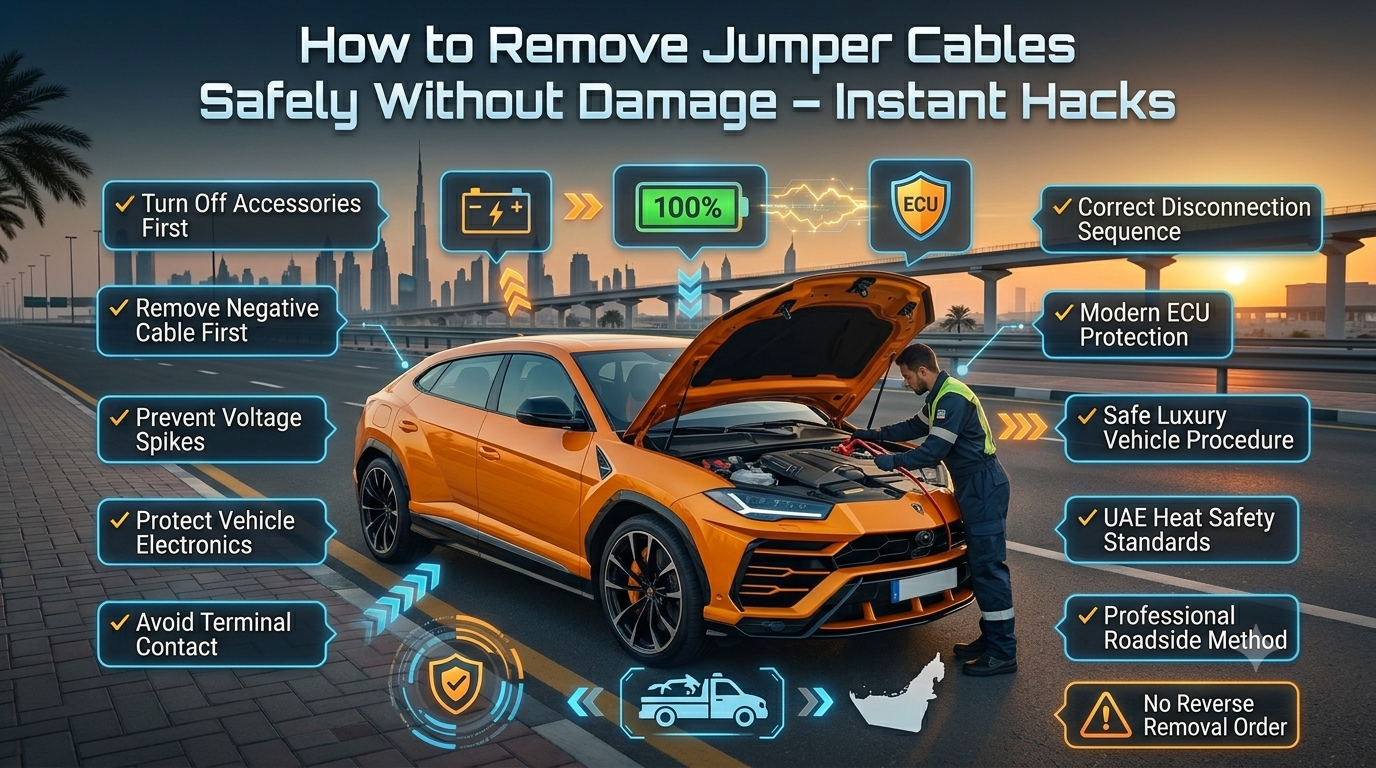
How to Remove Jumper Cables Safely Without Damage-Instant Hacks is one of the most important car battery handling procedures every driver in the UAE should understand, especially in high-temperature environments like Dubai, Abu Dhabi, and Sharjah where battery failures are extremely common due to extreme heat, stop-and-go traffic, and heavy AC usage.
Click Here
Table of Contents
In real-world roadside situations, most engine damage or electrical faults don’t happen during the jump start itself—they happen during incorrect jumper cable removal, reversed order disconnection, or sudden power drops in modern ECU-equipped vehicles.
This guide is written from a UAE automotive service perspective, aligned with EuroSwift Auto Services and professional roadside operations where safety protocols are designed to protect luxury vehicles, SUVs, hybrid systems, and rental fleets operating under extreme conditions.
UAE Driving Reality & Why Jumper Cable Safety Matters More Here
In the UAE, vehicles face a unique combination of stress factors:
- Extreme summer heat above 45°C
- Heavy air conditioning load even at idle
- Frequent short trips in urban congestion
- High-end electronics in luxury vehicles (BMW, Mercedes, Lexus, Tesla)
- Airport rental turnover causing inconsistent battery maintenance
- Desert trips with sudden battery drain events
Because of this, jump starts are extremely common, especially when drivers search for:
jumpstart, jump start dubai, jump start service near me, jump start car service, jump start service, car jump start near me, battery jump start service, jump start car, emergency jump start dubai, roadside jump start service, 24/7 jump start service dubai, mobile jump start service, car battery jump start dubai, fast jump start service, cheap jump start service dubai, vehicle jump start service, auto jump start service, on demand jump start dubai, instant jump start service, professional jump start service, battery booster service dubai, roadside battery assistance dubai.
But what most drivers ignore is this:
A correct jump start can save your car. A wrong cable removal can damage your ECU, alternator, or battery management system permanently.
Understanding the Electrical Flow Before Cable Removal
Before removing jumper cables, you must understand how current flows between two vehicles.
When a jump start is successful:
- Donor battery provides voltage stabilization
- Dead battery starts accepting charge
- Alternator takes over power regulation
- ECU stabilizes ignition mapping
- Electrical load shifts from donor to recipient vehicle
In modern UAE vehicles (especially German and hybrid models), voltage fluctuation is tightly controlled. A sudden disconnection can cause:
- ECU reset failure
- Airbag warning lights
- Transmission sensor glitches
- Infotainment system crash
- Battery management system errors
This is why professional services like car jump start service Dubai and battery booster service Dubai follow strict disconnection sequencing.
Step-by-Step Safe Jumper Cable Removal (Expert Protocol)
Step 1: Ensure Both Vehicles Are Stable
Before touching any cable:
- Keep both engines ON for at least 2–3 minutes
- Ensure RPM is stable (idle smoothness)
- Turn off headlights, AC load, and infotainment systems
- Confirm no warning lights are flashing
In UAE roadside support scenarios like emergency jump start Dubai, technicians always stabilize voltage first before disconnecting.
Step 2: Remove Negative Cable from Jumped Car First
This is the most critical safety step.
- Start with the black (negative) cable
- Remove from the recipient vehicle first
- Keep clamps away from metal surfaces
Why this matters:
- Prevents grounding sparks
- Protects ECU from reverse surge
- Reduces alternator load shock
Incorrect order can lead to expensive ECU repairs in luxury cars.
Step 3: Remove Negative Cable from Donor Car
After recipient disconnection:
- Remove black clamp from donor vehicle
- Keep cable isolated
- Do not let clamps touch each other
At this stage, power flow is already stabilized.
Step 4: Remove Positive Cable from Donor Car
Now move to red cable:
- Remove from donor battery first
- Avoid touching metal chassis
- Maintain insulated grip
Professional mobile jump start service Dubai technicians always double-check polarity labeling at this stage.
Step 5: Remove Positive Cable from Jumped Car
Finally:
- Remove red cable from recipient battery
- Ensure no sparks near battery terminal
- Place cables in dry, insulated storage
At this point, the system is fully separated safely.
Common Mistakes That Damage Cars in UAE Roadside Situations
Many drivers searching car jump start near me or roadside battery assistance Dubai unknowingly make these errors:
1. Removing Positive First
- Causes voltage spike
- Damages ECU capacitors
2. Letting Cable Clamps Touch
- Creates short circuit
- Can burn fuse box
3. Turning Off Engine Immediately
- Alternator hasn’t stabilized charge
- Battery drops instantly again
4. Using Wrong Cable Thickness
- Overheating during transfer
- Weak current flow in SUVs
5. Jump Starting Hybrid Vehicles Incorrectly
- Battery management system lock
- High-voltage isolation failure
UAE Vehicle Types & Jump Cable Sensitivity Comparison
| Vehicle Type | Risk Level | Cable Sensitivity | Removal Caution |
|---|---|---|---|
| Economy Sedan | Low | Standard | Basic protocol |
| SUV (Toyota, Nissan Patrol) | Medium | Moderate | Stabilize longer |
| Luxury (BMW, Mercedes) | High | Sensitive ECU | Strict sequence |
| Hybrid Vehicles | Very High | Battery management system | Professional handling required |
| EV Support Systems | Critical | High-voltage logic | Expert-only removal |
Why Professional Jump Start Services Are Preferred in Dubai
In Dubai’s luxury car ecosystem, many drivers rely on:
- jump start dubai
- jump start service near me
- jump start car service
- 24/7 jump start service dubai
- mobile jump start service
Because professional technicians handle:
- Voltage calibration before disconnection
- ECU-safe grounding techniques
- Battery health diagnostics
- Alternator load testing
- On-site replacement recommendations
Real Case Study: Dubai Marina Battery Surge Incident
A luxury sedan parked overnight in Dubai Marina experienced a dead battery due to excessive AC drain.
Owner attempted jump start using random cables from another driver.
Mistakes made:
- Positive cable removed first
- Engine turned off immediately after start
- No voltage stabilization period
Result:
- ECU reset failure
- Dashboard warning cascade
- Temporary immobilizer lock
When professional roadside jump start service Dubai arrived, they:
- Reset system safely
- Stabilized alternator output
- Performed controlled disconnection
- Restored vehicle without replacement
This highlights why proper jumper cable removal is not optional—it is essential.
Temperature Impact on Cable Removal Safety in UAE
High heat affects:
- Cable insulation flexibility
- Battery internal resistance
- Spark probability during disconnection
- Metal terminal expansion
At 45°C+, even a small incorrect disconnection can cause:
- Micro-sparking
- Terminal corrosion acceleration
- Voltage instability
That’s why instant jump start service Dubai teams avoid rapid disconnects during peak summer hours.
UAE Roadside Safety Rules That Affect Jumper Cable Removal
In the UAE, roadside assistance procedures follow strict safety expectations, especially in high-traffic zones like Sheikh Zayed Road, Dubai Marina, Downtown Dubai, and Sharjah Industrial areas.
When using services like roadside jump start service or emergency jump start Dubai, technicians must follow:
- No open ignition exposure near fuel lines
- Controlled grounding during cable removal
- Engine stabilization before disconnection
- No metal-to-metal clamp collision
- Battery temperature checks in summer heat
These rules are especially important for high-end vehicles supported by services where even a small electrical surge can trigger:
- Transmission limp mode
- ECU fault memory
- Immobilizer lock activation
- Sensor recalibration delays
Professional Jump Start Workflow (UAE Service Standard)
A professional jump start service Dubai follows a structured lifecycle:
1. Pre-Inspection Phase
- Battery voltage test (below 12V = weak state)
- Terminal corrosion check
- Alternator output scan
- ECU fault scan (luxury cars)
2. Safe Connection Phase
- Red clamp to positive terminal
- Black clamp to donor ground point
- Controlled engine start sequence
3. Stabilization Phase
- Engine runs 2–5 minutes
- Electrical load gradually normalized
- AC and infotainment kept OFF
4. Safe Removal Phase
- Negative cable removed first
- Positive cable removed last
- No sudden engine shutdown
This workflow is standard in mobile jump start service Dubai and battery booster service Dubai operations.
Jump Start Pricing Ecosystem in UAE (Real Market Structure)
Pricing in UAE varies based on urgency, vehicle type, and location density.
| Service Type | Average Cost (AED) | Response Time | Risk Coverage |
|---|---|---|---|
| Cheap jump start service Dubai | 80 – 150 | 30–60 min | Basic cars |
| Fast jump start service | 120 – 250 | 20–40 min | Standard + SUVs |
| 24/7 jump start service Dubai | 150 – 300 | 15–30 min | All vehicles |
| Emergency jump start Dubai | 200 – 400 | 10–25 min | High urgency |
| Luxury vehicle jump start | 250 – 600 | Priority dispatch | ECU-safe handling |
- On-site diagnostics
- Battery health reports
- Alternator testing
- ECU-safe disconnection protocols
Case Study: Dubai Airport Rental Battery Failure
A tourist rental SUV parked at Dubai International Airport experienced a dead battery due to prolonged AC use during luggage unloading.
Situation:
- Vehicle: Toyota Land Cruiser
- Environment: 46°C runway heat
- Cause: Extended infotainment + AC drain
- Service requested: car battery jump start Dubai
Mistakes avoided by professionals:
- No immediate cable removal
- No engine revving during stabilization
- No random clamp switching
Outcome:
- Safe jump start completed in 12 minutes
- No ECU reset issues
- Vehicle returned to rental fleet operational state
This is a typical scenario handled daily in roadside battery assistance Dubai operations.
Case Study: Luxury Car ECU Protection Failure Avoided
A Mercedes S-Class in Downtown Dubai suffered a deep battery drain after 3 days of parking.
Risk Factors:
- Sensitive electrical architecture
- Dual battery system
- Advanced driver assistance systems (ADAS)
What could go wrong:
- Incorrect jumper cable removal
- Reverse polarity surge
- ECU corruption
Professional intervention:
- Controlled voltage ramp-up
- Ground-based negative connection
- Delayed disconnection sequence
Result:
- Zero ECU damage
- No sensor recalibration required
- Full system recovery
This is why professional jump start service near me is preferred for luxury vehicles.
Comparative Analysis: DIY vs Professional Jump Start Removal
| Factor | DIY Method | Professional Service |
|---|---|---|
| Cable removal safety | Low | High |
| ECU protection | Unstable | Fully controlled |
| Risk of spark damage | High | Minimal |
| Time efficiency | Medium | Fast |
| Luxury car compatibility | Poor | Fully supported |
| Cost efficiency | Short-term cheap | Long-term safe |
Advanced Safety Techniques Used in UAE Roadside Services
Modern auto jump start service Dubai teams use advanced methods such as:
1. Ground Point Disconnection Technique
Instead of removing from battery terminals, technicians disconnect from chassis ground to reduce spark risk.
2. Voltage Stabilizer Units
Portable devices that prevent ECU surge during cable removal.
3. Smart Clamp Monitoring
LED indicators detect reverse polarity instantly.
4. Thermal Battery Detection
Used in desert conditions to avoid overheating failures.
Jump Start Violations & Mistakes Common in UAE
Improper handling of jumper cables can lead to:
- Alternator diode burnout
- ECU memory reset loss
- Battery swelling
- Fuse box overload
- Sensor calibration failure
These issues are frequently reported in unmanaged roadside attempts without professional jump start service Dubai support.
All of these services are coordinated under platforms which operate across UAE highways and urban zones.
EV & AI Impact on Jumper Cable Safety (2026 Trend)
The UAE automotive ecosystem is rapidly shifting toward:
- AI-based battery diagnostics
- Smart alternator regulation
- EV-assisted jump systems
- Cloud-based vehicle health tracking
Future jump start systems will:
- Auto-detect polarity before contact
- Prevent cable removal if voltage is unstable
- Send real-time ECU safety alerts
- Integrate with mobile apps for roadside dispatch
This means jumper cable removal will soon be semi-automated in luxury vehicles, especially in Dubai’s premium fleet sector.
Post-Jump Electrical Stabilization (Most Drivers Ignore This Phase)
After a successful jump start, the vehicle is not immediately “safe.” It is in a temporary power recovery state where the alternator is gradually taking over from the external boost source.
During this phase:
- Voltage is unstable between 12.2V – 14.4V
- ECU is re-learning idle mapping
- Sensors are recalibrating throttle response
- Battery is accepting partial surface charge
If jumper cables are removed too early or incorrectly, it can cause:
- Sudden voltage drop
- Engine stalling
- Dashboard error lights
- Transmission hesitation
- Battery recharge failure
That’s why professional car jump start service Dubai teams always maintain a stabilization window before disconnection.
Advanced Safe Removal Technique (UAE Professional Method)
This is the industry-level protocol used in high-end roadside recovery operations:
Step 1: Engine Load Normalization
- Keep engine running at idle for 3–5 minutes
- Turn off AC, headlights, and infotainment
- Ensure RPM is steady (no fluctuation)
Step 2: Alternator Transition Check
Technicians verify:
- Stable alternator output (13.8V–14.4V)
- No sudden voltage dips
- No warning lights on dashboard
Step 3: Controlled Negative Disconnection
The first removal is always:
- Black clamp from recipient vehicle
- Then black clamp from donor vehicle
This prevents:
- Ground spark discharge
- ECU voltage backflow
- Sensor spike damage
Step 4: Positive Terminal Isolation
- Red clamp removed from donor vehicle first
- Then from recipient vehicle
- Kept away from metal surfaces
Step 5: Final System Observation
- Vehicle runs independently for 2–3 minutes
- Technician checks idle stability
- Ensures no re-stalling risk
Battery Decision Point: Replace or Continue Driving?
After jumper cable removal, UAE technicians always assess whether the battery is:
1. Recoverable Battery
- Voltage returns to 12.4V+ after 15 minutes
- Engine starts normally again
- No rapid discharge
2. Weak Battery (Borderline)
- Requires repeated jump start
- Voltage drops quickly
- Common in 2–3 year old UAE batteries
3. Failed Battery (Replacement Required)
- No charge retention
- Rapid ECU warning return
- Common in extreme heat exposure cases
This is where services like:
- battery jump start service
- battery jump service
- roadside battery assistance Dubai
- vehicle jump start service
become part of a full replacement decision workflow rather than just emergency ignition support.
Luxury Car Sensitivity in Jumper Cable Removal
In UAE, high-end vehicles are extremely sensitive during disconnection:
BMW / Mercedes / Audi Systems
- Require voltage stabilization before disconnection
- ECU memory must remain uninterrupted
- Improper removal triggers fault codes
Lexus / Infiniti / Toyota Hybrid Systems
- Battery management system locks if unstable
- Hybrid ECU may enter safety shutdown mode
Land Cruiser / Patrol (SUV Segment)
- Higher cranking load
- Longer stabilization time required
This is why professional jump start car service Dubai is preferred over DIY methods in luxury and fleet environments.
Real UAE Case Study: Sheikh Zayed Road Voltage Drop Incident
A luxury SUV experienced a dead battery near Sheikh Zayed Road during peak traffic hours.
Situation:
- Vehicle: Range Rover Sport
- Cause: AC + infotainment overnight drain
- Service requested: emergency jump start Dubai
Initial Risk:
Driver attempted cable removal immediately after engine start.
Problems Prevented:
Technician intervened before:
- ECU reset failure
- Transmission error lock
- Alternator overload
Correct Action Taken:
- Stabilized engine for 4 minutes
- Performed controlled negative disconnection
- Verified voltage recovery
Result:
- No system damage
- No warning lights
- Vehicle resumed normal operation
Why UAE Heat Makes Cable Removal More Dangerous
Extreme UAE climate increases failure risk due to:
- Battery electrolyte evaporation
- Faster internal resistance buildup
- Metal terminal expansion
- Higher spark probability during removal
At temperatures above 45°C:
- Even small disconnection errors create micro-arcing
- ECU sensitivity increases
- Alternator stress rises significantly
That’s why 24/7 jump start service Dubai providers follow heat-based adjustment protocols.
Comparison: Safe vs Unsafe Jumper Cable Removal Outcomes
| Factor | Safe Professional Method | Unsafe DIY Method |
|---|---|---|
| ECU protection | Fully stable | High risk of reset |
| Battery recovery | Optimized | Incomplete recharge |
| Spark risk | Minimal | High |
| Alternator stress | Controlled | Sudden load shock |
| Long-term reliability | High | Reduced battery life |
All coordinated under structured UAE roadside ecosystems for rapid-response vehicle recovery.
Final Technical Insight (Industry-Level Reality)
In modern UAE automotive systems, jumper cable removal is no longer a mechanical action—it is a controlled electronic transition phase between external power assistance and internal battery autonomy.
Incorrect removal can silently damage:
- ECU memory modules
- Alternator diode bridges
- Battery management systems
- Transmission control units
Correct removal ensures:
- Stable voltage normalization
- Long-term battery health
- Zero electronic fault propagation
- Safe ECU recovery
-
1.How to safely take jumper cables off?
To safely remove jumper cables, you must reverse the connection order carefully to avoid sparks, voltage spikes, or ECU damage.
Follow this safe sequence:
Keep both cars running and stable for a few minutes after the jump start
Turn off headlights, AC, and extra electrical load
Remove cables in the correct order (explained below)
Keep metal clamps from touching each other or the car body
Correct removal order is critical because sudden disconnection can create a voltage surge that may affect the alternator or electronic control unit. -
2.Which jumper cable do you take off first?
You always remove the negative (black) cable first.
Safe removal order:
Black cable from the jump-started car (dead battery vehicle)
Black cable from the donor car
Red cable from the donor car
Red cable from the dead battery car
Why negative first?
The negative terminal is connected to ground
Removing it first reduces risk of short circuits
Prevents accidental sparks near the battery
Protects sensitive electronics (ECU, sensors) -
3.Which battery terminal do you connect first?
When connecting jumper cables, the correct order is the opposite:
Safe connection order:
Red (+) clamp → dead battery positive terminal
Red (+) clamp → donor battery positive terminal
Black (–) clamp → donor battery negative terminal
Black (–) clamp → metal ground point on dead car (not the battery)
Why this order matters:
Red (positive) is energized first in a controlled way
Ground connection last reduces spark risk near battery gas
Modern cars are safer when grounded away from battery -
4.Do you leave both cars on when removing jumper cables?
Yes — both cars should remain ON during removal, but with conditions:
You should:
Keep both engines running for 2–5 minutes after jump start
Ensure RPM is stable (no shaking or low idle)
Turn off unnecessary electrical load (AC, lights, infotainment)
You should NOT:
Turn off either engine immediately
Rev the engine aggressively during removal
Disconnect cables too quickly after starting
Why both cars stay ON:
Alternator stabilizes voltage
ECU completes power transition
Prevents sudden power drop or stalling
Helps the weak battery receive initial charge safely
Conclusion
Understanding how to safely remove jumper cables is not just a basic driving skill—it is a critical electrical safety procedure that directly protects your vehicle’s battery system, alternator, and ECU, especially in modern cars commonly used across the UAE.
In high-temperature environments like Dubai, Abu Dhabi, and Sharjah, where batteries are already under heavy stress from heat, traffic, and constant AC usage, even a small mistake during cable disconnection can lead to serious issues such as voltage spikes, warning lights, or long-term electrical damage.
The correct approach is always simple but strict: follow the proper connection and disconnection sequence, keep both vehicles stable during removal, and avoid rushing the process. Most vehicle damage during jump-start situations does not happen while starting the car—it happens when cables are removed incorrectly or too quickly.
For luxury vehicles, hybrids, and modern ECU-controlled systems, professional handling becomes even more important. That is why many drivers rely on expert roadside solutions like EuroSwift Auto Services and emergency platforms which follow controlled, damage-free jump-start and disconnection procedures designed for UAE driving conditions.
Ultimately, safe jumper cable removal is about one principle: stability before disconnection. If the electrical system is allowed to settle properly, the vehicle remains protected, reliable, and ready for continued driving without hidden damage.
Top Hacks
How to Remove Jumper Cables Safely Without Damage starts the moment the engine successfully turns over after a jump-start. At this stage, the electrical system is still unstable, and the alternator is gradually taking control of voltage regulation. Rushing this process is one of the most common causes of ECU stress and minor electrical faults in modern vehicles.
How to Remove Jumper Cables Safely Without Damage requires patience immediately after ignition. The engine should be left running for a few minutes so the voltage stabilizes naturally. This is especially important in UAE conditions where heat and battery strain can already weaken electrical consistency.
How to Remove Jumper Cables Safely Without Damage depends heavily on the reverse-order rule. The cables must always be removed in the opposite sequence of installation to prevent sudden current surges. This is a standard practice in professional roadside assistance services.
How to Remove Jumper Cables Safely Without Damage also involves ensuring that both vehicles remain stationary and in park or neutral with handbrakes engaged. This prevents accidental movement while cables are being handled in tight parking spaces.
How to Remove Jumper Cables Safely Without Damage becomes safer when electrical load inside both vehicles is kept minimal. Turning off AC, headlights, and infotainment systems ensures smoother voltage stabilization during disconnection.
How to Remove Jumper Cables Safely Without Damage requires careful handling of the grounded clamp. The ground connection is always removed first because it safely breaks the circuit away from the battery itself, reducing spark risk.
How to Remove Jumper Cables Safely Without Damage also depends on avoiding any contact between red and black clamps during removal. Even a brief touch can create a short circuit, damaging cables or fuses.
How to Remove Jumper Cables Safely Without Damage should always include checking that clamps are not stuck or tightly fused to terminals due to heat or corrosion. Gentle twisting motion helps release them safely.
How to Remove Jumper Cables Safely Without Damage improves significantly when high-quality insulated gloves are used, especially in hot climates where metal parts can become extremely warm.
How to Remove Jumper Cables Safely Without Damage requires ensuring that cables are not stretched or under tension before removal. Loose and relaxed cables are easier and safer to handle.
How to Remove Jumper Cables Safely Without Damage becomes more controlled when both hands are used to stabilize each clamp before lifting it off the terminal, reducing accidental slipping.
How to Remove Jumper Cables Safely Without Damage also involves avoiding sudden jerks. Slow and steady lifting motion prevents terminal damage and protects battery posts from loosening.
How to Remove Jumper Cables Safely Without Damage should always include a quick visual inspection of battery condition after engine start to ensure no leakage, swelling, or burning smell is present.
How to Remove Jumper Cables Safely Without Damage is safer when the donor vehicle continues running during the entire removal process to maintain voltage stability.
How to Remove Jumper Cables Safely Without Damage requires keeping cables separated in the air while disconnecting, preventing accidental clamp-to-clamp contact.
How to Remove Jumper Cables Safely Without Damage also depends on removing the chassis ground connection before touching battery terminals directly, which reduces spark risk.
How to Remove Jumper Cables Safely Without Damage becomes more efficient when the removal sequence is mentally planned before starting, avoiding confusion during execution.
How to Remove Jumper Cables Safely Without Damage should always avoid placing metal tools near the battery during disconnection to prevent accidental bridging of terminals.
How to Remove Jumper Cables Safely Without Damage is critical in modern vehicles where ECU systems are sensitive to sudden voltage changes and require smooth disconnection.
How to Remove Jumper Cables Safely Without Damage benefits from checking cable temperature; overheated cables indicate resistance and should be handled with extra caution.
How to Remove Jumper Cables Safely Without Damage also includes ensuring that children or passengers remain at a safe distance from the engine bay during the process.
How to Remove Jumper Cables Safely Without Damage requires confirming that the engine is running smoothly before any cable is removed, ensuring successful jump-start recovery.
How to Remove Jumper Cables Safely Without Damage becomes safer when cables are placed on non-metal surfaces after removal to avoid accidental conduction.
How to Remove Jumper Cables Safely Without Damage also involves inspecting clamps for burn marks or deformation after use, which may indicate poor-quality cables.
How to Remove Jumper Cables Safely Without Damage is more effective when performed on flat ground, especially in urban UAE parking structures where slope can affect stability.
How to Remove Jumper Cables Safely Without Damage should always avoid touching both clamps simultaneously while removing any connection point.
How to Remove Jumper Cables Safely Without Damage also requires ensuring the engine bay is dry, as moisture can increase electrical risk during handling.
How to Remove Jumper Cables Safely Without Damage becomes easier when cables are labeled or color-coded properly for quick identification during removal.
How to Remove Jumper Cables Safely Without Damage depends on maintaining calm, controlled movement rather than rushed actions under stress.
How to Remove Jumper Cables Safely Without Damage also includes verifying that no warning lights appear on the dashboard during removal.
How to Remove Jumper Cables Safely Without Damage improves when drivers understand that the alternator, not the battery, is now powering the system.
How to Remove Jumper Cables Safely Without Damage requires patience because immediate disconnection can cause voltage imbalance.
How to Remove Jumper Cables Safely Without Damage also involves checking that clamps are fully released before stepping away from the vehicle.
How to Remove Jumper Cables Safely Without Damage becomes safer when drivers avoid wearing loose clothing that could get caught in engine parts.
How to Remove Jumper Cables Safely Without Damage should always include final confirmation that both vehicles are secure before finishing the process.
How to Remove Jumper Cables Safely Without Damage also means ensuring no metallic objects are left near the battery area after completion.
How to Remove Jumper Cables Safely Without Damage is more reliable when drivers understand that jump-start success is not just starting the car, but stabilizing it afterward.
How to Remove Jumper Cables Safely Without Damage requires attention to detail because small mistakes can lead to expensive electrical repairs in modern vehicles.
How to Remove Jumper Cables Safely Without Damage also includes ensuring that the hood is properly closed after completion to protect engine components.
How to Remove Jumper Cables Safely Without Damage becomes part of a larger safety system that includes prevention, not just emergency response.
How to Remove Jumper Cables Safely Without Damage should always end with a short driving period to allow full alternator recharge.
How to Remove Jumper Cables Safely Without Damage is most effective when drivers treat it as a controlled technical procedure rather than a quick roadside task.
How to Remove Jumper Cables Safely Without Damage also highlights the importance of using quality jumper cables to avoid unstable current transfer.
How to Remove Jumper Cables Safely Without Damage becomes more predictable when drivers follow standardized professional procedures used in roadside assistance services.
How to Remove Jumper Cables Safely Without Damage requires awareness that battery systems in modern cars are interconnected with multiple electronic modules.
How to Remove Jumper Cables Safely Without Damage also emphasizes that safety is more important than speed during removal.
How to Remove Jumper Cables Safely Without Damage is a skill that improves with practice and understanding of vehicle electrical systems.
How to Remove Jumper Cables Safely Without Damage ultimately ensures both vehicle safety and long-term battery health when done correctly.
Leave a Reply