click here to reach topics instantly
Table of Contents
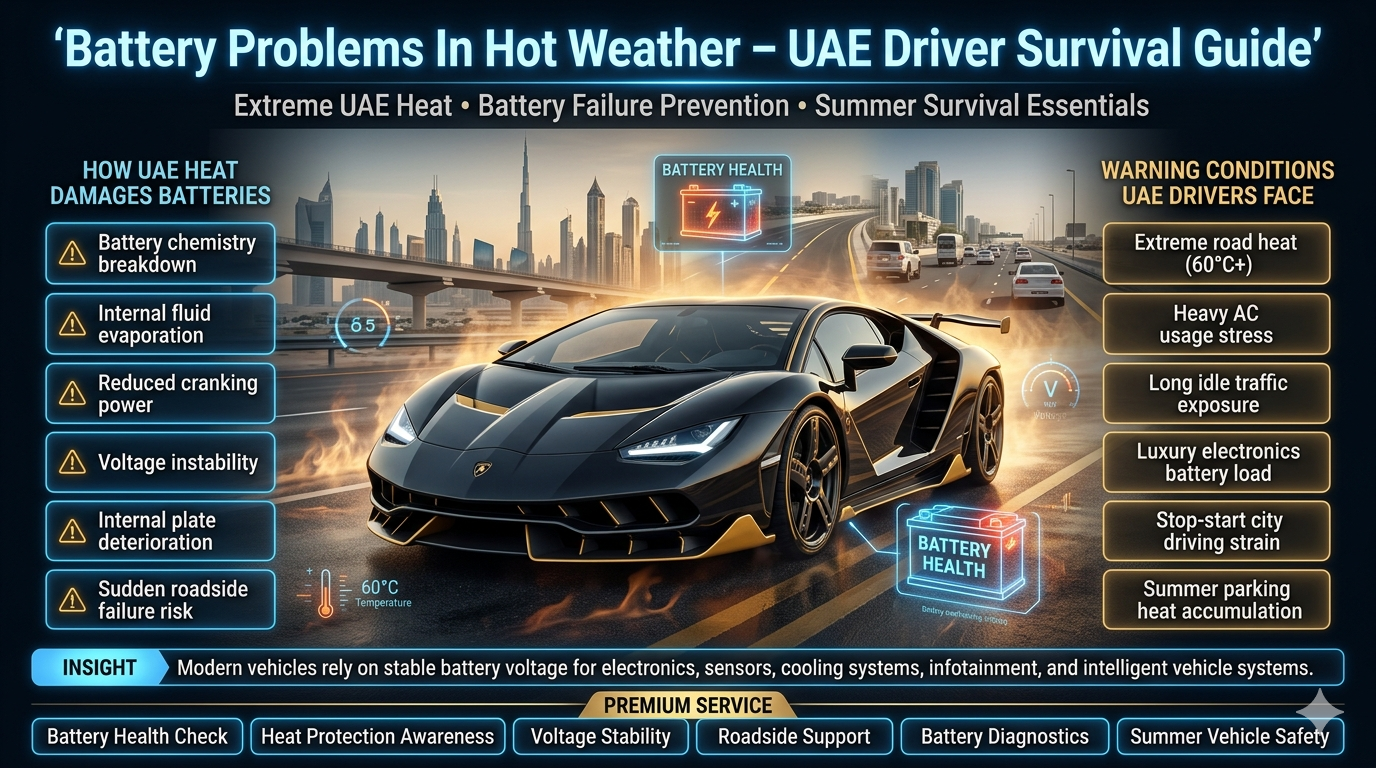
Battery Problems In Hot Weather – UAE Driver Survival Guide.The UAE summer is not just uncomfortable for drivers — it is one of the harshest environments on earth for vehicle batteries. In cities like Dubai, Abu Dhabi, Sharjah, and Ajman, road temperatures regularly exceed 60°C during peak summer months. That heat silently destroys battery chemistry, weakens cranking power, evaporates internal fluid, and causes sudden roadside breakdowns without warning.
For UAE drivers, battery failure is not a minor inconvenience. It can leave families stranded on Sheikh Zayed Road, tourists stuck outside shopping malls, delivery fleets delayed during peak business hours, and luxury vehicle owners facing expensive electronic failures. Modern cars in the Emirates rely heavily on electronic systems, smart sensors, AI-assisted driving technology, infotainment modules, adaptive cooling systems, and advanced ECU networks — all of which demand a stable and healthy battery.
Why UAE Heat Damages Car Batteries Faster Than Other Countries
Most vehicle batteries worldwide are designed around moderate weather conditions. The Gulf climate creates an entirely different stress level. Continuous exposure to extreme heat accelerates chemical degradation inside lead-acid and AGM batteries.
Inside the engine bay of a parked SUV in Dubai Marina or Business Bay, temperatures may rise beyond safe operating limits within minutes. Battery plates expand under excessive heat, electrolyte fluid evaporates faster, and corrosion begins forming around terminals. Over time, this weakens battery capacity and shortens overall lifespan.
In colder countries, batteries often fail during winter because engines need more cranking power. In the UAE, batteries fail because heat permanently damages their internal structure.
Common UAE summer battery stress factors include:
| UAE Heat Factor | Battery Impact | Real-World Effect |
|---|---|---|
| Long idle parking | Charge depletion | Weak morning ignition |
| Desert temperatures | Electrolyte evaporation | Battery swelling |
| Traffic congestion | Continuous electrical load | Alternator stress |
| AC running constantly | High power demand | Faster battery drain |
| Short city trips | Incomplete charging cycles | Reduced battery life |
| Sand and dust | Terminal corrosion | Poor electrical contact |
Vehicles parked outdoors in Downtown Dubai, Al Quoz industrial zones, or desert safari areas experience much faster battery degradation than vehicles parked in underground shaded parking.
Early Warning Signs Of Battery Failure In UAE Summers
Most drivers ignore the early symptoms of battery trouble until the vehicle completely stops starting. In UAE conditions, warning signs appear weeks before total failure.
Slow Engine Cranking During Morning Start
One of the first indicators is delayed ignition during morning startup. Drivers may notice the engine turning over slowly before starting. This usually means heat has reduced battery cranking amperage.
Luxury vehicles such as BMW, Mercedes-Benz, Audi, and Range Rover are especially sensitive because of advanced onboard electronics.
Weak Air Conditioning Performance
Many UAE drivers do not realize battery weakness can affect AC performance. A struggling battery forces the alternator to compensate continuously, increasing engine load and reducing cooling efficiency during idle traffic.
Flickering Dashboard Lights
Heat-damaged batteries often create unstable voltage output. This may cause:
- Dashboard flickering
- Infotainment rebooting
- Sensor warning lights
- Camera malfunctions
- Parking assist failures
- Keyless entry issues
These electrical symptoms are extremely common in high-end SUVs and hybrid vehicles operating in UAE summer traffic.
Battery Swelling
Physical swelling is a major danger sign. If the battery casing appears bloated or misshapen, internal heat damage has likely reached critical levels. Immediate replacement is necessary to avoid leakage or complete failure.
The Hidden Impact Of UAE Traffic On Battery Life
Heavy traffic in Dubai and Abu Dhabi creates unique battery stress conditions. Drivers often assume batteries recharge while driving, but stop-and-go urban traffic can actually reduce battery performance.
Modern vehicles consume significant power while stationary:
- Air conditioning compressors
- Navigation systems
- Adaptive cruise modules
- Interior cooling seats
- Mobile charging systems
- Dash cameras
- Fleet tracking systems
- AI driving assistants
During slow-moving Sheikh Zayed Road traffic, electrical demand may exceed charging efficiency, especially in older batteries.
Ride-share vehicles, taxis, delivery vans, and corporate fleets suffer the highest battery failure rates because of prolonged idling combined with nonstop cooling usage.
EuroSwift Auto Services Emergency Response Model In UAE
EuroSwift Auto Services operates within one of the most demanding roadside assistance environments in the Middle East. UAE battery emergencies require speed, technical expertise, heat-safe handling procedures, and rapid navigation across dense urban traffic zones.
Unlike conventional garages, EuroSwift Auto Services focuses on mobile roadside battery solutions. Their operational ecosystem is designed around emergency response rather than workshop dependency.
How Their UAE Emergency Battery Assistance Works
Step 1 — Rapid Dispatch System
Drivers experiencing battery trouble can request:
- jump start service
- car jump start service dubai
- emergency jump start dubai
- instant jump start service
The dispatch system assigns the nearest available mobile technician using real-time UAE traffic mapping.
Step 2 — On-Site Battery Diagnostics
Technicians inspect:
- Voltage stability
- Alternator output
- Terminal corrosion
- Heat swelling
- Charging efficiency
- ECU compatibility
This prevents temporary jump starts from masking deeper electrical failures.
Step 3 — Safe Jump Start Procedure
Modern vehicles require controlled voltage transfer during jump starting. Improper methods can damage:
- ECU modules
- Infotainment systems
- Sensor arrays
- Hybrid battery systems
- Smart ignition systems
Professional roadside technicians use regulated booster equipment suitable for UAE luxury and hybrid vehicles.
Step 4 — Battery Replacement If Needed
If testing confirms permanent heat damage, on-site replacement options may be offered immediately.
This mobile approach is particularly valuable during:
- Mall parking emergencies
- Airport parking failures
- Desert roadside breakdowns
- Residential tower parking issues
- Fleet vehicle downtime
Why Luxury Cars Face Higher Battery Failure Risk In UAE Heat
The Emirates has one of the world’s highest luxury vehicle ownership rates. High-end cars contain dozens of power-hungry systems that remain active even when parked.
Luxury SUVs and performance sedans continuously power:
- Security sensors
- Smart key detection
- AI parking systems
- Cabin cooling memory systems
- Telematics
- GPS modules
- Adaptive suspension electronics
Even overnight parking can significantly drain weak batteries.
Common Luxury Vehicles Frequently Requiring Jump Starts
| Vehicle Category | Common UAE Battery Issue |
|---|---|
| German sedans | Electronic standby drain |
| Luxury SUVs | AC overload demand |
| Sports cars | Irregular driving patterns |
| Hybrid vehicles | Complex voltage balancing |
| Fleet executive cars | Excessive idle operation |
UAE Heat Vs EV And Hybrid Battery Systems
Electric vehicles and hybrid cars are growing rapidly across the UAE. While EVs eliminate traditional engine cranking batteries in some cases, they still rely on auxiliary 12V systems.
Extreme heat affects:
- Battery cooling systems
- Charging efficiency
- Voltage management
- Thermal balancing
- Regenerative charging performance
Manufacturers such as Tesla, BYD, and Nissan recommend avoiding prolonged exposure to direct sunlight during UAE summers.
EV roadside assistance is becoming a specialized sector within the Emirates automotive industry.
Common UAE Driver Mistakes That Destroy Batteries Faster
Many battery failures are preventable. However, certain habits dramatically shorten battery lifespan in Gulf conditions.
Leaving Cars Parked For Long Periods
Tourists and frequent travelers often leave vehicles parked at airports for weeks. Heat combined with parasitic drain weakens batteries quickly.
Installing Cheap Aftermarket Electronics
Low-quality dash cams, LED systems, or audio upgrades can create unstable electrical loads and increase drain rates.
Ignoring Corrosion
Humidity near coastal UAE areas accelerates terminal corrosion, especially in:
- Jumeirah
- Abu Dhabi Corniche
- Sharjah waterfront districts
Delaying Battery Replacement
Many drivers continue using weak batteries after repeated jump starts. This increases alternator strain and can damage electronic modules.
Comparison Of Common Battery Types Used In UAE Vehicles
| Battery Type | UAE Heat Resistance | Typical Lifespan | Best For |
|---|---|---|---|
| Lead-Acid | Moderate | 1.5–2 years | Budget vehicles |
| AGM Battery | High | 2–4 years | Luxury cars |
| Gel Battery | High | 2–5 years | Off-road vehicles |
| Lithium Auxiliary | Very High | 4–6 years | EV systems |
| EFB Battery | Good | 2–3 years | Start-stop systems |
AGM batteries are increasingly preferred for premium UAE vehicles because they handle high electrical demand better during extreme heat.
Real UAE Case Study – Downtown Dubai Summer Breakdown
A business executive parked his luxury SUV outdoors near DIFC during a July afternoon meeting. After approximately four hours under direct sunlight, the battery temperature rose significantly.
Symptoms included:
- No ignition response
- Flickering dashboard
- AC system error messages
- Smart key malfunction
- Instead of a temporary boost alone, the technician recommended immediate replacement due to swelling risk.
Total roadside resolution time:
- Technician arrival: 22 minutes
- Diagnostics: 10 minutes
- Replacement and testing: 18 minutes
Without rapid assistance, towing and dealership delays could have extended downtime to several hours.
Why UAE Tourists Face Higher Battery Risks
Tourists renting vehicles often underestimate Gulf weather severity. Common tourist battery problems include:
- Leaving headlights on during beach visits
- Parking outdoors for extended shopping trips
- Running AC while stationary
- Using phone chargers continuously
- Not recognizing early warning signs
Rental vehicles also experience high turnover usage, increasing battery wear cycles.
AI And Smart Diagnostics Changing UAE Battery Assistance
The UAE automotive sector is rapidly adopting AI-driven roadside support systems.
Modern roadside assistance platforms now integrate:
- Predictive battery analytics
- GPS technician routing
- Live traffic optimization
- AI-powered battery health scoring
- Fleet monitoring systems
- Automated dispatch algorithms
Future UAE roadside ecosystems may detect battery failure probabilities before breakdowns occur.
Fleet operators already use smart telematics to monitor:
- Voltage trends
- Charging behavior
- Heat exposure
- Idle duration
- Alternator performance
This allows preventive maintenance instead of reactive emergency service calls.
UAE Summer Survival Tips For Drivers Facing Extreme Battery Conditions
Park In Covered Areas Whenever Possible
Shaded parking dramatically reduces engine bay temperature buildup.
Start Vehicles Regularly
Cars left unused for extended periods should be started periodically to maintain battery charge cycles.
Clean Battery Terminals
Removing corrosion improves conductivity and charging efficiency.
Avoid Excessive Idle Cooling
Long stationary AC operation increases electrical demand and accelerates battery wear.
Replace Aging Batteries Before Summer Peaks
Preventive replacement before June and July reduces emergency failure risk significantly.
UAE Roadside Battery Service Trends In 2026
The roadside assistance market in the Emirates is evolving rapidly due to:
- Increased EV adoption
- Smart city integration
- AI fleet management
- Luxury vehicle growth
- Tourism expansion
- High-demand delivery logistics
Mobile automotive assistance is becoming faster, more data-driven, and more specialized.
Future roadside services may include:
- AI thermal battery prediction
- Drone-delivered emergency power packs
- Smart roadside diagnostics
- Autonomous assistance routing
- Integrated EV charging rescue
The UAE remains one of the world’s most technologically advanced automotive environments, making battery reliability more important than ever for residents, tourists, and commercial operators alike.
How Sandstorms And Desert Dust Quietly Destroy UAE Car Batteries
Extreme heat is only one side of the UAE battery problem. Desert dust and sandstorms create another hidden danger that many drivers underestimate. Fine sand particles enter engine bays, settle around terminals, and accelerate corrosion. Over time, this weakens electrical conductivity and creates unstable current flow between the battery and the vehicle’s electronic systems.
In areas near the desert outskirts of Dubai, Al Ain, and Sharjah, drivers often experience faster battery wear because airborne dust combines with humidity and engine heat.
Sand accumulation commonly causes:
- Terminal oxidation
- Weak electrical contact
- Voltage inconsistency
- Reduced charging efficiency
- Alternator overwork
- Battery overheating
Vehicles used for desert safaris, construction operations, or long highway drives toward Abu Dhabi industrial zones suffer particularly high exposure levels.
Why Short UAE City Trips Damage Batteries Faster
Many UAE residents use vehicles mainly for short urban trips:
- School runs
- Grocery shopping
- Office commuting
- Mall visits
- Marina traffic movement
These short journeys often prevent the alternator from fully recharging the battery after ignition. Starting a vehicle requires significant electrical energy, especially in hot conditions where cooling systems activate immediately.
When drivers repeatedly make short trips without longer charging cycles, the battery remains partially depleted most of the time. This creates:
- Sulfation buildup
- Reduced storage capacity
- Lower cranking power
- Premature battery aging
Hybrid traffic conditions in Downtown Dubai and Business Bay worsen the issue because stop-start movement increases electronic demand while reducing charging efficiency.
UAE Airport Parking And Long-Term Battery Drain
One of the most common battery emergencies in the Emirates happens after airport parking. Residents traveling abroad often leave vehicles parked for days or weeks at:
- Dubai International Airport
- Al Maktoum International Airport
- Abu Dhabi International Airport
Modern cars never fully shut down electronically. Even while parked, systems continue consuming small amounts of electricity:
- Alarm systems
- GPS modules
- Smart key sensors
- Tracking systems
- ECU memory retention
- Remote connectivity features
Under UAE heat exposure, this slow electrical drain becomes far more aggressive. Returning travelers frequently discover:
- Completely dead batteries
- Weak ignition response
- Electronic malfunction warnings
- Smart key recognition failures
Luxury vehicles are especially vulnerable because their standby electrical consumption is much higher than economy cars.
Heat Damage Inside Modern Smart Batteries
Many drivers assume all batteries work the same way, but modern automotive batteries contain increasingly sophisticated internal structures.
Today’s UAE vehicles use:
- AGM batteries
- Enhanced flooded batteries
- Lithium auxiliary systems
- Smart battery sensors
- Intelligent charging management modules
These systems improve performance but also increase sensitivity to heat.
Inside a heat-damaged battery:
- Electrolyte fluid evaporates
- Internal resistance increases
- Plate warping begins
- Voltage stability weakens
- Charge acceptance declines
- Thermal stress accelerates
Eventually, the battery may still show voltage on testing equipment while lacking actual cranking strength under load conditions.
This is why many UAE drivers experience sudden failure even after the vehicle seemed normal the previous day.
Common Summer Battery Emergencies Across UAE Locations
Different Emirates create different battery stress patterns because of driving habits, climate exposure, and traffic density.
| UAE Area | Most Common Battery Problem |
|---|---|
| Downtown Dubai | Heat from outdoor parking |
| Abu Dhabi highways | Long-distance thermal stress |
| Sharjah traffic zones | Idle AC battery drain |
| Ajman residential areas | Aging batteries in older vehicles |
| Marina districts | Humidity-related corrosion |
| Industrial zones | Dust contamination |
| Desert outskirts | Extreme engine bay temperatures |
Battery emergencies increase sharply between May and September when temperatures remain high even during nighttime.
Why SUV Owners In UAE Face Higher Battery Failure Rates
SUVs dominate UAE roads because drivers prefer larger vehicles for family use, comfort, desert travel, and luxury status. However, SUVs place heavier demands on batteries compared to smaller sedans.
Large SUVs power:
- Multiple cooling zones
- Electric tailgates
- Large infotainment displays
- Air suspension systems
- Advanced driver-assistance systems
- Seat ventilation
- Off-road electronics
- High-capacity lighting systems
During extreme summer conditions, these systems create enormous electrical loads.
Popular UAE SUVs from Toyota, Nissan, Lexus, and Cadillac frequently require stronger AGM battery systems to maintain stable operation.
Fleet Vehicles And Commercial Battery Stress In UAE
Commercial vehicles experience some of the harshest battery conditions in the country.
Industries heavily affected include:
- Food delivery fleets
- Ride-hailing vehicles
- Taxi operators
- Construction transport
- Courier companies
- Corporate transportation services
Fleet vehicles may operate:
- 12–18 hours daily
- Under nonstop AC usage
- In continuous traffic congestion
- Across high-temperature highways
Frequent engine restarts combined with heavy accessory use rapidly shorten battery lifespan.
Fleet operators increasingly rely on predictive maintenance systems that monitor:
- Voltage decline
- Battery temperature
- Alternator efficiency
- Idle duration
- Charging cycles
This helps reduce roadside breakdowns and operational downtime.
UAE Heat And Alternator Overload Problems
Many drivers blame the battery when the alternator is actually the underlying issue.
During UAE summers, alternators work harder because they must simultaneously:
- Recharge the battery
- Power air conditioning
- Support cooling fans
- Operate infotainment systems
- Supply smart safety modules
- Handle lighting loads
If the alternator becomes weak, the battery compensates by supplying additional power. This creates a dangerous cycle where:
- Alternator undercharges battery
- Battery becomes stressed
- Electrical systems demand more power
- Heat increases resistance
- Battery deteriorates faster
Ignoring alternator warning signs can lead to repeated battery failure even after installing a new unit.
Nighttime Heat Still Damages UAE Batteries
Many people believe batteries recover after sunset, but UAE summer nights often remain extremely hot.
Even at midnight:
- Parking surfaces retain thermal energy
- Engine bays cool slowly
- Battery temperatures remain elevated
- Internal chemical degradation continues
Vehicles parked outdoors overnight in uncovered residential parking areas continue suffering heat stress long after the sun sets.
This constant exposure explains why UAE battery lifespan is dramatically shorter than in Europe or North America.
Battery Failure Risks For Ride-Share Drivers
Ride-share and app-based transport drivers experience intense battery usage patterns.
Typical stress factors include:
- Continuous mobile device charging
- GPS operation طوال day
- Frequent passenger stop-start movement
- Long idle waiting periods
- High AC dependence
Ride-share vehicles may complete dozens of ignition cycles daily, placing enormous strain on starter batteries.
Professional drivers increasingly adopt:
- Heavy-duty AGM batteries
- Preventive voltage testing
- Regular terminal maintenance
- Scheduled summer replacement cycles
Without proactive maintenance, roadside breakdown risk becomes extremely high during peak summer traffic periods.
UAE Luxury Parking Towers And Hidden Battery Heat
High-rise parking structures across Dubai and Abu Dhabi create unique battery stress environments. While shaded from sunlight, many enclosed parking towers trap heat with limited ventilation.
Temperatures inside poorly ventilated parking structures can remain dangerously high for hours, especially during July and August.
Vehicles parked for long workdays inside these towers may experience:
- Heat-soaked engine bays
- Reduced battery cooling
- Faster electrolyte evaporation
- Increased standby drain
This issue is common in:
- Financial districts
- Corporate office towers
- Marina residential buildings
- Mall parking structures
Battery Testing Technology Becoming More Advanced In UAE
Traditional voltage testing alone is no longer enough for modern vehicles. Advanced diagnostics now evaluate:
- Cold cranking performance
- Internal resistance
- Reserve capacity
- Charging acceptance
- Thermal condition
- Voltage stability under load
Professional diagnostic tools help identify hidden weakness before total failure occurs.
Modern testing systems can detect:
- Early sulfation
- Heat degradation
- Plate damage
- Smart sensor communication errors
- Charging imbalance
This allows technicians to predict failure risk more accurately during UAE summers.
Why Some New Batteries Fail Surprisingly Fast In UAE
Drivers are often shocked when relatively new batteries fail within one or two years. Several UAE-specific factors contribute to this:
| Cause | Result |
|---|---|
| Continuous high temperatures | Faster chemical degradation |
| Incorrect battery type | Insufficient heat tolerance |
| Cheap aftermarket batteries | Poor durability |
| Weak alternator output | Chronic undercharging |
| Excessive electronic load | Accelerated wear |
| Irregular driving patterns | Low recharge efficiency |
Using low-quality imported batteries without Gulf climate specifications significantly increases failure rates.
Heat Impact On Hybrid Vehicle Auxiliary Batteries
Hybrid vehicles contain complex electrical ecosystems. Even though propulsion may rely partly on hybrid systems, auxiliary batteries still power:
- ECU startup
- Electronic controls
- Safety modules
- Sensor systems
- Ignition logic
If the auxiliary battery weakens, the hybrid system itself may fail to initialize correctly.
In UAE summers, hybrid auxiliary batteries often fail due to:
- Continuous cabin cooling demand
- Smart charging complexity
- Heat-sensitive electronics
- Long idle periods
Hybrid owners must monitor battery health more carefully than conventional vehicle owners.
Future UAE Automotive Battery Technologies
The UAE automotive sector is rapidly moving toward advanced battery technologies designed for extreme climates.
Emerging innovations include:
- AI thermal battery monitoring
- Smart cooling battery compartments
- Solar-assisted charging systems
- Heat-resistant lithium designs
- Predictive failure analytics
- Cloud-connected battery diagnostics
Manufacturers are increasingly adapting vehicles specifically for Gulf conditions because Middle Eastern operating environments differ dramatically from European or Asian climates.
Future smart cities in the UAE may eventually integrate vehicle battery health monitoring directly into connected transportation ecosystems, reducing roadside breakdown frequency through predictive maintenance alerts.
How Extreme UAE Heat Reduces Battery Lifespan By Half
In many countries, a car battery may survive four to five years without major issues. In the UAE, the same battery often struggles to last beyond two years because of nonstop exposure to thermal stress. Heat accelerates every internal chemical reaction inside the battery, causing components to wear out much faster than manufacturers originally intended.
During peak summer months, parked vehicles in outdoor areas can experience engine bay temperatures high enough to permanently weaken battery plates within a single season. Once internal deterioration begins, battery performance declines rapidly.
The most dangerous part is that drivers usually notice symptoms too late. A battery can appear healthy during regular driving while quietly losing reserve power day after day under UAE heat exposure.
Why Parking Habits Matter More In UAE Than Most Drivers Realize
Parking decisions directly affect battery lifespan in Gulf countries. Two identical vehicles driven the same distance can experience completely different battery health depending on where they are parked daily.
Vehicles parked outdoors in:
- Open residential compounds
- Beach parking zones
- Construction sites
- Industrial areas
- Desert camps
- Roadside spaces
typically experience much faster battery aging than vehicles stored in underground or shaded parking.
Direct sunlight creates several problems simultaneously:
- Battery overheating
- Faster fluid evaporation
- Increased engine bay pressure
- Expanded battery casing stress
- Higher standby electrical drain
Luxury black-colored vehicles absorb even more heat, making cooling systems and electrical loads work harder immediately after startup.
Smart Keys And Constant Electronic Drain In Modern UAE Vehicles
Many drivers do not understand that modern smart vehicles continue consuming electricity 24 hours a day. Even when parked and switched off, several systems remain active:
- Smart key detection
- Alarm sensors
- GPS communication
- AI vehicle monitoring
- Remote access systems
- Parking cameras
- Memory modules
In UAE heat, batteries already weakened by high temperatures struggle to support these constant micro-loads.
This is especially problematic for:
- Premium SUVs
- Executive sedans
- EVs
- Hybrid vehicles
- High-tech luxury cars
Some premium vehicles may lose significant charge after only a few days of inactivity during extreme summer weather.
UAE Summer Traffic Creates “Battery Fatigue”
Battery fatigue is becoming increasingly common in Emirates traffic conditions. Unlike complete battery failure, fatigue refers to gradual weakening caused by continuous electrical stress.
Dubai traffic conditions often involve:
- Long idle periods
- Stop-and-go movement
- Constant AC operation
- Navigation usage
- Smartphone charging
- Heavy infotainment usage
During slow movement, the alternator may not fully recharge the battery fast enough to compensate for ongoing electrical demand.
Over time, the battery enters a partially depleted state repeatedly. This slowly damages its ability to hold stable charge levels.
Drivers usually notice:
- Delayed engine response
- Weak startup sounds
- Random electronic glitches
- Reduced AC efficiency
- Dashboard warning flickers
How Heat Impacts Battery Voltage Stability
Most drivers only think about whether the engine starts or not. However, voltage stability is equally important in modern vehicles.
A healthy battery should provide stable voltage to:
- ECU systems
- Safety sensors
- ABS modules
- Steering electronics
- Parking assistance
- Radar systems
- Hybrid controllers
In UAE summers, overheated batteries may still start the engine while supplying unstable voltage afterward.
This creates dangerous intermittent issues such as:
- Sensor malfunction warnings
- Sudden infotainment resets
- Gearbox communication errors
- False dashboard alerts
- Camera system failures
These problems are especially common in modern German vehicles loaded with advanced electronics.
Why Battery Problems Increase During UAE Vacation Seasons
Battery-related roadside emergencies rise sharply during school holidays and travel seasons.
Many residents leave vehicles unused while traveling abroad. Long inactivity combined with:
- Heat exposure
- Natural voltage loss
- Electronic standby drain
creates ideal conditions for dead batteries.
Upon returning, drivers commonly discover:
- No ignition response
- Weak electrical power
- Frozen infotainment systems
- Keyless entry failure
- Multiple warning lights
Airport parking facilities across the Emirates see major increases in battery assistance requests during Eid holidays and summer travel months.
Heat Damage Inside Engine Compartments
Modern engine bays are tightly packed with:
- Turbochargers
- Cooling systems
- Wiring harnesses
- ECU modules
- Hybrid controllers
- Advanced intake systems
While this improves performance and aerodynamics, it also traps heat more aggressively.
After shutdown, engine compartments can remain extremely hot for long periods. This “heat soak” effect continues damaging the battery even after the car is parked.
Turbocharged vehicles face particularly severe thermal conditions because turbo systems generate additional heat near electrical components.
Common Misconceptions About UAE Battery Problems
“The Battery Is Fine Because The Lights Turn On”
Interior lights require very little energy. A battery can illuminate lights while lacking enough cranking power to start the engine.
“Driving Longer Always Recharges The Battery”
Long highway drives help recharge batteries, but if the battery itself is already heat-damaged, charging efficiency may remain poor.
“A Jump Start Solves The Problem Permanently”
Jump starting only restores temporary ignition capability. It does not repair internal heat damage or restore lost battery capacity.
“New Cars Don’t Get Battery Problems”
Modern vehicles often place greater electrical demand on batteries than older cars. In some cases, newer luxury vehicles experience more battery-related electronic issues than simpler older models.
Why UAE Delivery Drivers Face Extreme Battery Stress
The growth of delivery platforms across the Emirates has transformed vehicle operating patterns.
Delivery vehicles often experience:
- Hundreds of short stops weekly
- Constant engine restarts
- Heavy phone charging
- Continuous navigation use
- High daytime AC loads
This nonstop cycle places enormous strain on:
- Starter systems
- Alternators
- Charging circuits
- Auxiliary electronics
Fleet managers increasingly monitor battery health proactively because roadside breakdowns directly impact business operations and customer delivery times.
The Connection Between AC Systems And Battery Failures
Air conditioning is one of the largest electrical demands in UAE vehicles.
During peak summer:
- Cooling fans operate continuously
- Cabin blowers run at high speed
- Compressor systems remain active constantly
Weak batteries struggle to support these loads, especially in older vehicles or during traffic congestion.
Drivers may notice:
- AC becoming weaker at idle
- Electrical dimming during cooling cycles
- Slow fan response
- Reduced cooling after startup
These symptoms sometimes indicate underlying charging system weakness rather than refrigerant problems alone.
Battery Corrosion Problems Near UAE Coastal Areas
Coastal humidity creates additional battery challenges. Salt-rich air accelerates corrosion around:
- Battery terminals
- Electrical connectors
- Grounding points
- Fuse systems
Areas near:
- Jumeirah coastline
- Abu Dhabi Corniche
- Marina districts
- Waterfront communities
often experience faster terminal degradation compared to inland desert regions.
Corrosion increases electrical resistance, reducing charging efficiency and creating unstable voltage flow.
Why Emergency Battery Calls Peak During Afternoon Hours
Roadside assistance providers across the UAE consistently experience the highest battery emergency volume during afternoon periods.
This happens because:
- Vehicles absorb heat throughout the day
- Battery temperatures rise continuously
- Internal resistance increases
- Voltage stability declines
- Restart attempts fail after parking
Drivers frequently encounter trouble after:
- Shopping mall visits
- Office parking
- School pickup
- Restaurant stops
- Friday prayer parking
The combination of prolonged heat exposure and restart demand pushes weakened batteries beyond operational limits.
Commercial Parking Structures And Heat Reflection
Many UAE urban environments create “heat reflection zones” where surrounding concrete, glass, and asphalt intensify temperatures around parked vehicles.
In dense city districts:
- Heat reflects from towers
- Asphalt retains thermal energy
- Airflow becomes restricted
- Engine bays cool slowly
Vehicles parked between tall buildings may experience surprisingly high thermal stress despite limited direct sunlight exposure.
Urban heat islands are becoming an increasingly important factor in battery degradation studies throughout Gulf cities.
The Rise Of Preventive Battery Maintenance In UAE
More UAE drivers are moving toward preventive battery care rather than waiting for failure.
Preventive strategies include:
- Scheduled voltage testing
- Summer battery inspections
- Terminal cleaning
- Charging system diagnostics
- Thermal condition monitoring
- Early replacement cycles
Luxury vehicle owners and fleet operators increasingly replace batteries before failure risk becomes critical.
This approach reduces:
- Emergency breakdowns
- Towing costs
- ECU damage risk
- Business downtime
- Roadside safety exposure
UAE Automotive Industry Shifting Toward Heat-Optimized Components
Vehicle manufacturers are gradually adapting systems specifically for Gulf markets.
Modern Gulf-spec vehicles increasingly include:
- Stronger cooling systems
- Improved thermal shielding
- Heat-resistant battery technology
- Smart charging management
- Enhanced ventilation designs
As EV adoption rises across the Emirates, manufacturers are investing heavily in thermal battery management systems capable of surviving extreme Middle Eastern operating conditions.
Future automotive development in the UAE will likely focus heavily on:
- AI-assisted battery prediction
- Real-time thermal monitoring
- Smart charging optimization
- Climate-adaptive energy management
- Predictive roadside assistance integration
-
1.🔥 Can Hot Weather Cause Battery Issues?
Absolutely — hot weather is one of the biggest causes of car battery failure in the UAE. In cities like Dubai, Abu Dhabi, and Sharjah, extreme summer temperatures can seriously damage a vehicle battery much faster than in cooler countries.
Most people think batteries only fail in winter, but in Gulf countries, heat is actually more dangerous. -
2.🔋 What Is The 30-90 Rule For Battery?
The 30-90 rule is a battery preservation guideline designed to reduce stress on battery cells and extend long-term lifespan. The rule suggests keeping battery charge levels between 30% and 90% rather than allowing the battery to fully discharge or remain constantly at 100% charge.
This principle is especially important for electric vehicles, hybrid systems, and lithium-ion batteries because extreme charge levels generate additional heat and chemical stress. In hot climates like the UAE, batteries already operate under intense thermal pressure, so controlled charging becomes even more important.
Keeping the battery within the 30%–90% range helps:
Reduce overheating
Slow internal chemical degradation
Improve charging stability
Extend battery lifespan
Maintain healthier energy storage capacity
Although traditional lead-acid car batteries function differently, avoiding repeated deep discharge cycles is still beneficial. Batteries that are regularly drained too low often suffer sulfation buildup, reduced cranking power, and shorter operating life. -
3.🌡️ Can Batteries Be Damaged By Heat?
Yes, excessive heat can permanently damage nearly every type of battery, including lead-acid, AGM, gel, lithium-ion, hybrid, and EV battery systems. Heat increases the speed of internal chemical reactions, which initially may appear harmless but eventually weakens the battery’s internal structure.
When batteries overheat, several damaging processes begin:
Electrolyte fluid evaporates faster
Internal plates corrode more rapidly
Voltage stability decreases
Internal resistance increases
Charging efficiency declines
Thermal expansion may cause battery swelling
Unlike cold weather, which usually creates temporary performance reduction, heat often causes permanent chemical deterioration. In severe cases, overheating may lead to battery leakage, cracked casings, electronic malfunctions, or sudden engine starting failure.
Modern vehicles are especially vulnerable because they rely heavily on sensitive electronic systems that require stable voltage. Even slight battery instability caused by heat can trigger sensor errors, infotainment problems, ECU communication faults, and dashboard warning lights. -
4.❄️ How Do I Stop My Battery From Getting Hot?
Preventing battery overheating requires proper maintenance, smart parking habits, and reducing unnecessary electrical stress on the vehicle. In high-temperature regions like the UAE, proactive battery protection is extremely important for avoiding unexpected breakdowns and expensive electrical damage.
One of the most effective steps is parking in shaded or covered areas whenever possible. Underground parking, shaded garages, and covered residential parking significantly reduce engine bay temperatures compared to outdoor asphalt parking under direct sunlight.
Drivers should also:
Keep battery terminals clean and corrosion-free
Inspect the charging system regularly
Replace aging batteries before peak summer months
Reduce unnecessary electrical accessory usage
Avoid excessive idle air conditioning operation
Use high-quality heat-resistant batteries designed for Gulf climates
Regular driving is equally important because vehicles left unused for long periods often develop charge depletion and internal sulfation. Modern luxury vehicles and SUVs should also receive routine battery and alternator inspections because advanced electronics create much higher electrical demand than older vehicles.
Professional preventive maintenance is far more cost-effective than emergency roadside repairs, especially during extreme UAE summer conditions where battery failure rates rise sharply.
🔋 Conclusion
Battery problems in hot weather are far more serious than many drivers realize, especially in extreme climates like United Arab Emirates where high temperatures, heavy traffic, and constant air conditioning usage place continuous stress on vehicle electrical systems. Excessive heat accelerates internal battery deterioration, weakens charging efficiency, increases corrosion, and dramatically shortens overall battery lifespan.
Modern vehicles are more dependent on stable battery performance than ever before. From luxury SUVs and hybrid systems to advanced safety electronics and smart driving technology, today’s cars require consistent voltage and reliable power under demanding operating conditions. Even minor battery weakness can quickly develop into ignition failure, electronic malfunctions, or unexpected roadside breakdowns during peak summer months.
Understanding warning signs early, following proper charging practices, maintaining healthy charging systems, and protecting vehicles from excessive heat exposure can significantly reduce the risk of sudden battery failure. Preventive maintenance, regular inspections, and timely battery replacement are essential for drivers operating in Gulf weather conditions where extreme heat remains one of the biggest threats to long-term vehicle reliability.
For UAE drivers, battery care is no longer basic maintenance — it is a critical part of safe, dependable, and stress-free driving throughout the year.
Leave a Reply