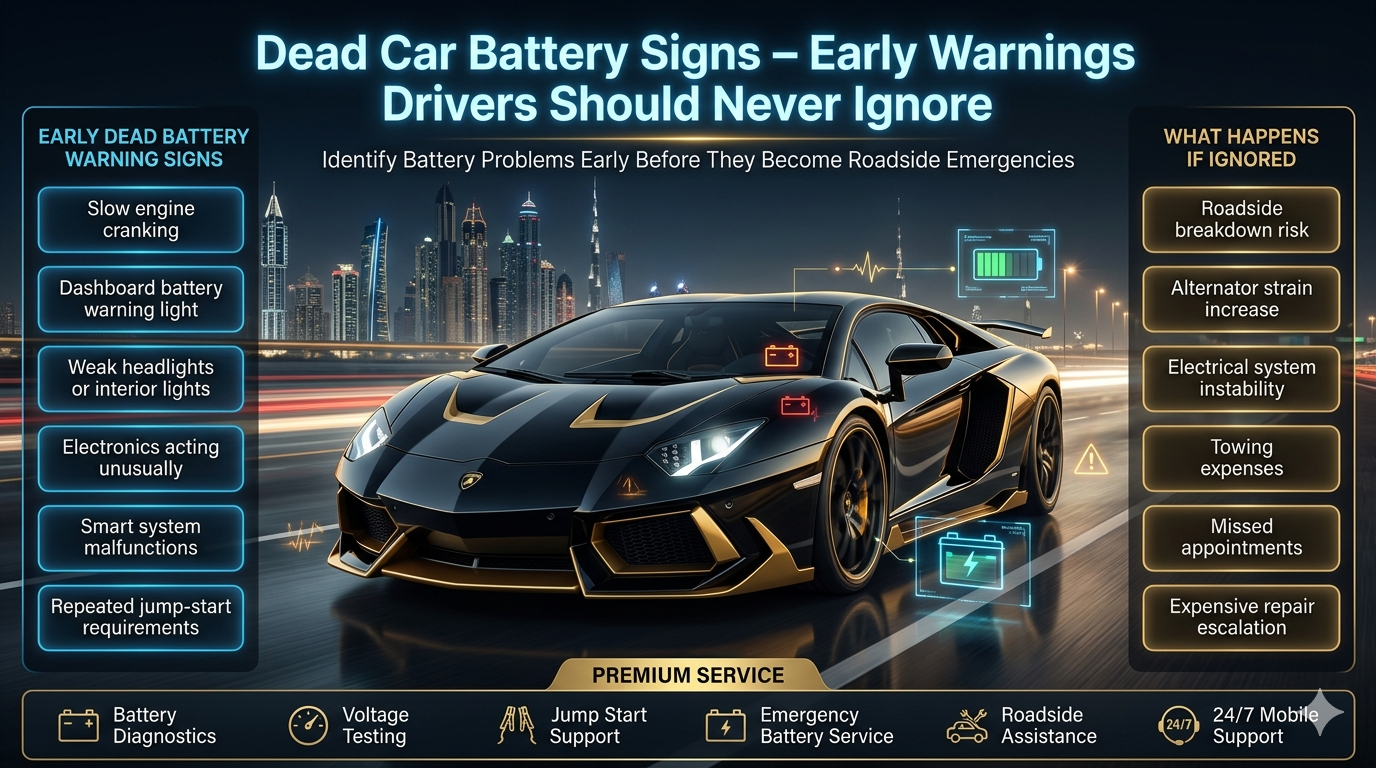
Click here to reach instantly to the topics
Dead Car Battery Signs – Early Warnings Drivers Should Never Ignore.A weak or failing car battery rarely dies without warning. In the UAE, especially in high-temperature cities like Dubai, Abu Dhabi, and Sharjah, battery failure often starts silently before turning into a roadside emergency. Modern vehicles rely heavily on electronic systems, smart sensors, AI-powered driving assistance, infotainment systems, adaptive lighting, GPS modules, and electronic ignition controls. Once battery voltage starts dropping, these systems begin showing early warning symptoms long before the engine completely stops starting.
For UAE drivers dealing with extreme heat, traffic congestion, luxury vehicle electronics, and long highway commutes, understanding dead car battery signs can prevent expensive towing bills, missed appointments, breakdowns during peak traffic, and sudden roadside failures.
Many drivers only search for help after the vehicle refuses to start. By that stage, battery sulfation, voltage instability, alternator strain, and terminal corrosion may already have caused secondary electrical damage. Recognizing warning indicators early allows faster diagnosis, safer driving, and reduced repair costs.
Drivers across the UAE increasingly rely on professional emergency assistance platforms for rapid roadside battery support, mobile diagnostics, jumpstart assistance, and emergency battery replacement services.
Why Car Batteries Fail Faster in UAE Climate Conditions
The UAE climate is one of the harshest environments for automotive batteries. Summer road temperatures can exceed 60°C, especially on asphalt highways, parking structures, desert roads, and traffic-heavy commercial zones.
Extreme heat accelerates:
- Electrolyte evaporation
- Internal plate corrosion
- Battery swelling
- Voltage instability
- Sulfation buildup
- Reduced cold crank amperage
- Electronic control module stress
- Starter motor overload
Luxury vehicles in Dubai Marina, Business Bay, Palm Jumeirah, and Downtown Dubai often consume more standby power due to advanced electronics, ambient lighting systems, active suspension systems, and multiple onboard processors.
Vehicles parked for extended periods at airports, hotels, shopping malls, or residential towers commonly develop parasitic battery drain.
Common UAE battery stress factors include:
| UAE Driving Condition | Battery Impact |
|---|---|
| Extreme summer heat | Faster internal chemical degradation |
| Stop-and-go traffic | Increased alternator load |
| Long idle time with AC | Voltage instability |
| Underground parking humidity | Terminal corrosion |
| Luxury vehicle electronics | Higher standby power drain |
| Short-distance trips | Incomplete charging cycles |
| Desert driving | Vibration-related plate damage |
| Tourist rental vehicle usage | Frequent restart cycles |
Modern roadside technicians from EuroSwift Auto Services report that battery failures spike dramatically during peak summer months across UAE highways and residential districts.
Slow Engine Crank Is Usually the First Major Warning
One of the earliest and most ignored dead battery signs is a slow engine crank.
When starting the vehicle:
- Engine turns over sluggishly
- Starter motor sounds weak
- Ignition delay increases
- Dashboard lights dim during startup
- Clicking noises may appear
This happens because the battery can no longer deliver sufficient cold cranking amps.
In UAE heat conditions, many drivers mistake slow cranking for starter motor issues while the actual problem is battery voltage collapse caused by internal heat damage.
Vehicles commonly affected include:
- German luxury sedans
- Range Rover SUVs
- Hybrid crossovers
- Turbocharged sports cars
- Fleet taxis
- Commercial vans
- Ride-sharing vehicles
Drivers noticing delayed ignition should immediately inspect battery voltage before complete roadside failure occurs.
Dashboard Warning Lights Often Signal Voltage Problems
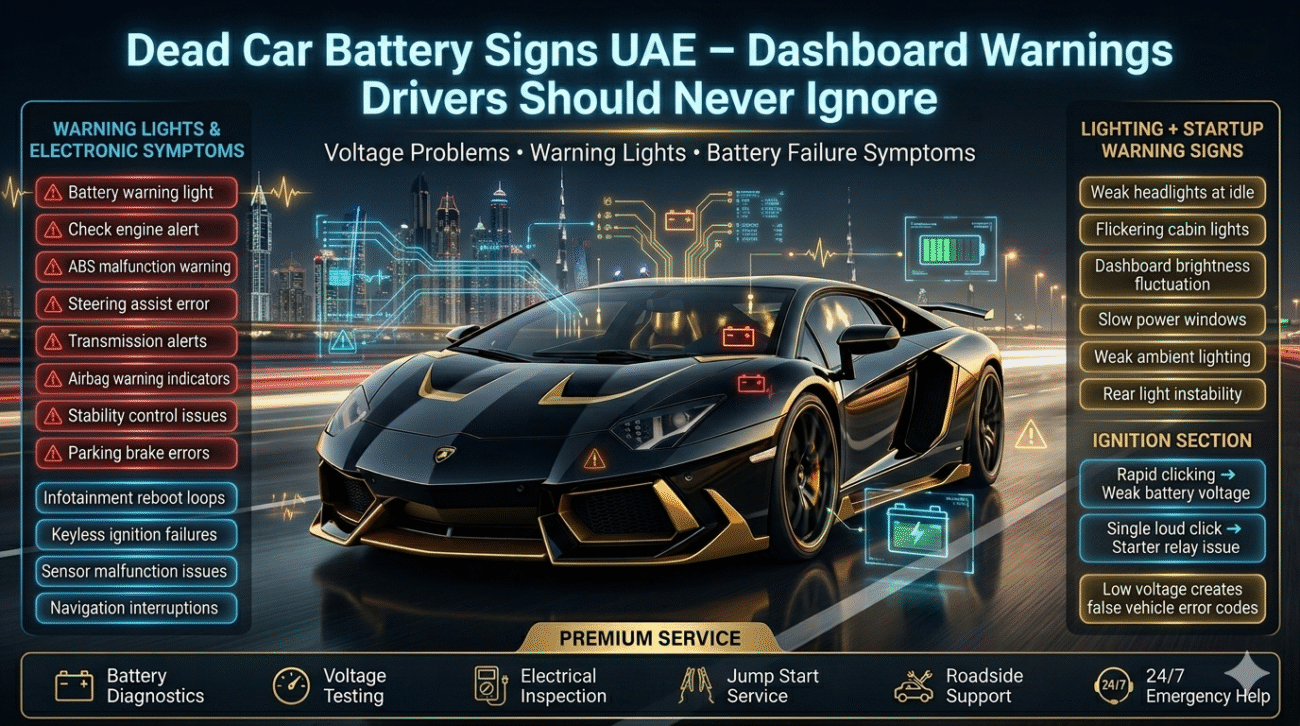
Modern vehicles constantly monitor electrical system health. When battery output weakens, dashboard indicators begin activating unpredictably.
Common warning lights linked to battery failure include:
- Battery warning symbol
- Check engine light
- ABS malfunction warning
- Steering assist warning
- Transmission warning
- Airbag system alerts
- Stability control warnings
- Electronic parking brake errors
Low voltage can confuse onboard computers and produce false error codes.
Luxury vehicles in the UAE are especially sensitive because modern control modules require stable voltage ranges.
Drivers often experience:
- Random warning lights
- Infotainment reboot loops
- Sensor malfunctions
- Adaptive cruise errors
- Keyless ignition failures
- Electronic seat memory reset
- Navigation system interruptions
Dim Headlights and Flickering Interior Lights
Lighting problems are one of the clearest battery failure indicators.
Signs include:
- Weak headlights at idle
- Flickering cabin lights
- Dashboard brightness fluctuations
- Delayed power window movement
- Weak ambient lighting
- Inconsistent LED brightness
- Rear light instability
These symptoms worsen during:
- Night driving
- Heavy AC usage
- Traffic congestion
- Rainy conditions
- Parking mode operation
In Dubai traffic jams, drivers often run AC systems continuously while the engine idles. Weak batteries struggle to maintain voltage stability under these conditions.
Electric luxury systems create even greater strain on aging batteries.
UAE roadside technicians frequently receive emergency calls for vehicles stuck at valet areas, underground parking facilities, hotels, shopping centers, and office towers due to lighting-related voltage failures.
Clicking Sound Without Engine Startup
A clicking sound during ignition is another major dead battery sign.
Common causes include:
- Insufficient starter current
- Corroded terminals
- Low battery voltage
- Damaged battery cells
- Loose cable connections
- Alternator undercharging
There are usually two types of clicking:
| Clicking Type | Likely Cause |
|---|---|
| Rapid clicking | Weak battery voltage |
| Single loud click | Starter relay activation failure |
In UAE roadside emergencies, rapid clicking is among the most common symptoms technicians encounter.
Heat expansion and corrosion around battery terminals worsen connection instability.
Vehicles parked outdoors near beaches, humid coastal districts, or dusty construction areas are particularly vulnerable.
Swollen Battery Case Means Immediate Danger
Battery swelling is extremely common in hot UAE weather.
Heat exposure causes:
- Internal gas buildup
- Electrolyte expansion
- Structural deformation
- Pressure imbalance
- Case warping
A swollen battery is dangerous because it can:
- Leak acid
- Damage nearby components
- Crack internally
- Fail without warning
- Cause electrical instability
Common symptoms of swollen batteries include:
- Rotten egg smell
- Distorted battery shape
- Hot battery surface
- Acid residue
- Corroded terminals
Vehicles parked under direct sunlight in areas like Jumeirah, Al Barsha, Silicon Oasis, and Dubai Investment Park frequently experience heat-swollen batteries.
Professional technicians strongly advise immediate replacement instead of temporary jumpstarting.
Ignoring swelling risks complete electrical failure during driving.
Frequent Need for Jumpstarting Indicates Battery Collapse
If a vehicle repeatedly needs jumpstarting, the battery is already near failure.
Common patterns include:
- Car starts only after boosting
- Battery dies overnight
- Morning startup failures
- Multiple jumpstarts weekly
- Voltage drops after short parking periods
Temporary boosting may restart the engine, but internal battery capacity is usually permanently degraded.
without realizing the battery itself requires replacement.
Repeated jumpstarting also stresses:
- Alternators
- Starter motors
- ECUs
- Voltage regulators
- Fuse systems
Professional diagnostics help determine whether the problem involves:
- Battery failure
- Charging system issues
- Parasitic drain
- Alternator malfunction
- Wiring defects
Corroded Battery Terminals Create Electrical Resistance
Corrosion around battery terminals disrupts electrical flow.
Common UAE corrosion causes include:
- Humidity
- Heat exposure
- Salt air near coastal roads
- Electrolyte leakage
- Dust accumulation
Symptoms include:
- White or green residue
- Startup hesitation
- Flickering electronics
- Inconsistent charging
- Battery overheating
Corroded terminals increase resistance, preventing efficient current delivery.
Luxury SUVs, commercial fleets, and airport transfer vehicles commonly experience terminal corrosion due to long operational hours and environmental exposure.
Battery Age Matters More in UAE Than Other Countries
In moderate climates, car batteries may last 4–5 years.
In UAE conditions, average battery lifespan often drops to:
| Vehicle Type | Average UAE Battery Lifespan |
|---|---|
| Economy sedan | 2–3 years |
| Luxury SUV | 2 years |
| High-performance sports car | 18–24 months |
| Commercial fleet van | 1.5–2 years |
| Taxi vehicles | 1–2 years |
| Hybrid vehicles | 3–5 years |
| EV auxiliary batteries | 2–4 years |
Drivers should proactively inspect batteries after two years of UAE usage.
Ignoring aging batteries increases roadside breakdown risks during:
- Airport commutes
- Desert trips
- Long highway drives
- Peak summer traffic
- Late-night driving
Smart Cars and EVs Show Different Battery Failure Symptoms
Electric vehicles and hybrid cars behave differently from conventional petrol vehicles.
Common EV battery warning signs include:
- Reduced driving range
- Charging inconsistency
- Slow system boot
- Auxiliary battery warnings
- Regenerative braking issues
- Power limitation alerts
Modern EVs still rely on 12V auxiliary batteries for:
- ECU activation
- Door systems
- Infotainment
- Lighting
- Safety electronics
Tesla, BMW EV, Mercedes EQ, Audi e-tron, and hybrid Lexus vehicles frequently experience auxiliary battery failures in UAE heat.
AI-powered diagnostics now help roadside technicians predict battery deterioration before total failure occurs.
Advanced battery monitoring systems track:
- Voltage history
- Temperature cycles
- Charging efficiency
- Internal resistance
- Cranking performance
This predictive technology is becoming increasingly common within UAE automotive service ecosystems.
Common Driver Mistakes That Kill Batteries Early
Many battery failures result from preventable habits.
Frequent mistakes include:
- Leaving lights on overnight
- Excessive idling
- Ignoring warning lights
- Using cheap replacement batteries
- Delaying terminal cleaning
- Installing incorrect battery size
- Running accessories with engine off
- Skipping voltage inspections
Tourists renting vehicles in Dubai often accidentally drain batteries by:
- Keeping AC active while parked
- Charging multiple devices
- Leaving infotainment systems running
- Using parking mode cameras continuously
Luxury vehicle owners commonly overload electrical systems with aftermarket accessories including:
- Dash cams
- Audio amplifiers
- Ambient lighting kits
- Portable refrigerators
- Wireless charging hubs
These increase standby battery consumption significantly.
Real UAE Case Study – Downtown Dubai Luxury Sedan Failure
A business executive parked his luxury German sedan overnight in Downtown Dubai basement parking during August.
Symptoms before failure included:
- Slow startup for two weeks
- Dashboard warning flickers
- Weak ambient lighting
- Random infotainment resets
The driver ignored these signs assuming software glitches were responsible.
The next morning:
- Vehicle completely failed to start
- Electronic gear selector locked
- Parking brake malfunctioned
- Smart key detection failed
Emergency technicians diagnosed:
- Severe heat-related battery degradation
- Terminal corrosion
- Voltage instability damaging electronic modules
A rapid 24/7 jump start service dubai response restored temporary power while full battery replacement was completed onsite.
Comparison Table – Weak Battery vs Alternator Failure
| Symptom | Weak Battery | Alternator Failure |
|---|---|---|
| Slow startup | Yes | Sometimes |
| Battery warning light | Sometimes | Common |
| Vehicle dies while driving | Rare | Common |
| Repeated jumpstarts needed | Yes | Yes |
| Dim lights at idle | Common | Common |
| Clicking noise | Common | Rare |
| Burning smell | Rare | Possible |
| Electrical glitches | Common | Common |
| Vehicle starts after boosting | Usually | Temporarily |
| Battery loses charge overnight | Common | Rare |
Correct diagnosis is essential before replacing expensive electrical components unnecessarily.
How Professional UAE Roadside Teams Diagnose Battery Problems
Professional roadside technicians use advanced diagnostic tools instead of guessing.
Standard inspections include:
- Voltage load testing
- Alternator output checks
- Cranking performance analysis
- Battery health scanning
- Terminal resistance testing
- Charging system diagnostics
- ECU voltage monitoring
Modern mobile service fleets operating across Dubai, Abu Dhabi, and Sharjah now use AI-assisted battery analyzers capable of predicting imminent battery failure.
UAE Traffic Conditions Increase Battery Stress Daily
Dubai traffic conditions create unique battery strain.
Common stress scenarios include:
- Continuous AC usage
- Heavy stop-start driving
- Long idle periods
- Smart system activation
- GPS navigation loads
- Phone charging
- Entertainment system usage
Vehicles operating in:
- Sheikh Zayed Road traffic
- Marina congestion
- Downtown valet zones
- Airport queues
- Delivery fleet operations
experience significantly higher battery wear rates.
Commercial ride-sharing drivers and limousine fleets often replace batteries more frequently than private drivers.
Premium vs Cheap Batteries in UAE Conditions
Battery quality matters significantly in extreme climates.
| Battery Type | UAE Suitability | Average Lifespan |
|---|---|---|
| Budget flooded battery | Low | 1–2 years |
| AGM battery | Excellent | 3–4 years |
| EFB battery | Good | 2–3 years |
| Gel battery | Moderate | 2–3 years |
| OEM luxury battery | Excellent | 3–4 years |
Cheap imported batteries often fail rapidly under UAE summer temperatures.
Professional automotive workshops recommend heat-resistant AGM batteries for luxury vehicles and commercial fleets.
Emergency Roadside Risks of Ignoring Battery Warnings
Ignoring battery symptoms can create dangerous situations including:
- Highway breakdowns
- Desert isolation
- Parking lockouts
- ECU shutdowns
- AC system failures
- Nighttime lighting loss
- Smart key malfunction
UAE roadside emergency cases commonly occur during:
- Summer evenings
- Airport pickups
- Long-distance travel
- Weekend desert trips
- Tourist commutes
High-end vehicles are particularly vulnerable because advanced electronic systems require stable voltage at all times.
Modern AI Battery Monitoring Is Changing UAE Automotive Services
Artificial intelligence is transforming battery diagnostics in UAE automotive operations.
New systems analyze:
- Voltage fluctuations
- Heat exposure history
- Driver behavior
- Charging cycles
- Traffic conditions
- Climate impact patterns
Fleet companies increasingly use predictive maintenance software to avoid roadside breakdowns.
AI-powered systems can now forecast battery replacement timelines with impressive accuracy.
Benefits include:
- Reduced downtime
- Faster emergency response
- Preventive servicing
- Lower repair costs
- Improved fleet efficiency
Luxury fleet operators across Dubai increasingly integrate cloud-based battery monitoring systems into daily operations.
Signs Drivers Commonly Ignore Before Total Failure
Most roadside breakdowns happen after ignored warnings.
The most overlooked symptoms include:
- Slightly slower ignition
- Occasional dim dashboard lights
- Intermittent infotainment resets
- Weak power window speed
- Minor clicking sounds
- Morning startup hesitation
Drivers often delay inspections because the car still starts temporarily.
Unfortunately, battery deterioration accelerates rapidly once internal damage begins.
Best Preventive Practices for UAE Drivers
Drivers can extend battery life significantly by following preventive strategies.
Recommended practices include:
- Monthly voltage testing
- Terminal cleaning
- Parking in shaded areas
- Avoiding unnecessary idling
- Using OEM-approved batteries
- Regular alternator inspections
- Limiting accessory usage while parked
- Checking charging system health annually
For luxury vehicles, experts recommend proactive battery replacement every 2–3 years regardless of apparent condition.
Commercial fleet operators increasingly schedule preventive onsite inspections before peak summer months begin.
Roadside Support Ecosystem in UAE Automotive Industry
The UAE automotive support sector has evolved rapidly.
Modern service ecosystems now include:
- GPS-dispatched roadside units
- AI-assisted diagnostics
- Mobile battery replacement vans
- Smart dispatch systems
- Real-time ETA tracking
- Digital payment integration
- EV-compatible support teams
Companies specializing in:
have expanded significantly due to rising demand from residents, tourists, ride-share drivers, luxury car owners, and delivery fleets.
Real UAE Fleet Case Study – Delivery Van Battery Failures
A UAE logistics company operating delivery vans across Dubai and Sharjah experienced repeated roadside failures during summer.
Initial symptoms included:
- Delayed startup
- AC power fluctuations
- GPS resets
- Driver complaints about electrical instability
Fleet management ignored early warnings to avoid operational downtime.
Within three weeks:
- Six vans suffered complete battery failure
- Delivery schedules collapsed
- Multiple roadside recoveries became necessary
Diagnostic findings revealed:
- Severe heat degradation
- Excessive idle-time battery strain
- Alternator overload
- Low-quality aftermarket batteries
The company implemented predictive battery replacement scheduling and significantly reduced future roadside emergencies.
Battery Failure Can Affect Vehicle Safety Systems
Modern cars depend heavily on electrical stability.
Weak batteries may affect:
- ABS braking
- Electronic steering
- Collision warning systems
- Lane assist
- Adaptive headlights
- Radar sensors
- Parking cameras
- Airbag readiness
Luxury and AI-assisted vehicles are particularly sensitive.
Drivers should never ignore electrical warning signs before long UAE highway trips.
Tourist and Rental Car Battery Problems in Dubai
Tourism creates additional battery-related issues across UAE rental markets.
Rental vehicle batteries often deteriorate faster due to:
- Frequent short trips
- Continuous AC operation
- Heavy infotainment usage
- Irregular maintenance
- High restart frequency
Tourists unfamiliar with UAE climate conditions frequently leave electronics running while parked.
Common roadside tourist requests involve:
- Dead batteries at hotels
- Airport parking failures
- Desert excursion breakdowns
- Marina parking startup issues
Emergency providers offering auto jump start service coverage frequently support tourists unfamiliar with local automotive conditions.
High-End Car Culture Increases Battery Demand
The UAE luxury vehicle market places extraordinary stress on batteries.
Premium vehicles include:
- Active suspension systems
- Adaptive lighting
- Multiple digital displays
- Electronic seat controls
- AI driving systems
- Cabin climate preconditioning
- Remote start systems
Luxury SUVs parked in valet zones or residential towers consume standby power continuously.
High-end battery systems require specialized diagnostics and proper replacement specifications.
Incorrect battery installation can damage:
- Control modules
- ECU programming
- Smart charging systems
- Start-stop functionality
Professional technicians trained on luxury vehicle electrical systems are increasingly important across UAE automotive service networks.
Early Diagnostics Save Thousands in Repair Costs
Battery-related voltage instability can eventually damage:
- Alternators
- Starter motors
- Electronic modules
- Fuse systems
- Wiring harnesses
- Sensor networks
Early intervention dramatically reduces long-term repair costs.
Drivers noticing warning signs should arrange immediate inspections rather than waiting for roadside failure.
Professional providers offering roadside battery assistance dubai services now combine emergency response with preventive diagnostics to reduce recurring breakdowns.
Advanced Dead Car Battery Warning Indicators UAE Drivers Frequently Misdiagnose
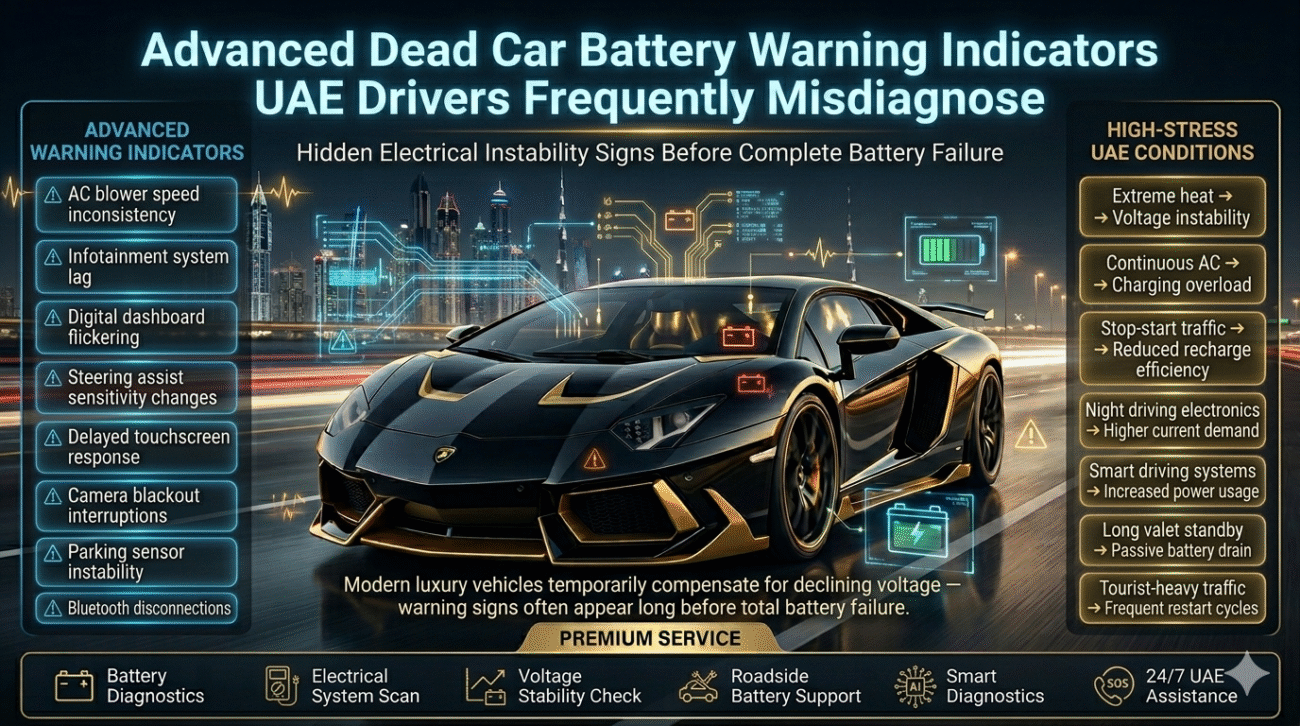
Modern vehicles rarely experience sudden battery collapse without showing progressive electrical instability first. In premium automotive environments across Dubai, Abu Dhabi, Sharjah, and rapidly expanding residential districts throughout the UAE, battery deterioration has become increasingly sophisticated due to the evolution of intelligent vehicle electronics, AI-assisted driving systems, luxury infotainment architecture, and advanced onboard power management networks.
Many motorists incorrectly assume a dead battery only means a vehicle completely refusing to start. In reality, modern battery degradation creates a chain reaction of electronic inconsistencies long before total ignition failure occurs. These warning patterns often appear subtle at first, especially in high-end vehicles equipped with adaptive electronics that temporarily compensate for declining voltage stability.
Understanding these advanced indicators allows drivers, fleet operators, luxury car owners, tourism transport companies, and commercial vehicle managers to intervene before expensive roadside breakdowns or secondary electrical failures develop.
Electronic Power Fluctuations During UAE Summer Traffic Conditions
Heavy UAE traffic environments place extraordinary demand on vehicle charging systems. Long idle periods combined with aggressive climate-control usage create constant electrical stress, particularly during peak summer months.
Drivers commuting through:
- Sheikh Zayed Road congestion
- Dubai Marina traffic corridors
- Downtown Dubai valet zones
- Abu Dhabi business districts
- Sharjah industrial traffic routes
- Airport transfer lanes
- Tourist entertainment districts
often experience accelerated battery degradation without realizing the underlying cause.
Advanced warning indicators include:
- AC blower speed inconsistency
- Infotainment lag
- Digital dashboard flickering
- Steering assist sensitivity changes
- Delayed touchscreen response
- Temporary camera blackout
- Parking sensor interruptions
- Random Bluetooth disconnections
These symptoms usually intensify during:
| High-Stress Operating Conditions | Electrical Impact |
|---|---|
| Extreme ambient heat | Battery voltage instability |
| Continuous AC operation | Charging system overload |
| Stop-start traffic | Reduced recharge efficiency |
| Night driving with full electronics | Increased current draw |
| Smart driving assistance usage | Processor power consumption |
| Valet standby operation | Passive battery drain |
| Tourist-heavy urban routes | Frequent restart cycles |
Modern luxury vehicles attempt to redistribute power intelligently, but once reserve battery capacity declines below safe thresholds, onboard modules begin malfunctioning unpredictably.
Intelligent Vehicle Systems Now Hide Battery Weakness Temporarily
Premium automotive manufacturers increasingly integrate adaptive energy management systems capable of masking early battery deterioration.
Vehicles equipped with:
- Dynamic power allocation
- Smart alternator regulation
- AI-driven energy balancing
- Adaptive idle compensation
- Predictive voltage management
may continue operating normally despite declining battery health.
However, hidden battery deterioration eventually produces advanced symptoms including:
- Delayed smart key recognition
- Intermittent auto start-stop failure
- Random seat memory resets
- Sunroof calibration errors
- Adaptive lighting interruptions
- Steering wheel control lag
- Digital instrument cluster rebooting
- Wireless charging instability
This is especially common in:
- German executive sedans
- Luxury British SUVs
- Performance sports coupes
- Premium hybrid crossovers
- High-output turbocharged vehicles
Many UAE drivers mistakenly interpret these behaviors as software glitches rather than underlying battery instability.
Luxury Vehicle Battery Stress in UAE High-End Residential Communities
Premium residential districts create unique operating patterns that accelerate battery deterioration.
Vehicles parked for extended periods in:
- Palm Jumeirah
- Emirates Hills
- Dubai Hills Estate
- Bluewaters Island
- Jumeirah Golf Estates
- Yas Island
- Saadiyat Island
often experience substantial passive electrical drain.
Modern luxury vehicles continuously power:
- Security modules
- Remote access systems
- GPS tracking
- AI-assisted standby monitoring
- Cabin climate preconditioning
- Digital communication gateways
- Motion detection systems
Even while parked, these systems consume measurable battery reserves.
Extended low-usage patterns common among luxury vehicle owners frequently lead to:
- Sulfation buildup
- Voltage imbalance
- Reduced reserve capacity
- Electronic wake-up failures
- Smart charging irregularities
High-net-worth vehicle owners often discover battery failure only after returning from overseas travel or prolonged vehicle storage.
Why Short-Distance UAE Driving Quietly Damages Batteries
Contrary to common assumptions, short urban driving cycles are among the most damaging operating conditions for modern batteries.
Frequent short trips prevent:
- Complete recharge cycles
- Proper voltage stabilization
- Thermal balancing
- Efficient alternator recovery
This pattern is extremely common among:
- School-run drivers
- Luxury SUV owners
- Urban commuters
- Hotel transfer vehicles
- Food delivery operators
- Ride-sharing fleets
Vehicles operating primarily within short-distance city environments accumulate gradual charging deficits daily.
Symptoms usually develop progressively:
- Slight ignition hesitation
- Mild infotainment instability
- Reduced startup responsiveness
- Morning voltage weakness
- Increased electrical sensitivity
- Repeated low-voltage events
- Sudden roadside failure
Professional diagnostics frequently reveal that batteries appearing functional externally are already operating below safe reserve thresholds internally.
Heat-Soaked Batteries Behave Differently at Night
One of the most misunderstood battery behaviors in the UAE involves thermal voltage recovery.
During daytime heat exposure:
- Internal resistance rises
- Electrolyte expansion increases
- Voltage delivery weakens
- Cranking efficiency declines
After sunset, temperatures temporarily drop, causing the battery to appear functional again.
This creates misleading patterns where:
- Vehicle struggles during afternoon parking
- Startup improves slightly at night
- Morning ignition becomes inconsistent
- Failures appear random
Drivers often delay replacement because the battery occasionally recovers temporary performance after cooling.
However, this thermal cycling usually indicates severe internal degradation already in progress.
Performance Vehicles Experience Accelerated Battery Wear
Sports cars and high-performance engines place substantially greater demand on battery systems.
Vehicles equipped with:
- Twin-turbocharged engines
- Active exhaust systems
- Adaptive suspension
- Carbon ceramic braking electronics
- Performance ECU mapping
- Track telemetry systems
- Dynamic launch controls
require exceptionally stable voltage delivery.
Battery weakness in performance vehicles may trigger:
- Reduced engine response
- Gearbox adaptation errors
- Suspension calibration faults
- Driving mode limitations
- Exhaust valve inconsistencies
- Turbo management irregularities
In UAE conditions, performance vehicles also experience additional thermal stress due to:
- Aggressive acceleration
- High engine bay temperatures
- Summer traffic exposure
- Elevated cooling system demand
Battery instability can therefore affect both performance and drivability simultaneously.
Commercial Fleet Operations Face Different Battery Failure Patterns
Commercial vehicles experience unique battery deterioration due to operational intensity.
Industries most affected include:
| Industry Sector | Common Battery Stress Factor |
|---|---|
| Logistics fleets | Constant engine cycling |
| Ride-sharing vehicles | Continuous idle operation |
| Delivery vans | Repeated stop-start driving |
| Luxury chauffeur fleets | Extended standby cooling |
| Tourism transport | Heavy accessory usage |
| Airport transfer vehicles | Long operational hours |
| Construction fleets | Dust and vibration exposure |
Fleet managers increasingly rely on predictive maintenance scheduling to avoid operational disruption.
Advanced fleet battery monitoring now tracks:
- Daily voltage trends
- Heat exposure accumulation
- Engine restart frequency
- Charging consistency
- Driver operating patterns
- Idle duration analytics
This proactive strategy dramatically reduces emergency roadside failures.
Voltage Instability Can Mimic Transmission Problems
One of the most expensive diagnostic mistakes occurs when battery instability imitates transmission faults.
Low voltage frequently causes:
- Delayed gear engagement
- Harsh shifting behavior
- Transmission warning alerts
- Drive mode malfunction
- Gear selector freezing
- Adaptive transmission reset
Modern transmissions rely heavily on electronically controlled hydraulic systems requiring stable voltage supply.
Luxury SUVs and executive sedans are particularly vulnerable because transmission management modules operate within narrow voltage tolerances.
Many drivers initially authorize expensive gearbox inspections before discovering the true issue originates from unstable battery output.
Premium AGM Batteries vs Conventional Flooded Batteries
Battery technology selection significantly impacts reliability in UAE operating conditions.
Conventional Flooded Batteries
Advantages:
- Lower purchase cost
- Widely available
- Simpler installation
Disadvantages:
- Shorter UAE lifespan
- Higher evaporation risk
- Lower heat resistance
- Reduced vibration durability
- Increased maintenance sensitivity
AGM Batteries
Advantages:
- Superior heat tolerance
- Enhanced voltage stability
- Faster recharge capability
- Better luxury vehicle compatibility
- Improved deep-cycle performance
- Reduced leakage risk
Disadvantages:
- Higher initial investment
- Requires proper charging calibration
Premium automotive workshops increasingly recommend AGM technology for:
- Luxury vehicles
- High-electronic-load vehicles
- Fleet operations
- Smart charging systems
- AI-assisted vehicles
- Start-stop equipped cars
Underground Parking Structures Accelerate Hidden Battery Damage
Underground parking environments create unexpected electrical stress factors.
Common issues include:
- Elevated humidity exposure
- Reduced ventilation
- Passive standby operation
- Condensation buildup
- Limited airflow around engine bays
Vehicles stored long-term inside underground structures frequently develop:
- Terminal oxidation
- Ground connection instability
- Moisture-related resistance
- Voltage leakage pathways
This problem intensifies in coastal UAE regions where humidity combines with elevated ambient temperatures.
High-rise residential towers with automated parking systems present additional standby power demands because vehicles continuously communicate with access-control infrastructure.
AI-Powered Automotive Diagnostics Are Transforming Battery Detection
The UAE automotive sector is rapidly adopting AI-integrated diagnostic platforms capable of identifying failure patterns before breakdown occurs.
Advanced diagnostic algorithms now evaluate:
- Internal resistance fluctuation
- Charge retention efficiency
- Heat degradation history
- Voltage collapse patterns
- Charging cycle irregularities
- Predictive lifespan estimation
Modern service ecosystems increasingly combine:
- Cloud diagnostics
- Mobile roadside analytics
- Real-time battery health reporting
- Predictive maintenance scheduling
- AI-assisted fleet monitoring
This technology is especially valuable for:
- Luxury fleet operators
- Airport transportation companies
- Tourism logistics
- Executive chauffeur services
- Commercial delivery operations
Preventive diagnostics now reduce unplanned roadside incidents significantly across UAE transport sectors.
False Battery Recovery Creates Dangerous Driver Assumptions
A weak battery may occasionally appear to recover temporarily after:
- Highway driving
- External charging
- Cooling periods
- Jumpstarting
- Alternator-assisted recharge
This temporary improvement often convinces drivers the issue has resolved.
In reality:
- Internal plate damage remains
- Sulfation continues progressing
- Reserve capacity stays compromised
- Voltage stability remains unreliable
The battery may fail again unpredictably during:
- Heavy traffic
- Airport pickups
- Late-night travel
- Desert routes
- High-temperature parking
This inconsistent behavior explains why many roadside emergencies appear “sudden” despite weeks of prior warning symptoms.
High-End SUV Electrical Architectures Are More Sensitive Than Ever
Modern luxury SUVs now contain dozens of interconnected control modules.
These systems manage:
- Air suspension
- Terrain response
- Adaptive cruise
- AI safety systems
- Digital cockpit environments
- Matrix lighting
- Radar integration
- Smart cooling systems
Even slight voltage instability may trigger widespread system irregularities.
Battery deterioration therefore no longer affects only engine startup; it impacts the entire digital operating ecosystem of the vehicle.
This complexity explains why professional diagnostics have become essential instead of relying on basic voltage testing alone.
Warning Signs Most Drivers Misinterpret as Minor Glitches
Experienced automotive specialists report that the following symptoms are commonly ignored before major battery failure:
- Clock resetting after startup
- Touchscreen freezing briefly
- Smart trunk delay
- Weak keyless entry range
- Mirror adjustment lag
- Temporary camera blackout
- Navigation rebooting
- Parking brake hesitation
- Audio system popping noise
- Dashboard startup delay
Individually these symptoms appear insignificant. Together, they often indicate progressive voltage instability already affecting sensitive electronic systems.
Future UAE Automotive Trends Increasing Battery Demands
Battery stress will continue rising due to evolving automotive technologies including:
- AI-assisted driving systems
- Autonomous parking functions
- Over-the-air software updates
- Vehicle-to-cloud connectivity
- Smart city integration
- Digital cockpit expansion
- Advanced driver monitoring systems
- Real-time navigation intelligence
Future vehicles will depend even more heavily on electrical stability than current models.
As UAE cities continue investing in intelligent transport ecosystems, battery performance will become increasingly critical to daily vehicle reliability, safety, and electronic system integrity.
Hidden Dead Car Battery Symptoms That Common UAE Drivers Notice Too Late
Dead battery incidents across the UAE rarely begin with complete engine failure. In most real-world cases, the vehicle spends days or even weeks displaying subtle electrical abnormalities before finally shutting down unexpectedly. Unfortunately, many drivers overlook these symptoms because modern vehicles are designed to temporarily compensate for declining battery performance through intelligent voltage management systems.
In ultra-modern automotive environments like Dubai, Abu Dhabi, Sharjah, and rapidly expanding luxury communities throughout the UAE, battery systems now support far more than simple engine ignition. Today’s vehicles operate as fully integrated electronic ecosystems where battery instability can silently affect dozens of interconnected modules simultaneously.
This shift is especially important in the UAE, where extreme temperatures, heavy traffic density, long idle periods, luxury SUV ownership, premium tourism transportation, and AI-integrated driving systems create uniquely aggressive operating conditions for automotive batteries.
Why Modern Vehicles Hide Battery Failure Better Than Older Cars
Older vehicles usually displayed obvious symptoms when batteries weakened:
- Slow cranking
- Weak headlights
- Complete startup failure
Modern vehicles behave differently.
Advanced energy-management systems now redistribute available power intelligently to maintain critical operations for as long as possible. This creates a dangerous illusion of reliability while internal battery degradation accelerates silently.
Modern control modules prioritize:
- Ignition systems
- ECU stability
- Safety electronics
- Steering assistance
- Brake control systems
Meanwhile, non-critical systems begin showing early instability first.
Drivers often notice:
- Random infotainment lag
- Delayed touch response
- Temporary parking sensor interruption
- Climate-control inconsistency
- Ambient lighting flicker
- Wireless charger instability
- Voice command malfunction
- Navigation latency
Because these systems continue functioning intermittently, most drivers delay inspection until complete electrical collapse occurs.
Intelligent Alternator Compensation Masks Battery Weakness
One of the most misunderstood aspects of modern battery deterioration involves adaptive alternator compensation.
New-generation alternators dynamically increase charging activity when battery reserve capacity drops. Initially, this allows the vehicle to continue operating normally despite internal battery damage.
However, prolonged alternator overcompensation eventually creates secondary problems including:
| Charging System Consequence | Long-Term Impact |
|---|---|
| Continuous high-load charging | Alternator overheating |
| Excessive voltage correction | ECU stress |
| Irregular charge cycling | Reduced battery lifespan |
| Thermal charging imbalance | Internal plate degradation |
| Voltage spikes | Sensor instability |
| Smart charging overload | Module communication faults |
Luxury German vehicles operating in UAE summer conditions are especially vulnerable because their intelligent charging systems continuously optimize power delivery based on climate conditions, traffic behavior, and accessory demand.
Why UAE Heat Creates Internal Battery Damage Faster Than Expected
Extreme heat remains the primary reason automotive batteries fail prematurely across the Gulf region.
Many drivers incorrectly assume battery problems occur only during winter climates. In reality, UAE summer temperatures create far more aggressive chemical degradation.
Heat exposure accelerates:
- Electrolyte evaporation
- Lead plate corrosion
- Internal separator breakdown
- Sulfation accumulation
- Thermal expansion stress
- Water loss inside cells
- Internal resistance instability
Engine compartments inside performance SUVs and luxury sedans frequently exceed safe battery operating temperatures during prolonged idle traffic conditions.
Vehicles parked outdoors in:
- Downtown commercial zones
- Airport parking facilities
- Beachfront valet areas
- Tourist attraction districts
- Open residential compounds
often experience continuous heat soaking for several consecutive hours daily.
This prolonged exposure silently destroys battery chemistry even when outward appearance remains normal.
Why Luxury SUVs Drain Batteries Faster in UAE Conditions
Premium SUVs now contain some of the most power-intensive electrical architectures in the automotive industry.
High-end systems continuously consuming standby power include:
- Adaptive air suspension
- 360-degree camera systems
- Intelligent parking assist
- Motion-detection security
- AI driving analysis
- Digital cockpit displays
- Active cooling modules
- Automatic tailgate systems
- Remote mobile app communication
- Smart climate pre-conditioning
Even while parked overnight, these systems continue drawing reserve battery capacity.
Luxury SUVs commonly operating in:
- Palm Jumeirah
- Dubai Hills
- Emirates Hills
- Business Bay
- Yas Marina
- Saadiyat Island
often remain parked for extended periods while maintaining active digital communication systems.
This combination of heat exposure and continuous passive electrical consumption dramatically accelerates battery wear.
Hidden Morning Startup Symptoms Drivers Ignore
Battery deterioration often becomes most noticeable during early morning ignition cycles.
Subtle symptoms include:
- Slight ignition hesitation
- Brief dashboard blackout
- Slow digital gauge activation
- Delayed infotainment startup
- Temporary camera unavailability
- Soft starter engagement sound
- Weak electronic parking brake release
Many drivers dismiss these signs because the engine eventually starts successfully.
However, experienced UAE automotive specialists recognize morning startup instability as one of the strongest indicators of declining reserve battery capacity.
This happens because overnight parking allows battery voltage to stabilize temporarily before heavy electrical demand returns during ignition.
Why Airport Parking Frequently Triggers Dead Batteries
Airport parking is one of the most common real-world scenarios leading to unexpected battery failure in the UAE.
Vehicles parked at:
- Dubai International Airport
- Al Maktoum International Airport
- Abu Dhabi International Airport
often remain stationary for extended durations while continuing to power:
- Security systems
- GPS modules
- Keyless access networks
- Remote communication systems
- Alarm sensors
- Smart parking communication
Luxury vehicles experience especially high passive drain rates during travel periods.
Upon return, drivers commonly encounter:
- Total ignition failure
- Smart key detection problems
- Gear selector lockout
- Dashboard communication errors
- Parking brake release failure
These incidents become significantly more frequent during summer months when elevated parking temperatures intensify internal battery degradation simultaneously.
Electrical Ghost Faults Often Originate From Weak Batteries
Modern vehicles frequently produce “ghost faults” when battery voltage becomes unstable.
These include:
- Random warning lights
- Temporary drivetrain alerts
- Sensor communication faults
- Transmission adaptation errors
- Radar malfunction messages
- Lane assist interruption
- Adaptive cruise deactivation
- Suspension calibration warnings
Many workshops initially investigate expensive modules before discovering the root cause involves inconsistent voltage delivery.
Low-voltage conditions disrupt communication between sensitive electronic control units, especially in AI-assisted driving systems.
Premium automotive platforms operating with over 50 interconnected modules become extremely vulnerable once voltage stability declines.
Why Stop-Start Technology Accelerates Battery Wear
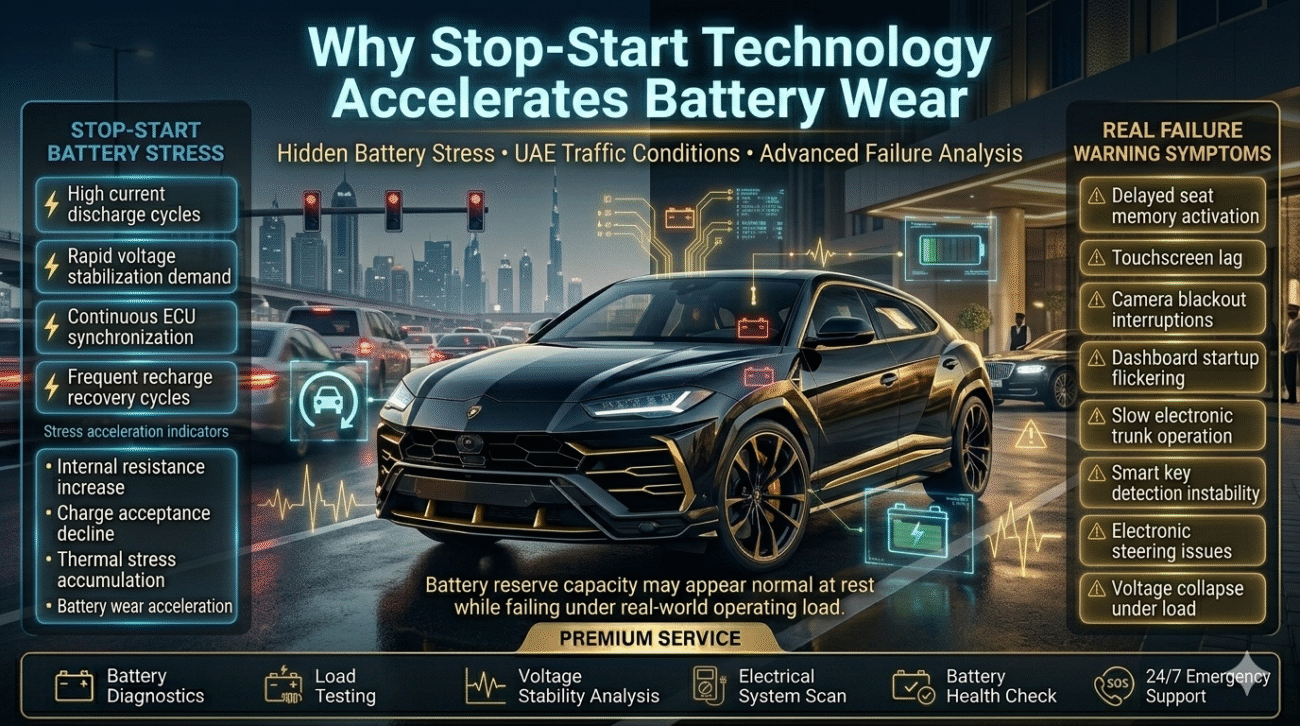
Vehicles equipped with automatic stop-start systems experience substantially higher battery stress than traditional vehicles.
Each traffic-light restart cycle requires:
- High current discharge
- Rapid voltage stabilization
- Immediate recharge recovery
- Continuous ECU synchronization
In UAE urban traffic conditions, vehicles may perform hundreds of restart cycles weekly.
This operating pattern significantly accelerates:
- Plate fatigue
- Internal resistance growth
- Charge acceptance reduction
- Thermal stress accumulation
Drivers frequently disable stop-start systems manually because repeated restart vibration becomes uncomfortable in traffic. However, even disabled systems continue affecting overall charging behavior.
Real UAE Case Study — Premium SUV Failure During Valet Parking
A luxury SUV owner visiting a five-star hotel in Downtown Dubai experienced complete electrical shutdown during valet retrieval.
Prior warning symptoms over previous weeks included:
- Delayed seat memory activation
- Random touchscreen lag
- Intermittent parking camera blackout
- Slow trunk opening
- Dashboard flickering during startup
The owner assumed software updates were responsible.
During valet retrieval:
- Vehicle failed to unlock electronically
- Smart key detection stopped functioning
- Air suspension entered fault mode
- Gear selector remained locked
- Electronic steering assistance disabled
Emergency diagnostics later confirmed:
- Severe AGM battery degradation
- Voltage collapse under load
- Heat-related internal plate damage
- Alternator overcompensation stress
The battery showed acceptable resting voltage but failed instantly during dynamic load testing.
Why Cheap Replacement Batteries Fail Rapidly in Luxury Cars
Battery compatibility has become critically important in modern vehicles.
Low-cost aftermarket batteries often lack:
- Proper reserve capacity
- Heat resistance certification
- Smart charging compatibility
- Deep-cycle durability
- Correct voltage stabilization characteristics
Improper battery installation can create:
| Incorrect Battery Issue | Resulting Problem |
|---|---|
| Weak reserve capacity | Frequent low-voltage events |
| Incorrect charging profile | Alternator strain |
| Poor heat tolerance | Premature swelling |
| Low vibration durability | Internal separator damage |
| Incompatible smart charging response | ECU charging faults |
Luxury vehicles now require battery registration procedures after replacement to synchronize charging systems correctly.
Failure to perform calibration may shorten battery lifespan dramatically.
Why Night Driving Exposes Battery Weakness Faster
Nighttime operation increases electrical demand substantially.
Simultaneous power consumption often includes:
- LED matrix headlights
- Adaptive beam control
- Cabin ambient lighting
- Climate-control systems
- Navigation processors
- Entertainment systems
- Charging ports
- Radar safety sensors
Weak batteries struggle maintaining stable voltage during these high-demand conditions.
Drivers commonly notice:
- Headlight intensity fluctuation
- Touchscreen dimming
- Audio system distortion
- Sluggish power windows
- Delayed steering response
These symptoms typically worsen during traffic congestion when alternator output decreases at low engine speeds.
Hybrid Vehicles Have Unique Battery Failure Patterns
Hybrid vehicles introduce additional electrical complexity.
Many UAE hybrid owners incorrectly assume the high-voltage hybrid battery powers everything continuously. In reality, hybrids still depend heavily on conventional auxiliary batteries for:
- System startup
- ECU activation
- Lighting systems
- Safety electronics
- Communication modules
Auxiliary battery deterioration in hybrids commonly causes:
- Hybrid system warning lights
- Startup refusal
- Charging communication faults
- Electronic brake system alerts
- Power management instability
Hybrid battery behavior can appear unpredictable because the vehicle alternates between electric and combustion operating modes.
Vehicle Storage Habits Quietly Destroy Batteries
Seasonal travel patterns common among UAE residents create significant battery risks.
Vehicles left unused during:
- Summer overseas vacations
- Long business travel
- Seasonal relocation periods
- Fleet downtime cycles
experience gradual parasitic discharge combined with heat exposure.
Without periodic charging maintenance:
- Sulfation hardens internally
- Voltage drops below recovery thresholds
- Internal plate crystallization increases
- Smart charging recovery weakens
After extended storage, many batteries become permanently damaged even if temporary recharging restores superficial voltage readings.
Why Battery Diagnostics Require More Than Voltage Testing
Traditional voltage testing alone no longer provides reliable battery evaluation.
Modern diagnostics now assess:
- Dynamic load stability
- Internal resistance fluctuation
- Cranking amperage performance
- Heat-cycle deterioration
- Charge retention efficiency
- Recovery response under stress
A battery may show acceptable resting voltage while still failing instantly under ignition load conditions.
Professional diagnostic platforms therefore simulate real operating demands rather than relying solely on static voltage measurements.
AI-Integrated Vehicles Will Increase Future Battery Sensitivity
Future automotive platforms entering the UAE market will rely even more heavily on stable electrical infrastructure.
Emerging technologies include:
- Autonomous driving support
- Vehicle-to-cloud communication
- Predictive navigation intelligence
- Driver monitoring systems
- Biometric access control
- AI-assisted traffic adaptation
- Over-the-air performance optimization
These systems require uninterrupted voltage consistency to function correctly.
As vehicles become increasingly software-dependent, battery health will evolve from a simple maintenance issue into a critical operational requirement directly affecting safety, performance, connectivity, and intelligent driving functionality.
Most Frequently Asked Questions
-
1.How Do You Know If Your Car Has a Dead Battery?
A dead car battery usually gives multiple warning signs before the vehicle completely stops starting. In modern vehicles, especially luxury cars and electronically advanced models commonly driven in the UAE, battery failure often appears gradually through electrical instability rather than sudden shutdown.
The most common indicator is when the engine does not crank properly after pressing the ignition button or turning the key. Instead of a strong engine turnover, the vehicle may produce:
Rapid clicking sounds
Weak starter noise
Delayed ignition response
Complete silence during startup
Flickering dashboard lights
Another strong sign is dim or unstable electrical performance. Drivers may notice:
Weak headlights
Slow power windows
Touchscreen lag
Air conditioning fluctuations
Dashboard warning lights appearing randomly
Infotainment systems restarting unexpectedly
Modern vehicles also become highly sensitive to low voltage conditions. In many luxury cars, a weak battery can trigger:
Parking sensor faults
Smart key detection errors
Transmission warnings
Steering assistance alerts
Electronic brake notifications
A completely dead battery usually results in:
No ignition response
No dashboard illumination
Failure of central locking systems
Non-functional interior electronics
In UAE weather conditions, especially during extreme summer heat, batteries often deteriorate faster because excessive temperature accelerates internal chemical damage and fluid evaporation.
Professional battery diagnostics should always include:
Voltage testing
Load testing
Alternator performance inspection
Terminal corrosion evaluation
Charging system analysis
Many drivers mistakenly assume the starter motor or alternator is defective when the actual issue is simply a battery that can no longer maintain stable reserve power. -
2.How Long Does an Audi A6 Battery Last?
The battery lifespan of an Audi A6 depends heavily on driving habits, climate conditions, battery quality, and electronic load demands. Under normal international driving conditions, an Audi A6 battery may last between 4 to 5 years. However, in the UAE, the average lifespan is usually shorter due to extreme temperatures and intensive electronic system usage.
The Audi A6 uses advanced electrical architecture that continuously powers:
MMI infotainment systems
Adaptive lighting
Electronic seat modules
Climate control memory
Smart key communication
Driver assistance systems
Parking sensors
AI-assisted safety technologies
Because these systems consume standby power even when parked, the battery experiences constant low-level discharge.
Several factors shorten Audi A6 battery life significantly:
Extreme Heat
UAE summer temperatures accelerate electrolyte evaporation and internal plate corrosion.
Short-Distance Driving
Frequent short trips prevent the battery from fully recharging.
Stop-Start Technology
Repeated engine restarts increase charging cycle stress.
Long Parking Periods
Vehicles parked for days or weeks may develop parasitic discharge issues.
Cheap Aftermarket Batteries
Low-quality replacements often fail quickly in luxury German vehicles.
Common signs an Audi A6 battery is nearing failure include:
Slow push-button ignition
MMI system rebooting
Random warning messages
Auto start-stop malfunction
Flickering ambient lighting
Weak remote key response
Modern Audi systems are highly voltage-sensitive, meaning even slight battery weakness can affect multiple electronic modules simultaneously. -
3.What Happens Before a Car Battery Dies?
Before a battery completely fails, vehicles usually display a progressive sequence of electrical and performance-related symptoms. These early-stage warning signs are extremely important because they provide drivers an opportunity to replace the battery before becoming stranded.
Battery deterioration typically occurs in stages.
Stage 1 — Minor Electrical Inconsistency
At first, symptoms appear subtle:
Slightly slower engine cranking
Brief dashboard flickering
Delayed touchscreen startup
Weak interior lighting
Mild infotainment lag
Most drivers ignore these signs because the vehicle still starts normally.Stage 2 — Voltage Instability
As battery reserve capacity weakens further, voltage delivery becomes inconsistent.
Drivers may notice:
Random warning lights
Parking sensor interruptions
Smart key recognition delay
Electronic seat memory resetting
Air conditioning fluctuation
Power window slowdown
Luxury vehicles often experience multiple electronic faults simultaneously because modern systems depend heavily on stable voltage.Stage 3 — Startup Struggle
At this point, the battery begins struggling under ignition load.
Common symptoms include:
Clicking sounds during startup
Long crank times
Weak starter engagement
Morning startup hesitation
Dashboard dimming while cranking
This stage is especially common during UAE summer months when heat weakens internal battery chemistry.Stage 4 — Temporary Failure Recovery
Many failing batteries behave inconsistently.
For example:
Vehicle fails during daytime heat
Starts again after cooling down
Works temporarily after driving
Fails randomly after short parking
This temporary recovery confuses many drivers into delaying replacement.Stage 5 — Complete Battery Failure
Eventually the battery can no longer maintain minimum operational voltage.
At this stage:
Engine does not crank
Electronics shut down
Dashboard remains dark
Smart entry may stop functioning
Gear selector may lock electronically
In premium vehicles, total voltage collapse can even disable:
Electronic parking brakes
Steering assistance
Transmission communication
Safety systems
Modern automotive batteries rarely fail instantly without prior warning signs. The problem is that many drivers misinterpret those signs as unrelated software or sensor issues. -
4.How Does a Car Act When the Battery Is Going Bad?
When a car battery is going bad, the vehicle often behaves unpredictably because modern electrical systems rely on stable voltage to operate correctly. A weakening battery affects not only engine startup but also communication between dozens of electronic control modules.
The earliest behavioral change is usually startup hesitation.
The car may:
Crank slowly
Struggle during ignition
Produce clicking sounds
Hesitate more in the morning
Start normally one day and poorly the next
In luxury vehicles, symptoms become even more noticeable because advanced systems demand continuous stable current.
A failing battery may also cause:
Navigation rebooting
Adaptive headlights malfunctioning
Parking camera blackout
Bluetooth disconnection
Radar sensor interruption
Steering wheel control lag
One of the most dangerous aspects of battery deterioration is inconsistency. The vehicle may operate normally for several days before suddenly failing in:
Traffic
Parking garages
Airport parking
Valet zones
Residential towers
Shopping mall parking areas
This unpredictable behavior is extremely common in hot UAE climates where battery chemistry degrades rapidly under thermal stress.
Professional inspection becomes essential once these symptoms begin appearing because continued driving with unstable voltage can eventually damage:
Alternators
Electronic control modules
Starter motors
Sensor systems
Intelligent charging circuits
Modern vehicles are no longer mechanically simple machines; they are highly interconnected electronic platforms where battery health directly influences overall vehicle reliability, safety, and performance. -
5.What Are the Signs of a Bad Car Battery vs Alternator?
Bad Battery Signs
Slow engine crank
Clicking sound during startup
Dashboard lights flicker while starting
Car starts after jumpstart only
Battery dies overnight
Weak electrical power before ignition
Bad Alternator Signs
Battery warning light while driving
Headlights dim during driving
Car stalls while running
Burning smell from engine bay
Battery keeps dying even after replacement
Electrical systems fail while driving
Expert Guidance
If the car struggles mainly during startup, suspect the battery.
If problems happen while driving, suspect the alternator. -
6.What Are the Signs of a Bad Car Battery While Driving?
Main Signs
Random dashboard warning lights
Flickering lights
Infotainment restarting
AC becomes weak suddenly
Steering feels inconsistent
Transmission or ABS warnings appear
Engine may stall at signals
Expert Guidance
A weak battery causes unstable voltage, which affects modern electronics heavily — especially in luxury vehicles. -
7.What Are the Dead Car Battery Signs in Toyota Vehicles?
Common Toyota Battery Symptoms
Slow push-button start
Clicking noise during ignition
Dim dashboard lights
Smart key not detected properly
Auto start-stop stops working
Hybrid warning messages (in hybrids)
Random electronic glitches
Expert Guidance
Toyota vehicles are reliable, but UAE heat shortens battery lifespan significantly, especially in SUVs and hybrids. -
8.What Are the Symptoms of a Dead Cell in a Car Battery?
Main Symptoms
Very slow cranking
Rapid clicking sound
Battery drains quickly
Car needs frequent jumpstarts
Lights dim heavily during startup
Battery loses charge fast after charging
Expert Guidance
A dead battery cell means internal battery damage. Recharge usually will not permanently fix it. -
9.Why Did My Car Battery Die While Parked?
Common Reasons
Lights left on
Parasitic electrical drain
Old battery age
Faulty alternator
Long parking periods
Extreme UAE heat
Expert Guidance
Modern cars still use battery power while parked for alarms, smart keys, and tracking systems. -
10.What Is the Difference Between a Flat Battery and a Dead Battery?
Flat Battery
Temporarily discharged
Usually rechargeable
Often caused by lights or inactivity
Dead Battery
Internally damaged
Will not hold charge properly
Usually needs replacement
Expert Guidance
A flat battery can recover. A dead battery has permanent internal failure. -
11.What Are the Signs of a Bad Car Battery vs Starter Motor?
Bad Battery Signs
Slow crank
Flickering lights
Clicking noise
Weak electronics
Bad Starter Signs
Single loud click
Grinding sound
Engine will not crank even with good battery
Smoke near starter area
Expert Guidance
If electronics weaken too, suspect the battery. If lights stay strong but engine won’t crank, suspect the starter. -
12.Is My Car Battery Dead If the Lights Turn On?
Short Answer
Not always.
Why?
Lights need very little power. Starting the engine requires much higher battery current.
Main Signs
Lights work normally
Engine will not crank
Clicking during startup
Dashboard dims when starting
Expert Guidance
A weak battery may still powr lights but fail under engine startup load.
Top Benifites
🔋 Dead car battery signs often begin with a slow engine crank when you try to start your vehicle. If the engine sounds weak, sluggish, or takes longer than usual to turn over, your battery may be losing power. Recognizing this early can help you avoid getting stranded unexpectedly and gives you time to replace the battery before complete failure. 🚗⚡
🚘 Dead car battery signs can also appear through dim headlights and weak interior lights. When the battery struggles to provide proper voltage, your car lights may become noticeably darker, especially during nighttime driving. Detecting this issue early improves road safety and prevents sudden electrical failure while driving. 💡🔋
⚠️ Dead car battery signs include clicking sounds when turning the ignition key. A rapid clicking noise usually means the battery does not have enough power to start the starter motor. Understanding this symptom helps drivers diagnose battery problems quickly instead of assuming the engine itself is damaged. 🔧🚘
🔑 Dead car battery signs may show up when your vehicle refuses to start entirely. If dashboard lights come on but the engine remains silent, the battery could be fully discharged. Identifying this problem quickly allows you to arrange a jump start or replacement before missing important work or travel plans. 🚨🔋
🌡️ Dead car battery signs are more common during extreme weather conditions, especially in very hot or cold climates. Heat can evaporate battery fluids while cold temperatures reduce battery performance. Knowing this helps drivers prepare with regular battery inspections and avoid seasonal breakdowns. ❄️☀️
📱 Dead car battery signs can include malfunctioning electronics like power windows, infotainment systems, or charging ports working slowly. Since modern vehicles rely heavily on electrical systems, battery weakness affects overall vehicle performance. Early attention to these symptoms can save money on larger electrical repairs. 🚗🔌
🚦 Dead car battery signs often involve warning lights appearing on the dashboard, especially the battery-shaped warning icon. This alert indicates charging system problems that may eventually leave your battery dead. Paying attention to dashboard warnings helps prevent sudden roadside emergencies. ⚡🚨
🛑 Dead car battery signs may include a swollen or bloated battery case under the hood. Excessive heat or internal chemical reactions can damage the battery structure. Spotting physical damage early improves safety and reduces the risk of leaks or complete battery failure. 🔋🔥
💨 Dead car battery signs sometimes involve a strange rotten egg smell near the battery area. This odor can indicate leaking battery acid or internal battery damage. Identifying unusual smells quickly can protect your vehicle from corrosion and prevent further engine compartment damage. 🚘⚠️
🔧 Dead car battery signs include corrosion buildup around the battery terminals. White, green, or bluish deposits can interrupt electrical flow and weaken battery performance. Cleaning the terminals regularly improves conductivity and extends the life of your battery system. 🧼🔋
🚗 Dead car battery signs may become noticeable if your car needs frequent jump starts. A healthy battery should hold charge consistently, so repeated boosting usually means the battery is nearing the end of its lifespan. Replacing it early improves reliability and reduces roadside stress. ⚡🚙
⏳ Dead car battery signs often develop when the battery becomes old, typically after three to five years of use. Aging batteries naturally lose their ability to hold charge efficiently. Monitoring battery age helps drivers plan timely replacements before sudden breakdowns occur. 📅🔋
🌙 Dead car battery signs can appear after leaving lights or accessories on overnight. If the car struggles to start the next morning, the battery may already be weak. Understanding this issue encourages better driving habits and protects your battery from unnecessary strain. 💡🚘
🧰 Dead car battery signs are easier to detect with regular battery testing and maintenance checks. Professional inspections can identify low voltage levels before major problems happen. Preventive maintenance increases vehicle reliability and helps avoid expensive emergency service calls. 🔧📊
🏁 Dead car battery signs should never be ignored because they directly affect your car’s performance, safety, and dependability. Recognizing these warning symptoms early allows drivers to replace batteries on time, reduce repair costs, and enjoy smoother, stress-free driving every day. 🚗🔋
🚘 Dead car battery signs may appear when your engine suddenly stalls while driving or idling. A weak battery can struggle to support essential electrical systems, causing interruptions in performance. Identifying this issue early helps prevent dangerous roadside breakdowns and keeps your journeys smoother. ⚡🛣️
🔋 Dead car battery signs often include flickering dashboard lights that brighten and dim randomly. Inconsistent electrical power usually indicates a battery that can no longer maintain stable voltage. Catching this symptom early improves driving safety and protects sensitive vehicle electronics. 🚦💡
⚠️ Dead car battery signs can show through weak horn performance. If your car horn sounds faint or unusually quiet, the battery may not be supplying enough electrical power. Monitoring small changes like this can help prevent larger starting issues later on. 📢🚗
🌡️ Dead car battery signs sometimes develop after long periods of parking without driving. Batteries naturally lose charge over time when a vehicle sits unused. Understanding this helps drivers maintain battery health with occasional engine starts or battery chargers. 🔌🚘
🔧 Dead car battery signs may include difficulty locking or unlocking your car remotely. Weak battery power can reduce the effectiveness of keyless entry systems and remote controls. Recognizing this early can save you from unexpected inconvenience during daily travel. 🔑⚡
🚨 Dead car battery signs often involve sudden failure of the air conditioning blower or radio system. Since these systems rely on stable electrical current, a failing battery can cause them to malfunction. Early diagnosis prevents further stress on the vehicle’s electrical network. 🎵❄️
🛑 Dead car battery signs may appear when your vehicle struggles to start after short trips. Frequent short-distance driving may not give the alternator enough time to recharge the battery fully. Knowing this encourages healthier driving habits and better battery maintenance. 🚗🔋
💡 Dead car battery signs can include unusually dim brake lights or indicator lights. Reduced brightness may signal that your battery voltage is dropping below normal levels. Spotting these changes improves road visibility and helps maintain safer driving conditions. 🚦✨
🔋 Dead car battery signs are sometimes noticeable through battery fluid levels dropping too low. Low electrolyte levels reduce battery efficiency and increase the chance of overheating. Regular battery checks can extend lifespan and improve vehicle reliability. 🧰🚘
🚘 Dead car battery signs may occur if your car alarm behaves unpredictably or activates randomly. Weak electrical power can confuse the vehicle’s security system. Addressing battery issues early prevents unnecessary stress and protects your car’s security features. 🚨🔑
⚡ Dead car battery signs can become obvious when electronic seat adjustments or mirrors move slower than normal. Weak battery performance often affects comfort and convenience systems first. Detecting this issue helps avoid complete battery failure at inconvenient moments. 🪑🚗
🌙 Dead car battery signs may show after using mobile chargers, lights, or accessories while the engine is off for extended periods. Excessive power drain can weaken already aging batteries. Understanding this helps drivers use vehicle electronics more carefully and preserve battery life. 📱🔋
🔧 Dead car battery signs sometimes include overheating battery cables or loose terminal connections. Poor connections reduce charging efficiency and may even damage other electrical components. Regular inspections improve safety and ensure consistent vehicle performance. 🚘🛠️
🚗 Dead car battery signs can appear through inconsistent engine performance during ignition. The engine may start normally one day and struggle the next. Recognizing irregular starting behavior early helps drivers avoid unexpected no-start situations. 🔑⚠️
🏁 Dead car battery signs should always be taken seriously because a failing battery affects the entire vehicle system. Early identification allows timely replacement, reduces repair expenses, and provides peace of mind during daily driving and long road trips alike. 🚗🔋
🔋 Dead car battery signs can appear when your vehicle’s clock or radio settings reset automatically after turning the engine off. This usually means the battery is struggling to maintain consistent power. Spotting this issue early helps prevent complete battery failure and protects your driving routine. 🚘⏰
🚗 Dead car battery signs often include delayed response when pressing the start button in push-start vehicles. If there is hesitation before the engine starts, weak battery voltage may be the cause. Recognizing this symptom early helps drivers avoid sudden no-start emergencies. ⚡🔑
💡 Dead car battery signs may show through weak cabin lighting that fades noticeably when the engine is off. A healthy battery should support interior lights properly for a reasonable time. Detecting reduced power output early improves vehicle reliability and electrical safety. 🌙🚘
⚠️ Dead car battery signs sometimes involve the check engine light appearing unexpectedly. While many issues can trigger this warning, battery voltage problems are a common cause. Addressing battery health early can prevent unnecessary stress on other vehicle systems. 🚨🔋
🛠️ Dead car battery signs can include unusual vibrations coming from the battery compartment. Loose or damaged internal battery components may create instability while driving. Identifying physical warning signs early improves safety and reduces the risk of sudden breakdowns. 🚗🔧
🌡️ Dead car battery signs are often worse during heavy traffic and stop-and-go driving conditions. Frequent starts and limited charging time place extra pressure on aging batteries. Understanding this helps drivers maintain batteries more effectively in busy city environments. 🚦⚡
🚘 Dead car battery signs may appear if windshield wipers move slower than usual. Since wipers depend on electrical power, weak battery performance can reduce their speed and effectiveness. Early detection improves driving visibility and overall road safety during bad weather. 🌧️🔋
🔧 Dead car battery signs sometimes include sparks around battery terminals when connecting jumper cables. Corroded or weak connections may indicate deeper battery problems. Regular maintenance and inspections help ensure safer electrical performance and smoother engine starts. ⚡🧰
📉 Dead car battery signs can involve poor fuel efficiency due to unstable electrical support for engine systems. Modern vehicles rely heavily on electronics for optimized performance. Replacing a failing battery can improve efficiency and restore smoother operation. ⛽🚗
🚨 Dead car battery signs often become noticeable when your car struggles after using headlights, air conditioning, and audio systems together. Heavy electrical demand can expose a weak battery quickly. Understanding this symptom helps drivers take preventive action before total battery failure. 🎵❄️
🔋 Dead car battery signs may include visible cracks or leaks around the battery body. Physical damage can reduce battery effectiveness and create safety hazards under the hood. Checking the battery regularly helps prevent corrosion and costly repairs. 🛑🚘
🚗 Dead car battery signs can show through inconsistent power steering assistance in electronically assisted systems. Weak voltage may affect steering response and driving comfort. Identifying battery problems early helps maintain smoother and safer vehicle control. ⚙️🔋
💨 Dead car battery signs sometimes involve smoke or excessive heat near the battery area. Overcharging or internal failure can create dangerous conditions. Immediate attention to these symptoms protects both the vehicle and passengers from serious damage. 🔥⚠️
🌙 Dead car battery signs may become more obvious at night when multiple lights and accessories are in use. A weak battery struggles more under higher electrical loads. Detecting nighttime performance issues early helps drivers avoid inconvenient roadside situations. 🚘✨
🏁 Dead car battery signs should always encourage timely maintenance because the battery powers nearly every electrical function in a vehicle. Understanding these warning symptoms helps drivers reduce repair costs, improve safety, and enjoy reliable performance every day. 🔋🚗
🚗 Dead car battery signs can appear when your engine takes multiple attempts to start in the morning. Overnight temperature changes often expose weak batteries first. Recognizing this issue early helps drivers replace the battery before getting stranded during important travel plans. 🌅🔋
🔋 Dead car battery signs may include a battery that loses charge quickly even after being fully recharged. If the battery drains again within a short time, it may no longer hold power properly. Early replacement prevents repeated jump-start situations and unnecessary stress. ⚡🚘
💡 Dead car battery signs sometimes involve headlights becoming brighter when accelerating and dimmer while idling. This fluctuation often indicates unstable electrical support from the battery system. Detecting this problem early improves nighttime driving safety and vehicle performance. 🌙🚦
⚠️ Dead car battery signs can show through unusual error messages appearing on the dashboard screen. Modern cars rely heavily on electronics, and low battery voltage may trigger false warnings. Addressing battery issues early helps avoid confusion and expensive diagnostic costs. 📟🔧
🛠️ Dead car battery signs may appear if your starter motor overheats frequently. A weak battery forces the starter to work harder than normal during ignition. Understanding this symptom can prevent damage to other important engine components. 🔥🚗
🚘 Dead car battery signs often include weak performance from electrically controlled door locks. If the locks respond slowly or fail occasionally, the battery could be losing strength. Early maintenance improves convenience and prevents unexpected access problems. 🔑⚡
🌡️ Dead car battery signs become more common in vehicles exposed to intense sunlight for long hours. Excessive heat accelerates battery fluid evaporation and internal wear. Parking in shaded areas can help preserve battery health and extend lifespan. ☀️🚙
🔧 Dead car battery signs can involve loose battery hold-down brackets causing excessive vibration. Constant shaking damages internal battery plates over time. Securing the battery properly improves durability and ensures safer vehicle operation. 🧰🔋
🚨 Dead car battery signs sometimes appear through unstable touchscreen or navigation system performance. Electronics may freeze, restart, or respond slowly due to insufficient battery voltage. Identifying this issue early protects modern vehicle technology systems. 📱🚘
⚡ Dead car battery signs may include delayed response from electric trunk or tailgate systems. Weak batteries struggle to support automatic opening and closing features efficiently. Regular battery checks improve reliability and reduce daily inconvenience. 🚗🔑
🌙 Dead car battery signs often show up after leaving the vehicle parked for only a few days. Healthy batteries usually maintain charge during short storage periods. Fast discharge can indicate aging cells or hidden electrical drain issues. 🛑🔋
🚗 Dead car battery signs can include inconsistent backup camera or parking sensor performance. Weak electrical flow may affect sensor accuracy and screen display quality. Addressing battery problems early improves driving safety and parking convenience. 📷⚠️
💨 Dead car battery signs may involve strange buzzing sounds from electrical systems after turning off the engine. Low voltage can create irregular behavior in relays and control modules. Detecting these sounds early helps prevent larger electrical failures. 🔊🚘
🔋 Dead car battery signs sometimes include difficulty maintaining charge during rainy or humid weather. Moisture can worsen corrosion around terminals and reduce battery efficiency. Regular cleaning and maintenance help improve battery reliability in all seasons. 🌧️🧼
🏁 Dead car battery signs should never be ignored because they can affect starting, lighting, safety systems, and overall driving comfort. Timely battery replacement keeps your vehicle dependable, reduces stress, and ensures smoother journeys every day. 🚘🔋
🚗 Dead car battery signs may appear when your vehicle suddenly loses power while using multiple electrical features together. Running headlights, air conditioning, and charging devices at once can expose a weak battery quickly. Recognizing this symptom early helps avoid complete electrical shutdowns. ⚡🔋
🔋 Dead car battery signs often include engine hesitation during cold morning starts. Low temperatures reduce battery efficiency, making weak batteries struggle harder than usual. Early detection allows drivers to replace failing batteries before winter breakdowns occur. ❄️🚘
💡 Dead car battery signs can involve dashboard screens flickering or restarting unexpectedly. Modern vehicles depend heavily on stable battery voltage for digital systems. Addressing these signs early protects sensitive electronics and improves driving reliability. 📱🚗
⚠️ Dead car battery signs sometimes show through delayed ignition even after refueling. If the engine struggles despite having fuel, battery weakness may be affecting the starting system. Understanding this symptom helps drivers avoid unnecessary mechanical concerns. ⛽🔧
🚘 Dead car battery signs may include weak performance from electronic handbrake systems. Low battery power can interfere with automatic brake engagement and release functions. Regular battery checks improve both safety and vehicle control. 🛑🔋
🛠️ Dead car battery signs often involve clicking noises from under the dashboard after turning off the engine. Electrical relays may behave abnormally when voltage becomes unstable. Identifying these sounds early helps prevent future electrical complications. ⚡🚗
🌡️ Dead car battery signs become more noticeable in vehicles that frequently make short trips. Short-distance driving limits the alternator’s ability to fully recharge the battery. Longer occasional drives help maintain better battery health and performance. 🚘🔋
🚨 Dead car battery signs may appear when the reverse camera display becomes blurry or slow to activate. Weak battery voltage affects camera systems and infotainment performance. Early replacement improves driving convenience and parking safety. 📷⚠️
🔧 Dead car battery signs can include battery terminals becoming excessively hot during charging. Overheating often points to poor connections or internal battery damage. Routine inspections help prevent larger electrical failures and safety risks. 🔥🔋
🚗 Dead car battery signs sometimes involve sudden loss of Bluetooth or infotainment connectivity. Modern car technology requires stable electrical support to function correctly. Identifying voltage problems early improves the overall driving experience. 🎵📱
⚡ Dead car battery signs may show through weak acceleration response in electronically controlled vehicles. Insufficient power can affect sensors and throttle communication systems. Replacing a weak battery restores smoother engine performance and responsiveness. 🚘💨
🌙 Dead car battery signs often become worse after parking with accessories running for too long. Interior lights, chargers, or entertainment systems can drain older batteries quickly. Careful accessory usage helps preserve battery lifespan and reliability. 💡🔋
🚘 Dead car battery signs can include unusual delays in automatic window movement. Weak batteries struggle to provide enough voltage for power windows and motor systems. Detecting this issue early prevents complete electrical malfunction. 🪟⚡
🛑 Dead car battery signs sometimes involve a burning smell near the engine compartment. Electrical strain or damaged battery wiring can create overheating odors. Immediate attention improves vehicle safety and reduces the chance of further damage. 🔥🚗
🔋 Dead car battery signs may appear when your vehicle struggles more after rainstorms or humid weather. Moisture can worsen terminal corrosion and reduce charging efficiency. Cleaning battery connections regularly improves electrical flow and performance. 🌧️🧼
🚗 Dead car battery signs often include unstable idle speed caused by weak electrical support to engine systems. Modern engines rely on electronics for balanced performance. Early diagnosis improves fuel efficiency and smoother driving. ⛽⚙️
💡 Dead car battery signs can involve dimming interior displays whenever additional accessories are turned on. This indicates the battery is struggling to handle increasing electrical demand. Replacing the battery improves system stability and driving comfort. 📟🔋
🔧 Dead car battery signs sometimes include loose or vibrating cables around the battery area. Poor connections reduce charging effectiveness and increase the risk of sudden power loss. Proper maintenance keeps the electrical system dependable. 🧰🚘
🚨 Dead car battery signs may show through delayed response from smart key systems and push-button ignition features. Weak voltage interferes with communication between electronic components. Timely battery replacement restores convenience and reliability. 🔑⚡
🏁 Dead car battery signs should always encourage preventive maintenance because a healthy battery supports every major electrical system in your vehicle. Understanding these warning symptoms helps drivers avoid breakdowns, reduce repair costs, and enjoy stress-free driving. 🚗🔋
🚘 Dead car battery signs can appear when your vehicle’s fuel gauge behaves irregularly or fluctuates unexpectedly. Weak battery voltage may affect dashboard sensors and electronic readings. Identifying this issue early helps maintain accurate vehicle monitoring and smoother driving performance. ⛽🔋
🔋 Dead car battery signs often include the engine shutting off immediately after starting. A severely weak battery may provide enough power to crank the engine but not enough to keep systems running. Early diagnosis prevents repeated starting failures and roadside inconvenience. 🚗⚡
💡 Dead car battery signs may involve dim vanity mirror lights or glove box lights inside the vehicle. Small interior electrical systems often reveal battery weakness before major components fail. Paying attention to these details can help prevent unexpected battery problems. 🌙🚘
⚠️ Dead car battery signs sometimes show through random resets of seat memory settings and digital preferences. Unstable electrical power can interrupt stored electronic configurations. Replacing a weak battery helps maintain modern vehicle convenience features. 🪑🔧
🚗 Dead car battery signs can include slower-than-normal response from electronic steering wheel controls. Weak battery voltage affects communication between electrical modules inside the car. Detecting this issue early improves overall driving comfort and system reliability. 🎛️🔋
🌡️ Dead car battery signs are more common in vehicles parked outdoors for extended periods without use. Lack of regular charging slowly drains battery power over time. Occasional engine starts and maintenance charging can help preserve battery life. ☀️🚘
🔧 Dead car battery signs may involve rust or corrosion spreading around nearby engine components. Battery acid leaks can damage surrounding metal parts if ignored. Early cleaning and battery replacement protect the engine bay from long-term deterioration. 🧼⚡
🚨 Dead car battery signs often include unusual warning beeps or alerts from the vehicle’s electronic systems. Low voltage may confuse onboard computers and create unnecessary notifications. Addressing battery health early prevents electrical instability. 📢🚗
🔋 Dead car battery signs can appear through reduced performance of heated seats and heated mirrors. These comfort systems require strong electrical support to operate properly. Identifying battery weakness early improves comfort during colder weather. ❄️🚘
🚗 Dead car battery signs sometimes involve delayed activation of windshield defoggers or demisters. Weak electrical current can reduce heating efficiency inside the vehicle. Replacing a failing battery helps improve visibility and driving safety. 🌫️🔋
💨 Dead car battery signs may include unusual humming sounds from the alternator or nearby electrical components. A failing battery places extra stress on the charging system. Detecting these sounds early helps prevent costly repairs to related components. ⚙️🚘
⚡ Dead car battery signs often show when USB charging ports stop working consistently. Weak voltage can interrupt charging performance for phones and electronic devices. Timely battery maintenance ensures stable power throughout the vehicle. 📱🔋
🛑 Dead car battery signs can involve unstable operation of automatic headlights or rain sensors. Electronic assistance features rely heavily on proper battery voltage. Early battery replacement restores system accuracy and dependable functionality. 🌧️🚗
🔧 Dead car battery signs sometimes include battery cables feeling loose even after tightening attempts. Worn connectors or damaged terminals can prevent proper power transfer. Regular inspection improves charging efficiency and prevents sudden electrical issues. 🧰⚡
🏁 Dead car battery signs should never be ignored because battery health directly affects starting, lighting, safety systems, and vehicle electronics. Understanding these warning symptoms helps drivers avoid unexpected breakdowns and maintain reliable daily transportation. 🚘🔋
🚗 Dead car battery signs may appear when your vehicle’s cruise control stops working properly or disconnects unexpectedly. Weak battery voltage can interfere with electronic driving assistance systems. Detecting this issue early helps maintain smoother and safer highway driving. ⚡🛣️
🔋 Dead car battery signs often include a faint buzzing sound when turning the ignition key. This noise can indicate the battery lacks enough power to engage the starter motor correctly. Early attention helps prevent complete starting failure. 🔧🚘
💡 Dead car battery signs can involve interior touchscreens loading slowly or freezing during use. Modern infotainment systems require stable electrical power for proper operation. Replacing a weak battery improves system speed and reliability. 📱🔋
⚠️ Dead car battery signs sometimes show through weak brightness from ambient interior lighting at night. A declining battery may struggle to support multiple lighting systems simultaneously. Recognizing this symptom early improves electrical system performance. 🌙🚗
🚘 Dead car battery signs may include reduced effectiveness of automatic start-stop systems in newer vehicles. If the system stops functioning normally, the battery could be losing its charging capacity. Addressing the issue early improves fuel efficiency and driving convenience. ⛽🔋
🌡️ Dead car battery signs become more noticeable after long hours of using the air conditioner while idling. Continuous electrical demand can quickly expose battery weakness. Monitoring battery performance during heavy usage helps avoid roadside problems. ❄️🚘
🔧 Dead car battery signs can involve inconsistent operation of electric sunroofs or convertible roof systems. Weak voltage affects motor-driven components and may cause slower movement. Early maintenance helps keep vehicle features functioning smoothly. ☀️⚡
🚨 Dead car battery signs often appear when parking sensors stop responding correctly or give false alerts. Electronic sensors depend on reliable power supply for accurate operation. Replacing a failing battery improves parking safety and confidence. 📡🚗
🔋 Dead car battery signs may include the engine struggling more after extended nighttime driving. Continuous use of lights and accessories increases strain on weak batteries. Identifying this issue early prevents sudden no-start situations. 🌃🚘
🏁 Dead car battery signs should always encourage timely inspection and maintenance because a strong battery supports your vehicle’s entire electrical system. Understanding these symptoms helps drivers enjoy safer, smoother, and more dependable journeys every day. 🚗🔋
🚗 Dead car battery signs can appear when your car takes longer than normal to recognize the smart key or key fob. Weak battery voltage may interrupt communication between the vehicle and security system. Early detection helps avoid sudden ignition problems. 🔑⚡
🔋 Dead car battery signs often include dashboard gauges moving slowly or behaving unpredictably. Unstable electrical flow can affect speedometers, fuel gauges, and temperature displays. Replacing a weak battery improves driving accuracy and confidence. 📟🚘
💡 Dead car battery signs may involve flickering cabin lights whenever the engine is started. A struggling battery cannot maintain consistent voltage during ignition. Recognizing this symptom early helps prevent complete battery failure. 🌙🔋
⚠️ Dead car battery signs sometimes show through delayed response from automatic trunk release systems. Weak electrical power can slow down motorized vehicle functions. Timely battery maintenance improves convenience and daily usability. 🚘🔧
🚨 Dead car battery signs can include warning lights briefly appearing and disappearing while driving. Low voltage may confuse onboard computer systems and trigger temporary alerts. Early battery replacement helps maintain stable vehicle performance. ⚡🚗
🌡️ Dead car battery signs become more common when a vehicle is frequently exposed to extreme heat without regular maintenance. Hot temperatures accelerate battery wear and reduce lifespan. Routine inspections help drivers avoid sudden breakdowns. ☀️🔋
🔧 Dead car battery signs may involve weak performance from windshield washer pumps or fluid spray systems. Reduced electrical support can limit motor strength and functionality. Identifying this issue early improves visibility and driving safety. 🌧️🚘
🚗 Dead car battery signs often appear when the engine sounds rough or uneven during startup. A low battery may not provide enough power for smooth ignition. Understanding this symptom helps prevent further strain on the starter system. 🔑⚙️
🔋 Dead car battery signs can show through slower charging of phones and devices connected to vehicle USB ports. Weak voltage output may affect charging speed and consistency. Replacing the battery restores proper electrical performance. 📱⚡
🏁 Dead car battery signs should always be addressed quickly because battery problems can impact safety systems, lighting, ignition, and overall driving reliability. Proper maintenance ensures smoother journeys, lower repair costs, and dependable vehicle performance every day. 🚘🔋
🚗 Dead car battery signs may appear when your vehicle’s engine suddenly feels weak during startup, even after recent driving. A failing battery can lose its ability to store power properly. Detecting this issue early helps prevent unexpected breakdowns. 🔋⚡
💡 Dead car battery signs often include interior lights fading immediately after turning off the engine. Weak batteries struggle to provide consistent electrical support for even small systems. Early maintenance improves battery lifespan and vehicle reliability. 🌙🚘
⚠️ Dead car battery signs can involve delayed response from rearview cameras or digital parking displays. Low voltage may affect electronic systems and reduce screen performance. Replacing the battery helps restore smoother functionality and safer parking assistance. 📷🔧
🔋 Dead car battery signs sometimes show through unusual battery drain even when the car is not being used. If the battery repeatedly loses charge while parked, it may be nearing the end of its lifespan. Regular testing helps avoid sudden no-start situations. 🚗⚡
🏁 Dead car battery signs should never be ignored because the battery powers ignition, lighting, electronics, and safety systems throughout the vehicle. Understanding these warning signs helps drivers maintain dependable performance and enjoy stress-free travel every day. 🚘🔋
Conclusion
A failing car battery almost never dies without warning. Modern vehicles usually display early electrical symptoms long before complete breakdown occurs. Slow engine cranking, flickering lights, random dashboard warnings, infotainment glitches, weak startup performance, and voltage-related electronic issues are all serious indicators that should never be ignored.
In UAE driving conditions, battery deterioration happens much faster because of:
- Extreme summer heat
- Heavy traffic congestion
- Continuous air conditioning usage
- Luxury vehicle electronics
- Long idle periods
- Smart driving technologies
Ignoring these warning signs can eventually lead to:
- Sudden roadside breakdowns
- Expensive electronic repairs
- Alternator damage
- Starter motor stress
- Safety system malfunctions
Modern vehicles are now highly dependent on stable electrical performance. Even a slightly weak battery can affect multiple systems including transmission control, steering assistance, parking sensors, AI safety features, and digital cockpit functions.
Professional battery diagnostics, regular voltage inspections, and preventive replacement are the smartest ways to avoid unexpected failures — especially for luxury cars, hybrid vehicles, commercial fleets, and daily-driven SUVs operating in UAE conditions.
Understanding early dead battery signs allows drivers to act before a minor electrical issue becomes a major roadside emergency.
Leave a Reply