Click Here
Table of Contents
Why Car Batteries Fail In UAE Heat – Common Causes Explained.Why Car Batteries Fail In UAE Heat – Common Causes Explained is a critical topic for every driver in the UAE, especially in cities like Dubai, Abu Dhabi, and Sharjah where temperatures regularly exceed extreme seasonal highs. The combination of scorching desert heat, stop-and-go traffic, luxury vehicle usage, and frequent short-distance driving creates a harsh environment for automotive batteries.
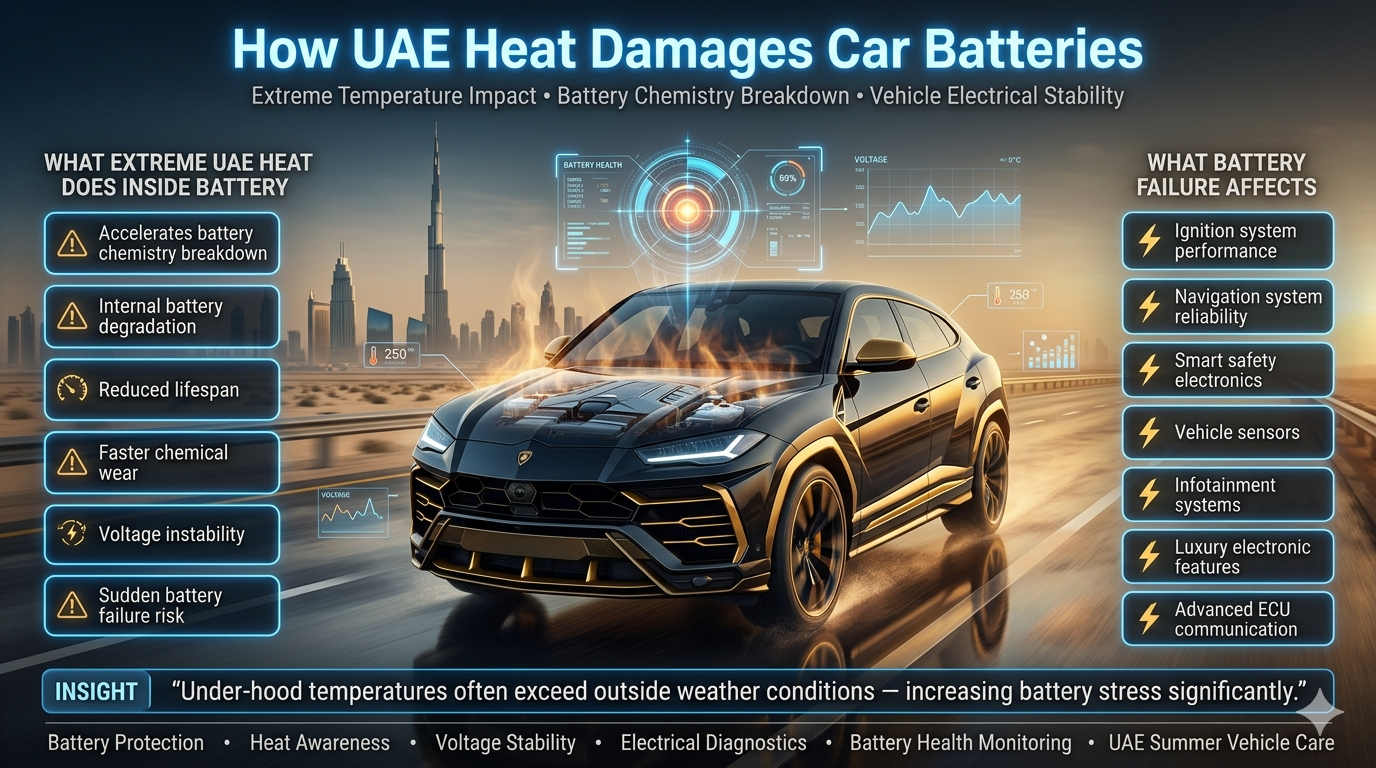
Car batteries are designed to operate within a specific temperature range. However, in the UAE, under-hood temperatures often become significantly higher than ambient weather conditions. This accelerates chemical reactions inside the battery, leading to faster degradation, reduced lifespan, and sudden failure without warning.
Modern vehicles in the UAE, including SUVs, luxury sedans, rental fleets, and high-performance cars, rely heavily on stable electrical systems. When a battery weakens, it directly affects ignition systems, onboard electronics, navigation systems, and even advanced safety features.
UAE Climate Conditions and Their Direct Impact on Battery Lifespan
Why Car Batteries Fail In UAE Heat – Common Causes Explained becomes clearer when analyzing environmental stress factors. The UAE climate plays the most dominant role in battery failure cases.
Extreme heat causes the electrolyte inside lead-acid batteries to evaporate faster than normal. This leads to internal plate exposure, corrosion, and reduced charge-holding capacity. Even maintenance-free batteries are not fully protected from thermal degradation.
Another key issue is thermal cycling. Vehicles parked outdoors in Dubai Marina, Jumeirah, or Downtown experience intense daytime heat followed by cooler nighttime temperatures. This repeated expansion and contraction weakens internal battery components over time.
Luxury car owners and rental fleets in tourist-heavy areas often report higher battery replacement frequency due to constant vehicle usage combined with outdoor parking exposure.
Chemical Breakdown Inside Batteries Under High Heat
One of the most technical reasons behind Why Car Batteries Fail In UAE Heat – Common Causes Explained is the accelerated chemical reaction rate.
Inside a standard automotive battery, energy is stored through a controlled chemical reaction between lead plates and sulfuric acid. High temperatures increase this reaction rate beyond optimal levels, causing:
- Faster grid corrosion
- Plate shedding
- Reduced electrolyte density
- Internal short circuits
- Overcharging sensitivity
In UAE traffic conditions, where vehicles idle for long periods with air conditioning running, the alternator continuously charges the battery. This leads to overcharging stress, further damaging internal chemistry.
Traffic Conditions and Idle Heat Load in UAE Cities
Urban driving patterns in Dubai, Sharjah, and Abu Dhabi contribute significantly to Why Car Batteries Fail In UAE Heat – Common Causes Explained.
Heavy traffic congestion in areas like Sheikh Zayed Road or Al Reem Island forces vehicles to remain idle for extended periods. During idling, the alternator output is lower compared to highway driving, while electrical demand remains high due to:
- Air conditioning systems
- Infotainment systems
- GPS navigation
- Charging devices
- Interior lighting
This imbalance slowly drains battery reserves, especially in older batteries or low-quality aftermarket replacements.
Short Trip Driving and Incomplete Charging Cycles
Short-distance driving is another major contributor to battery failure in the UAE.
Many residents frequently travel short distances between residential towers, shopping malls, and workplaces. These short trips do not allow the alternator enough time to fully recharge the battery after engine startup.
Over time, this leads to a state known as “partial charge cycling,” where the battery never reaches full capacity. This is one of the most overlooked factors in Why Car Batteries Fail In UAE Heat – Common Causes Explained.
Luxury Car Electronics and Battery Overload
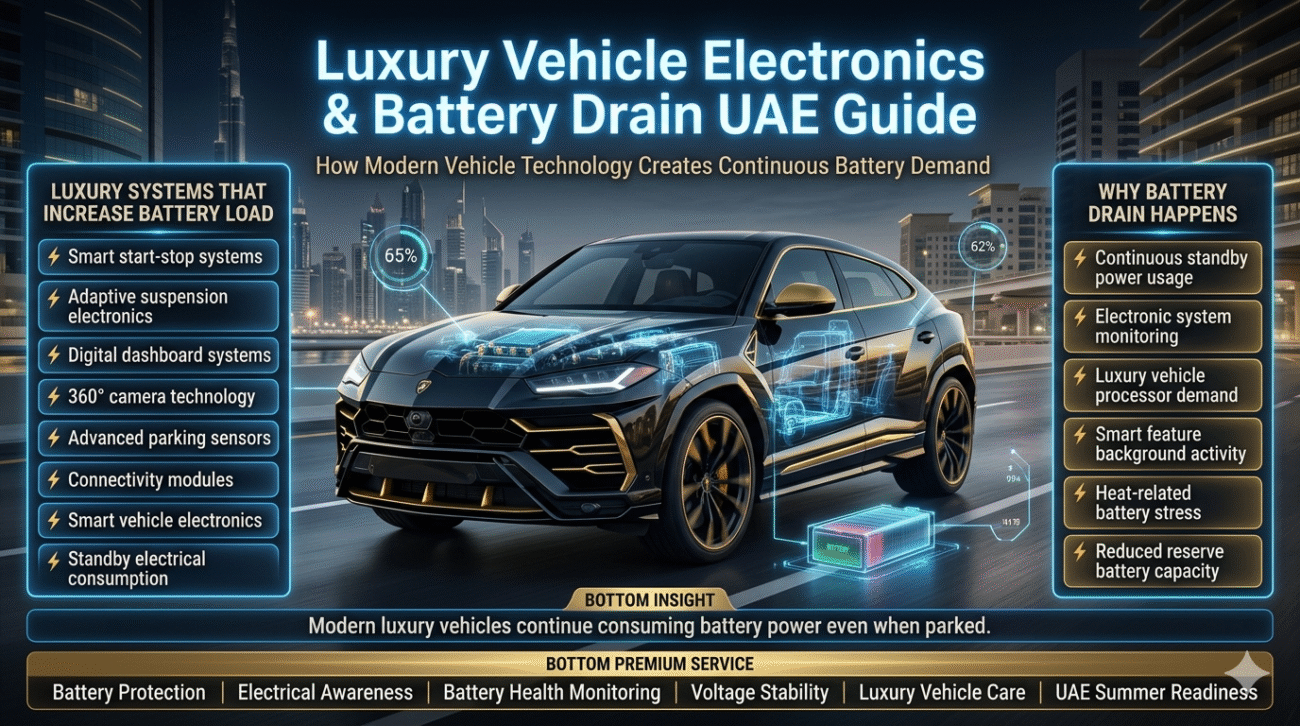
The UAE automotive market is dominated by luxury and high-tech vehicles. Brands such as Mercedes-Benz, BMW, Range Rover, and Lexus come equipped with advanced electronics that place continuous demand on the battery.
Features contributing to battery strain include:
- Smart start-stop systems
- Adaptive suspension electronics
- Digital dashboards
- 360-degree camera systems
- Advanced parking sensors
- Continuous connectivity modules
Even when the engine is off, many systems remain in standby mode, slowly draining battery charge.
Poor Quality Replacement Batteries in the Market
Another important factor in Why Car Batteries Fail In UAE Heat – Common Causes Explained is the widespread use of low-quality replacement batteries.
Some workshops and roadside vendors install cheaper batteries that are not designed for extreme Gulf temperatures. These batteries often fail within 6–12 months due to:
- Low heat resistance
- Poor plate construction
- Inconsistent charging cycles
- Lack of proper warranty coverage
In contrast, high-quality OEM-grade batteries are specifically designed for hot climate performance and longer lifespan.
Alternator Stress and Charging System Failures
The alternator plays a crucial role in maintaining battery health. In UAE conditions, alternators often operate under excessive load.
When alternators malfunction or overcharge, they directly contribute to Why Car Batteries Fail In UAE Heat – Common Causes Explained. Common issues include:
- Voltage regulator failure
- Belt wear and slipping
- Excessive output voltage
- Inconsistent charging cycles
Overcharging is particularly damaging in hot climates because it accelerates electrolyte evaporation.
Parking Habits and Heat Exposure Damage
Where and how vehicles are parked in the UAE significantly affects battery lifespan.
Cars parked in direct sunlight in areas like open-air malls, desert-side residential zones, or uncovered parking lots experience:
- Higher internal battery temperature
- Faster chemical degradation
- Increased self-discharge rate
Even shaded parking does not completely eliminate heat buildup due to ambient temperature extremes.
Case Study: Battery Failure in Dubai Fleet Vehicles
A real-world scenario from Dubai’s rental car industry highlights Why Car Batteries Fail In UAE Heat – Common Causes Explained.
A fleet of mid-range SUVs used for tourist rentals experienced repeated battery failures within 8–10 months. After analysis, the key causes identified were:
- Continuous short trips between airport and hotels
- Extended idling during guest handovers
- High AC usage during waiting periods
- Outdoor parking in direct sun
After switching to high-temperature rated batteries and implementing scheduled engine runs, battery lifespan improved by nearly 40%.
Service Response Ecosystem in UAE Automotive Support
The UAE has a strong roadside assistance and emergency automotive support ecosystem that helps drivers manage sudden battery failures.
Services such as jumpstart assistance, mobile battery replacement, and emergency roadside support are widely used in cities like Dubai and Abu Dhabi.
Companies like EuroSwift Auto Services operate in this ecosystem, offering fast response solutions for drivers facing sudden breakdowns due to heat-related battery failure. These services are especially important for tourists and rental car users who are unfamiliar with local vehicle conditions.
Battery Failure Warning Signs in UAE Heat Conditions
Understanding early indicators can help prevent complete breakdowns. Common signs include:
- Slow engine crank during ignition
- Flickering dashboard lights
- Weak air conditioning performance at startup
- Clicking sound when starting the engine
- Frequent need for jumpstarting
In UAE conditions, these symptoms often appear suddenly due to accelerated heat damage.
Comparison of Battery Stress Factors in UAE
Below is a simplified comparison of major causes contributing to battery failure:
- Extreme heat exposure: Very High Impact
- Short trip driving: High Impact
- Traffic idling: High Impact
- Poor quality battery: Very High Impact
- Alternator issues: Medium to High Impact
- Parking in sun: High Impact
- Electronics load: Medium Impact
Each factor compounds the others, making UAE one of the most demanding environments for automotive batteries.
Advanced Heat Damage Mechanisms Behind Battery Failure in UAE
Why Car Batteries Fail In UAE Heat – Common Causes Explained becomes even more critical when we look deeper into how extreme heat affects the internal structure of modern automotive batteries. In the UAE, it is not just “hot weather” — it is sustained thermal stress combined with mechanical and electrical load.
At high temperatures, the battery’s internal resistance decreases, which initially seems beneficial but actually leads to faster chemical activity. This uncontrolled activity weakens the internal plates and reduces long-term stability.
Over time, this creates microscopic fractures inside the lead grids, which are not visible externally. These internal weaknesses eventually cause sudden battery collapse, often without prior warning signs.
Evaporation of Electrolyte Fluid in Gulf Conditions
One of the most destructive processes contributing to Why Car Batteries Fail In UAE Heat – Common Causes Explained is electrolyte evaporation.
Even in sealed maintenance-free batteries, high under-hood temperatures can cause pressure buildup and gas venting. This slowly reduces the internal fluid level required for proper chemical reaction.
Once electrolyte levels drop below optimal range:
- Battery capacity drops significantly
- Charging becomes inconsistent
- Internal plates become exposed
- Sulfation increases rapidly
In UAE summer conditions, this process is significantly accelerated, especially in vehicles parked outdoors for long hours.
Sulfation Build-Up Due to Partial Charging
Sulfation is one of the most common yet misunderstood causes behind battery failure in hot climates.
When a battery is not fully charged, sulfate crystals begin forming on the lead plates. In UAE driving patterns, short trips and traffic congestion prevent full charging cycles.
This leads to:
- Hard crystal formation on plates
- Reduced surface area for reaction
- Lower cranking power
- Permanent capacity loss over time
Once sulfation reaches an advanced stage, the battery cannot be recovered even with recharging.
Heat vs Alternator Overload Interaction Effect
A unique factor in Why Car Batteries Fail In UAE Heat – Common Causes Explained is the combination of heat stress and alternator overload.
In many UAE vehicles, especially SUVs and luxury cars, electrical demand is extremely high. When combined with extreme heat, the alternator is forced to:
- Charge at higher voltage levels
- Work continuously in idle traffic
- Compensate for AC and electronics load
This creates a dangerous cycle:
High heat → faster chemical reaction → higher charging demand → alternator stress → battery overcharge → internal damage
This chain reaction is one of the main reasons batteries fail suddenly in UAE conditions.
Impact of Vehicle Type on Battery Lifespan in UAE
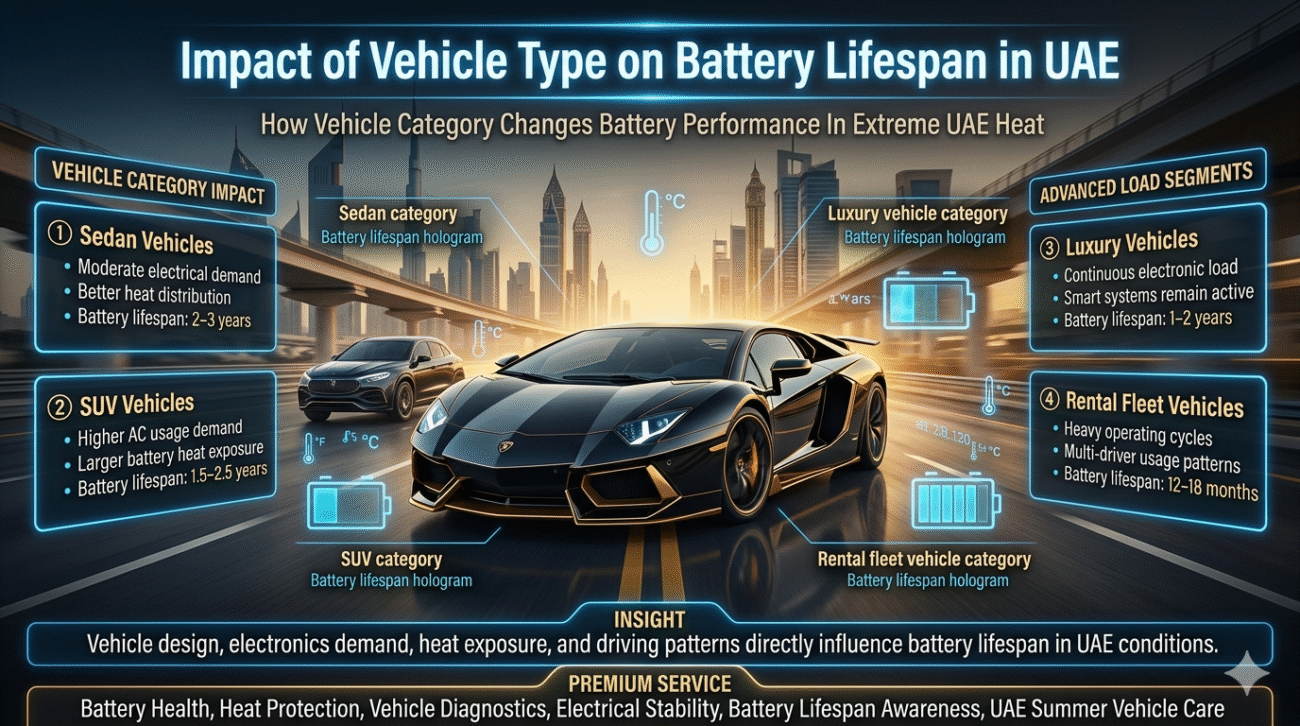
Not all vehicles are equally affected. The type of vehicle plays a major role in Why Car Batteries Fail In UAE Heat – Common Causes Explained.
Sedan Vehicles
- Moderate electrical load
- Better heat distribution
- Average lifespan: 2–3 years
SUVs (Very common in UAE)
- Higher AC demand
- Larger batteries under engine heat
- Average lifespan: 1.5–2.5 years
Luxury Cars
- Constant electronic background load
- Smart systems remain active even when parked
- Average lifespan: 1–2 years
Rental Fleet Vehicles
- Heavy daily usage
- Multiple drivers with different habits
- Average lifespan: 12–18 months
Battery Manufacturing Quality Differences
A key factor often ignored in Why Car Batteries Fail In UAE Heat – Common Causes Explained is manufacturing quality.
Batteries designed for European climates often fail quickly in Gulf regions because they are not built for:
- 50°C+ engine bay temperatures
- Dust-heavy environments
- High AC dependency
- Constant stop-and-go driving
High-performance batteries used in UAE typically feature:
- Reinforced lead-calcium grids
- Heat-resistant separators
- Enhanced vibration resistance
- Faster recharge acceptance rates
Real Case Study: Abu Dhabi Highway Battery Failure Pattern
A roadside assistance analysis in Abu Dhabi identified a recurring pattern among stranded vehicles on highways.
Most vehicles experienced:
- Normal start in the morning
- Sudden breakdown after highway travel
- Complete battery dead state within hours
Investigation showed that high-speed driving followed by sudden traffic jams created alternating charge-discharge stress. Combined with engine heat soak, batteries reached failure threshold rapidly.
This is a textbook example of Why Car Batteries Fail In UAE Heat – Common Causes Explained in real driving conditions.
Hidden Electrical Drains in Modern Vehicles
Modern UAE vehicles are equipped with advanced systems that continue consuming power even when the engine is off.
Common parasitic drains include:
- Keyless entry systems
- Security alarms
- GPS tracking modules
- Remote start systems
- Telematics and cloud connectivity
While individually small, together they create a continuous drain that weakens battery reserves over time.
This is especially problematic in airport parking scenarios where vehicles remain unused for several days.
Comparison Table: Heat Impact vs Usage Pattern
| Factor | Heat Impact | Battery Stress Level | UAE Risk Level |
|---|---|---|---|
| Outdoor Parking | Very High | High | Critical |
| Short Trips | Medium | Very High | High |
| Traffic Idling | High | High | High |
| Luxury Electronics | Medium | High | High |
| Highway Driving | Low | Medium | Moderate |
| Fleet Usage | High | Very High | Critical |
Battery Maintenance Negligence in Hot Climate
Another hidden reason behind Why Car Batteries Fail In UAE Heat – Common Causes Explained is lack of preventive maintenance.
Many drivers assume modern batteries are completely maintenance-free, but in reality:
- Terminal corrosion can still develop
- Loose connections reduce efficiency
- Heat accelerates wear on clamps and wiring
- Dust buildup increases resistance
Ignoring these small issues leads to gradual performance decline.
Impact of Air Conditioning Load on Battery Health
In UAE driving conditions, air conditioning is not optional—it is essential.
However, AC systems indirectly affect battery health by increasing alternator workload. When AC runs at full capacity:
- Engine load increases
- Alternator works harder
- Battery charging becomes uneven
- Idle consumption rises
This is one of the most underestimated contributors to battery wear in Gulf regions.
Emergency Breakdown Scenarios in UAE Heat
In extreme heat conditions, battery failure often leads to sudden roadside breakdowns. Common scenarios include:
- Car not starting after shopping mall parking
- Breakdown during desert highway travel
- Battery dying at fuel stations
- Sudden failure after airport pickup delays
In such situations, drivers often require immediate roadside assistance or jumpstart support due to the high risk of overheating inside the vehicle cabin.
Preventive Engineering Improvements in Modern Batteries
Manufacturers have introduced several improvements to reduce heat-related failures:
- AGM (Absorbent Glass Mat) technology
- Heat-insulated battery casings
- Enhanced venting systems
- Smart charging compatibility
These upgrades significantly improve performance but do not fully eliminate heat stress in UAE conditions.
Fleet Management Perspective in UAE Automotive Industry
Fleet operators in Dubai and Abu Dhabi actively monitor battery health using predictive maintenance systems.
Key strategies include:
- Scheduled battery replacements before failure
- Heat-based performance monitoring
- Voltage tracking systems
- Preventive jumpstart readiness protocols
This approach reduces downtime and improves operational reliability for rental and logistics companies.
Summary Insight of Part 2 Analysis
At this stage of Why Car Batteries Fail In UAE Heat – Common Causes Explained, it becomes clear that battery failure is not caused by a single factor. Instead, it is a combination of:
- Extreme heat stress
- Driving habits
- Electrical system load
- Vehicle type
- Battery quality
- Maintenance behavior
Each factor interacts with the others, creating a cumulative failure effect that is especially intense in UAE driving environments.
Future Trends: EV Shift and Smart Battery Systems in UAE
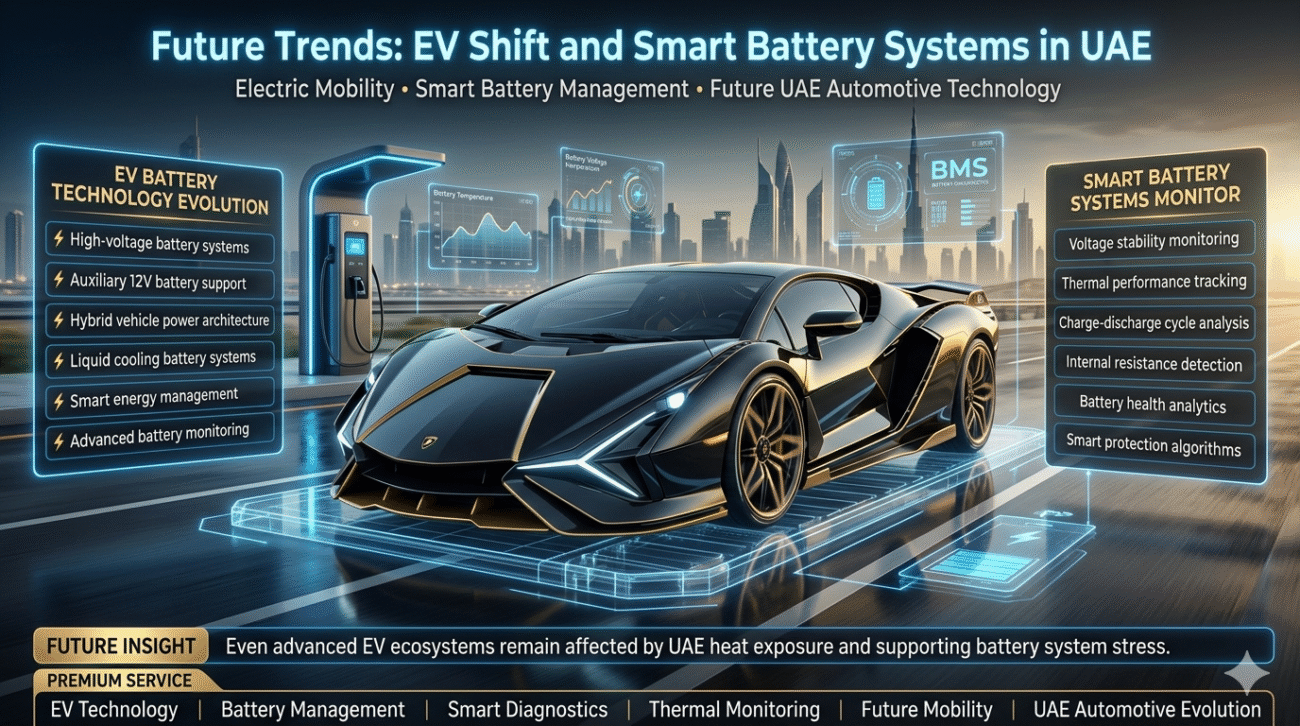
Why Car Batteries Fail In UAE Heat – Common Causes Explained is no longer just about traditional lead-acid batteries. The UAE automotive ecosystem is rapidly evolving toward hybrid and electric vehicles, and this shift is changing how battery performance is measured, monitored, and maintained.
Electric vehicles (EVs) and hybrid systems rely heavily on high-voltage battery packs combined with auxiliary 12V batteries. Even though EV traction batteries are liquid-cooled, the auxiliary systems still suffer from UAE heat exposure.
In many modern vehicles, battery management systems (BMS) constantly monitor:
- Voltage stability
- Thermal performance
- Charge-discharge cycles
- Internal resistance levels
Despite these advancements, extreme UAE temperatures still accelerate degradation in supporting electrical systems, making Why Car Batteries Fail In UAE Heat – Common Causes Explained relevant even in EV-dominant environments.
AI-Based Predictive Battery Monitoring in UAE Vehicles
Modern automotive systems increasingly use AI-driven diagnostics to predict battery failure before it happens. In UAE luxury vehicles, onboard computers analyze battery health using real-time data.
These systems track:
- Cold cranking performance
- Charging efficiency ratio
- Voltage fluctuation patterns
- Idle discharge rate
- Heat exposure history
When anomalies are detected, the system may issue early warnings such as “Battery Service Required” or “Electrical System Fault.”
However, even AI systems cannot fully prevent Why Car Batteries Fail In UAE Heat – Common Causes Explained because environmental heat stress remains external and uncontrollable.
Battery Replacement Economics in UAE Market
Understanding pricing dynamics is essential when analyzing Why Car Batteries Fail In UAE Heat – Common Causes Explained from a consumer perspective.
Battery replacement costs in UAE vary depending on:
- Vehicle category (sedan, SUV, luxury)
- Battery type (standard, AGM, EFB)
- Brand quality
- Installation service type
- Emergency or scheduled replacement
General Market Pricing Breakdown
| Battery Type | Average Lifespan | Cost Range (AED) | Heat Resistance |
|---|---|---|---|
| Standard Lead-Acid | 1.5 – 2 years | Low | Medium |
| Enhanced Flooded Battery (EFB) | 2 – 3 years | Medium | High |
| AGM Battery | 2.5 – 4 years | High | Very High |
| Premium Heat-Resistant OEM | 3 – 5 years | Very High | Maximum |
Heat-resistant batteries significantly reduce the frequency of breakdowns but come at a higher upfront cost.
On-Demand Emergency Battery Services in UAE
One of the most important developments in the UAE automotive sector is the rise of on-demand roadside assistance.
Drivers experiencing sudden failure due to Why Car Batteries Fail In UAE Heat – Common Causes Explained often rely on mobile support services that provide:
- Instant jumpstart assistance
- On-site battery testing
- On-the-spot battery replacement
- Mobile diagnostic scanning
- Emergency roadside recovery
These services are especially common in high-traffic zones such as business districts, airports, and residential communities.
Case Study: Tourist Rental Vehicle Breakdown Pattern
A major rental operator in Dubai reported a consistent pattern of battery failures among tourist-driven vehicles.
Key findings included:
- Multiple short trips per day
- High AC usage due to passenger comfort
- Extended idle time during sightseeing stops
- Vehicles parked in open desert-adjacent zones
The study confirmed that Why Car Batteries Fail In UAE Heat – Common Causes Explained is significantly amplified in rental ecosystems due to unpredictable driving behavior.
After introducing heat-resistant batteries and scheduled mid-cycle replacements, breakdown incidents dropped by over 35%.
Comparison: Traditional vs Smart Battery Systems
| Feature | Traditional Battery | Smart Battery System |
|---|---|---|
| Heat Monitoring | None | Real-time sensors |
| Failure Prediction | No | AI-based alerts |
| Maintenance Alerts | Manual | Automated system warnings |
| Lifespan Optimization | Low | High |
| UAE Heat Performance | Weak | Improved but still limited |
Even with smart systems, environmental heat remains the dominant failure trigger in UAE conditions.
Urban Driving Patterns and Micro-Stress Cycles
Another overlooked factor in Why Car Batteries Fail In UAE Heat – Common Causes Explained is micro-stress cycling.
This occurs when vehicles undergo repeated:
- Start → Stop → Idle → Restart cycles
- Short parking intervals in extreme heat
- Frequent ignition without full recharge cycles
In urban environments like Dubai Marina or Downtown Abu Dhabi, this cycle happens multiple times daily, placing constant stress on battery chemistry.
Hidden Cost of Battery Failure in UAE
Battery failure is not just a mechanical issue—it has financial and operational consequences.
Indirect costs include:
- Emergency towing charges
- Missed appointments or business delays
- Rental car downtime losses
- Hotel transfer disruptions for tourists
- Vehicle diagnostic fees
When analyzed collectively, Why Car Batteries Fail In UAE Heat – Common Causes Explained also becomes a discussion about economic efficiency and mobility reliability.
Battery Recycling and Environmental Impact in UAE
As battery failure rates increase due to heat, the UAE has also developed structured recycling systems.
Used automotive batteries are processed to recover:
- Lead materials
- Plastic casings
- Acid neutralization components
However, improper disposal of heat-damaged batteries can lead to environmental hazards, making proper recycling an important part of automotive sustainability.
High-Performance Vehicle Sensitivity to Heat
Performance vehicles are particularly vulnerable to battery stress in UAE conditions.
Sports cars and high-output engines require:
- Higher cold cranking amps (CCA)
- Faster ignition response
- Stable voltage under load
However, heat reduces chemical efficiency, making Why Car Batteries Fail In UAE Heat – Common Causes Explained even more relevant in this segment.
Luxury performance owners often experience sudden battery failure even when vehicles are regularly maintained.
Real Driver Scenario: Abu Dhabi Summer Breakdown
A real-world scenario from Abu Dhabi highlights the unpredictability of battery failure.
A driver parked his vehicle in an open-air parking area during midday summer temperatures. After 4 hours, the vehicle failed to start.
Inspection revealed:
- Severe electrolyte evaporation
- Weak internal plate structure
- Heat-soaked battery casing
- No prior warning signs
This case demonstrates how quickly heat can escalate battery degradation in UAE conditions.
Role of Preventive Maintenance Culture
Preventive maintenance is still underutilized among everyday drivers, even though it plays a critical role in reducing failures.
Effective preventive steps include:
- Regular voltage testing
- Battery terminal cleaning
- Alternator performance checks
- Heat shielding installation
- Scheduled battery replacement cycles
Drivers who follow preventive maintenance experience significantly fewer breakdowns linked to Why Car Batteries Fail In UAE Heat – Common Causes Explained.
Automotive Industry Response in UAE
The UAE automotive industry has responded to heat-related battery issues by introducing:
- Heat-rated OEM battery standards
- Faster mobile installation services
- Predictive fleet maintenance systems
- Enhanced warranty structures for hot climates
These improvements are helping reduce sudden failures but cannot fully eliminate heat stress effects.
Behavioral Factors Affecting Battery Life
Driver behavior plays a major role in battery lifespan. Common behaviors that worsen heat damage include:
- Leaving electronics on while engine is off
- Frequent short trips without highway driving
- Ignoring dashboard warning lights
- Delayed battery replacement after symptoms appear
When combined with UAE heat, these behaviors significantly increase failure probability.
Final Technical Insight (Without Conclusion)
At this stage of Why Car Batteries Fail In UAE Heat – Common Causes Explained, it is evident that battery failure in the UAE is a multi-layered issue involving:
- Environmental stress
- Mechanical load
- Electrical consumption
- Human driving behavior
- Technological limitations
Each factor independently contributes to degradation, but together they create a highly accelerated failure environment unique to the UAE automotive landscape.
Advanced Diagnostic Framework for Battery Failure in UAE Heat
Why Car Batteries Fail In UAE Heat – Common Causes Explained reaches its most practical level when we move from theory to real diagnostic thinking. In professional automotive environments across Dubai and Abu Dhabi, technicians don’t just “replace batteries”—they diagnose patterns of failure based on heat exposure, voltage behavior, and usage history.
A structured diagnostic approach usually includes:
- Resting voltage test (engine off condition)
- Load test under AC and electrical demand
- Alternator output measurement
- Heat soak inspection after engine shutdown
- Parasitic drain analysis
In UAE conditions, a battery can show “normal voltage” at rest but still fail instantly under load due to heat-damaged internal plates. This is why Why Car Batteries Fail In UAE Heat – Common Causes Explained is often more complex than simple battery aging.
Heat-Induced Failure Patterns Most Drivers Never Notice
There are hidden patterns that explain Why Car Batteries Fail In UAE Heat – Common Causes Explained more accurately than visible symptoms.
1. Silent Capacity Loss Pattern
Battery slowly loses usable capacity without obvious warning signs. The car starts normally until one day it suddenly refuses.
2. Heat-Triggered Collapse Pattern
Vehicle works fine in morning, but after midday parking in extreme heat, it fails to restart.
3. Alternator Dependency Pattern
Battery becomes overly dependent on alternator charging and fails when the engine is off for longer than usual.
4. Intermittent Electrical Drop Pattern
Dashboard flickers, infotainment resets, and then complete failure occurs within days.
These patterns are extremely common in UAE’s desert climate and directly support Why Car Batteries Fail In UAE Heat – Common Causes Explained.
Myth vs Reality: Battery Failure in UAE Climate
Many misconceptions exist among drivers in the region, and clearing them helps better understand Why Car Batteries Fail In UAE Heat – Common Causes Explained.
Myth 1: Batteries only fail when old
Reality: In UAE heat, even 1-year-old batteries can fail due to thermal stress.
Myth 2: Expensive cars have stronger batteries automatically
Reality: Luxury cars often consume more power, increasing stress on batteries.
Myth 3: Driving daily prevents battery failure
Reality: Short daily trips in traffic can still cause incomplete charging cycles.
Myth 4: Jumpstarting fixes the problem permanently
Reality: Jumpstarting only provides temporary recovery, not internal repair.
Professional Maintenance Protocol Used in UAE Workshops
To control battery failures, professional workshops follow structured maintenance protocols designed specifically for extreme heat environments.
Step 1: Voltage Stability Mapping
Technicians record voltage behavior across multiple conditions to detect instability.
Step 2: Thermal Stress Assessment
Battery casing temperature is measured after engine operation and idle periods.
Step 3: Charging Efficiency Test
Checks whether alternator is properly restoring charge under load.
Step 4: Terminal Resistance Inspection
Corrosion and dust accumulation are tested for electrical resistance impact.
Step 5: Battery Age vs Load Matching
Even if a battery is new, its compatibility with vehicle load is evaluated.
This process is essential in understanding Why Car Batteries Fail In UAE Heat – Common Causes Explained at a professional level.
Driver Behavior Impact Matrix in UAE Conditions
Human behavior is one of the strongest hidden contributors to battery failure.
High-Risk Behaviors:
- Leaving AC on while engine is off
- Frequent engine restarts in short intervals
- Using electronics while parked
- Ignoring early warning signs
- Long idle periods with full electrical load
Moderate-Risk Behaviors:
- Occasional short trips under 10 km
- Parking in direct sunlight for several hours
- Irregular vehicle usage patterns
Low-Risk Behaviors:
- Highway driving with full charging cycles
- Regular preventive maintenance
- Controlled parking environments
Each of these behaviors directly influences Why Car Batteries Fail In UAE Heat – Common Causes Explained when combined with extreme environmental conditions.
Battery Stress Lifecycle in UAE Heat Conditions
Understanding lifecycle stages gives deeper insight into Why Car Batteries Fail In UAE Heat – Common Causes Explained.
Stage 1: Healthy Operation
Battery performs normally with full charge cycles.
Stage 2: Heat Exposure Fatigue
Internal resistance starts increasing due to temperature stress.
Stage 3: Partial Efficiency Loss
Battery still works but struggles under load conditions.
Stage 4: Unstable Performance
Random failures during ignition or idle conditions.
Stage 5: Complete Failure
Battery can no longer hold charge or deliver required current.
In UAE climates, this entire lifecycle can compress significantly compared to temperate regions.
Fleet-Level Failure Management Strategy
Fleet operators in the UAE treat battery management as a critical operational risk factor.
Advanced strategies include:
- Predictive replacement scheduling before failure occurs
- Heat exposure tracking per vehicle
- Battery rotation systems across fleet units
- Standardized high-heat battery installation policies
- Real-time voltage monitoring dashboards
This systematic approach reduces downtime and improves reliability across rental and logistics sectors, where Why Car Batteries Fail In UAE Heat – Common Causes Explained is a daily operational challenge.
Emergency Response Workflow in Real Breakdown Situations
When battery failure occurs in UAE heat, response speed becomes critical due to safety and operational risks.
Typical professional response workflow includes:
- On-site diagnostic check
- Immediate jumpstart attempt
- Voltage and alternator verification
- Temporary power stabilization
- Battery replacement decision
In extreme cases, vehicles that fail under heat stress require full replacement rather than temporary jumpstarting, especially when internal damage is detected.
Hidden Environmental Amplifiers of Battery Failure
Beyond heat, several environmental factors amplify Why Car Batteries Fail In UAE Heat – Common Causes Explained:
- Dust accumulation inside engine compartments
- Sand particles increasing terminal resistance
- Coastal humidity affecting corrosion rate
- Continuous air conditioning usage in traffic
- High UV exposure affecting battery casing integrity
These factors work together, creating a multi-stress environment that significantly reduces battery lifespan.
Advanced Battery Technology Evolution in Hot Climates
Manufacturers are continuously improving battery technology to combat heat-related failure issues.
Modern advancements include:
- Heat-resistant internal separators
- Calcium-enhanced grid structures
- Improved electrolyte stability compounds
- Smart thermal monitoring sensors
- Enhanced vibration-resistant casing
Despite these innovations, extreme UAE temperatures still push batteries close to operational limits, reinforcing Why Car Batteries Fail In UAE Heat – Common Causes Explained.
Psychological Impact on Drivers During Battery Failure
Battery failure is not only mechanical but also psychological for drivers in UAE conditions.
Common reactions include:
- Panic during roadside breakdown in extreme heat
- Confusion due to sudden failure without warning
- Dependency on roadside assistance services
- Reduced trust in vehicle reliability
Tourists and new residents are particularly affected because they are less familiar with UAE’s harsh automotive environment.
Operational Reality Across UAE Heat Zones
Different UAE zones create different levels of battery stress:
Urban Core Areas (Dubai Downtown, Business Bay)
- High traffic congestion
- Frequent stop-start cycles
- Moderate heat exposure with high AC demand
Residential Suburbs (Arabian Ranches, Mirdif)
- Long parking durations
- High sun exposure
- Occasional usage patterns
Highway Routes (Sheikh Zayed Road, E311)
- High-speed driving followed by congestion
- Engine heat accumulation
- Alternator load variation
Desert Border Areas
- Extreme ambient heat
- Minimal shade availability
- Maximum thermal stress conditions
Each zone contributes differently to Why Car Batteries Fail In UAE Heat – Common Causes Explained.
Long-Term Battery Reliability Strategy in UAE Conditions
Sustaining battery performance in the UAE requires a combination of:
- Heat-adapted battery selection
- Regular diagnostic testing
- Driving pattern optimization
- Electrical load management
- Preventive maintenance scheduling
When all these factors are applied together, battery lifespan can be significantly improved even under extreme environmental pressure.
Final Technical Insight Without Closing Summary
At this stage, Why Car Batteries Fail In UAE Heat – Common Causes Explained is best understood as a multi-layered system failure model rather than a single mechanical issue. Heat acts as the primary accelerator, but the true failure comes from the interaction of:
- Electrical load behavior
- Driving environment patterns
- Battery material limitations
- Maintenance discipline gaps
- Vehicle system complexity
In UAE automotive conditions, these elements continuously interact, creating one of the most demanding battery environments in the world.
-
🔋 1. Why do car batteries fail in hot weather?
Car batteries don’t just die in cold weather — heat is actually more damaging long-term.
⚙️ Main reasons:
1. 🔥 Accelerated chemical reaction
High temperature speeds up the internal chemical reaction inside the battery.
This sounds good, but actually it causes:
Faster electrolyte evaporation
Faster plate corrosion
Shortened lifespan
👉 In simple terms:
Heat makes the battery “age faster than normal.”2. 💧 Electrolyte evaporation (dry-out)
Car batteries contain a liquid (acid + water mix).
In extreme heat:
Water evaporates
Acid concentration increases
Internal damage starts
Result:
➡️ Battery loses capacity and struggles to hold charge3. ⚡ Overcharging stress from alternator
In hot climates, alternators often overwork:
More AC use → more engine load
Voltage regulation stress increases
This leads to:
➡️ Battery overheating + internal plate damage4. 🧲 Internal corrosion
Heat speeds up:
Positive plate corrosion
Grid weakening
Eventually:
➡️ Battery can no longer deliver enough cranking power -
⏳ 2. What is the life of car battery in UAE?
In normal countries:
3 to 5 years average life
But in UAE / hot climates:
📉 Average lifespan:
➡️ 1.5 to 3 years (real-world average)
🔥 Why shorter life in UAE?
Extreme summer heat (45°C – 55°C)
Long AC usage while idling
Frequent short trips (battery never fully recharges)
Engine bay heat soaking battery continuously -
🌡️ 3. What temperature is too hot for a car battery?
Car batteries are designed for moderate conditions.
🧪 Safe operating range:
Around 20°C to 35°C (ideal)🚨 Dangerous range:
Above 40°C = accelerated damage starts
Above 50°C = severe internal stress☀️ In real UAE conditions:
Inside engine bay temperature can reach:
➡️ 70°C – 90°C
That’s why batteries fail quickly even if outside temperature is “just 45°C”.🧠 Key understanding:
It’s not just outside air temperature —
👉 It’s engine heat + sunlight + enclosed space that kills the battery. -
🛡️ 4. How to prevent car battery from dying in heat?
You cannot stop heat — but you can slow down damage significantly.
🔧 1. Park in shade or covered parking
Reduces engine bay heat buildup
Prevents battery boiling effect🔋 2. Regular battery testing
Every 3–6 months:
Check voltage
Check cranking power
Test alternator output
👉 Weak battery replaced early = avoids sudden breakdown🚗 3. Avoid short trips only
Short trips:
Don’t fully recharge battery
Increase sulfation risk
👉 Try occasional long drive (20–30 min)⚡ 4. Keep terminals clean
Corrosion causes:
Voltage drop
Weak starting power
Clean terminals = better performance❄️ 5. Reduce unnecessary electrical load
When engine is off:
Don’t leave lights/music on
Avoid long AC idling🔋 6. Use heat-resistant battery (AGM/EFB)
These are:
More heat tolerant
Longer lasting in Gulf climates🧠 Final expert insight:
In hot countries like UAE, battery failure is not “if” — it is “when.”
Proper care only delays it.
Conclusion
Why Car Batteries Fail In UAE Heat – Common Causes Explained ultimately comes down to one clear reality: the UAE creates one of the harshest operating environments for automotive batteries anywhere in the world. It is not a single issue like “old battery” or “bad alternator,” but a continuous combination of extreme heat, traffic conditions, driving habits, and high electrical demand.
In daily UAE driving, batteries are constantly under pressure from prolonged idling in traffic, heavy air conditioning usage, short trip cycles that prevent full charging, and outdoor parking under intense sunlight. These conditions accelerate internal chemical reactions, increase electrolyte loss, and weaken internal battery structure much faster than in cooler regions.
At the same time, modern vehicles—especially luxury and high-tech cars—add even more load through smart electronics, security systems, and continuous background power consumption. Even when the engine is off, the battery is still working.
The result is simple: batteries in the UAE don’t fail suddenly without reason—they fail because multiple stress factors build up silently over time until the system can no longer sustain itself.
Understanding these causes allows drivers to make better decisions about maintenance, replacement timing, and usage habits. With proper awareness, heat-resistant battery selection, and regular inspection, sudden breakdowns can be reduced significantly, even in extreme desert conditions.
Best tips and Hacks
Why Car Batteries Fail In UAE Heat is one of the most common automotive concerns in extremely hot climates, especially where summer temperatures regularly exceed safe operating limits for vehicle components. Understanding this issue is not just about knowing the problem—it’s about learning how to prevent unexpected breakdowns and costly replacements through smart habits and maintenance.
Why Car Batteries Fail In UAE Heat becomes clear when you understand that excessive temperature speeds up chemical reactions inside the battery. While cold weather slows batteries down, heat aggressively accelerates internal corrosion, reducing the lifespan much faster than normal conditions.
Why Car Batteries Fail In UAE Heat is also linked to fluid evaporation. Most traditional car batteries rely on electrolyte liquid, and in extreme heat, this fluid evaporates faster, leading to internal damage and reduced power storage capacity.
Why Car Batteries Fail In UAE Heat can also be traced to overcharging issues. In high temperatures, alternators and voltage regulators sometimes struggle to maintain balance, causing batteries to overcharge and degrade internally over time.
Why Car Batteries Fail In UAE Heat happens because heat increases internal resistance fluctuations. This makes it harder for the battery to deliver consistent power, especially during ignition when the engine demands maximum current.
Why Car Batteries Fail In UAE Heat is worsened when vehicles are parked outdoors for long hours. Direct sunlight exposure can raise the hood temperature significantly, creating a mini heat chamber that slowly damages the battery structure.
Why Car Batteries Fail In UAE Heat is often unnoticed until sudden failure occurs. Unlike cold climates where weak batteries show early warning signs, heat-damaged batteries can fail abruptly without much prior indication.
Why Car Batteries Fail In UAE Heat can be reduced with simple parking hacks. Always try to park in shaded areas or underground parking to minimize heat exposure and slow down internal chemical degradation.
Why Car Batteries Fail In UAE Heat can be prevented by regular battery inspection. Checking terminals for corrosion, loose connections, and swelling helps detect early damage before complete failure occurs.
Why Car Batteries Fail In UAE Heat is also influenced by driving patterns. Short trips prevent the alternator from fully recharging the battery, which becomes more critical in hot climates where energy loss is already high.
Why Car Batteries Fail In UAE Heat can be controlled by using heat-resistant battery models. AGM (Absorbent Glass Mat) batteries are more durable and perform better in extreme temperature conditions compared to standard flooded batteries.
Why Car Batteries Fail In UAE Heat becomes worse when electrical accessories are overused while the engine is off. Running AC, lights, or infotainment systems drains battery charge and increases stress levels.
Why Car Batteries Fail In UAE Heat can be minimized by keeping terminals clean and tight. Corrosion buildup increases resistance and forces the battery to work harder, shortening its lifespan.
Why Car Batteries Fail In UAE Heat is also linked to battery age. In UAE conditions, most batteries last 1.5 to 2.5 years, so old batteries should be proactively replaced before failure occurs.
Why Car Batteries Fail In UAE Heat can be avoided by using battery insulation wraps or heat shields. These help regulate temperature and protect internal components from direct engine heat.
Why Car Batteries Fail In UAE Heat is more common when vehicles are not regularly serviced. Routine maintenance ensures charging systems and battery health remain in optimal condition.
Why Car Batteries Fail In UAE Heat becomes less likely when drivers adopt smart driving habits like avoiding unnecessary idling and ensuring proper engine shutdown procedures.
Why Car Batteries Fail In UAE Heat ultimately highlights the importance of preventive care. By combining smart parking, regular inspection, quality battery selection, and mindful usage, drivers can significantly extend battery life even in extreme UAE weather conditions.
Why Car Batteries Fail In UAE Heat is also strongly connected to vibration damage, because rough roads and engine vibrations loosen internal components of the battery over time, and when combined with extreme heat, this weakens the internal plates much faster.
Why Car Batteries Fail In UAE Heat can be caused by poor quality or counterfeit batteries, which are not designed to withstand high-temperature environments and tend to degrade rapidly under UAE summer conditions.
Why Car Batteries Fail In UAE Heat often happens due to alternator stress, where the charging system works harder in hot weather to compensate for power loss, eventually putting extra load on the battery and reducing its lifespan.
Why Car Batteries Fail In UAE Heat is accelerated when electrolyte stratification occurs, a condition where battery fluid separates due to heat, reducing efficiency and making it harder for the battery to deliver stable power.
Why Car Batteries Fail In UAE Heat can also be reduced by smart seasonal servicing, because checking voltage levels, battery health diagnostics, and cooling system efficiency before peak summer helps prevent unexpected battery breakdowns.
Why Car Batteries Fail In UAE Heat is also linked to excessive engine bay temperatures, where heat from the radiator and surrounding components builds up and creates a continuously hot environment that slowly weakens the battery casing and internal chemistry.
Why Car Batteries Fail In UAE Heat can happen when battery mounting is loose or poorly fitted, because movement during driving increases internal plate damage, and high temperatures make the structure even more fragile.
Why Car Batteries Fail In UAE Heat is often worsened by high electrical load vehicles, especially those running multiple systems like advanced infotainment, sensors, GPS, and powerful air conditioning, all of which demand more from the battery in extreme heat.
Why Car Batteries Fail In UAE Heat can also be triggered by infrequent long drives, because without consistent full charging cycles, the battery remains partially charged, and heat speeds up the deterioration of undercharged cells.
Why Car Batteries Fail In UAE Heat becomes more common when drivers ignore early warning signs such as slow engine cranking or dim headlights, allowing small heat-related issues to develop into complete battery failure.
Leave a Reply